Best RAG Pentest Tools | 0xClaw
Compare the best AI pentesting tools for RAG apps by retrieval coverage, poisoning tests, evidence quality, retest workflow, and real-world fit.
Compare the best AI pentesting tools for RAG apps by retrieval coverage, poisoning tests, evidence quality, retest workflow, and real-world fit.
- Best RAG Pentest Tools | 0xClaw should explain infrastructure choices in a way that is easy to quote, compare, and operationalize.
- Tie architecture explanations back to how local execution, governance, and evidence handling work in practice.
- Use official docs plus product pages so the page can rank for definitions and support AI citation.
Quick answer
For most teams, Promptfoo is the best starting point for RAG app pentesting because it can attack a live retrieval workflow, simulate poisoned content, and keep the checks around for retests. Giskard is the strongest companion when you need tighter visibility into retrieval quality, groundedness, and whether the app fails closed instead of bluffing. PyRIT is the better choice when the target flow is ugly enough that you need to script ingestion, state, or cross-step attack paths yourself. garak is still useful as a cheap pressure test against model behavior, but it does not replace application-aware testing. And when the finding matters, you still want a request-level validation workflow around the AI tooling. That is where a broader local path such as 0xClaw earns its keep.
That short answer only works if you keep the category honest. "RAG pentesting" is not one neat task. You are testing how documents are ingested, how chunks are retrieved, how context is assembled, what the model is allowed to do, and whether the surrounding app enforces its own boundaries when the model gets tricked. Teams that buy a tool for one slice and assume they covered the whole chain usually end up with reassuring dashboards and weak evidence.
The comparison graphic below is the quick version:
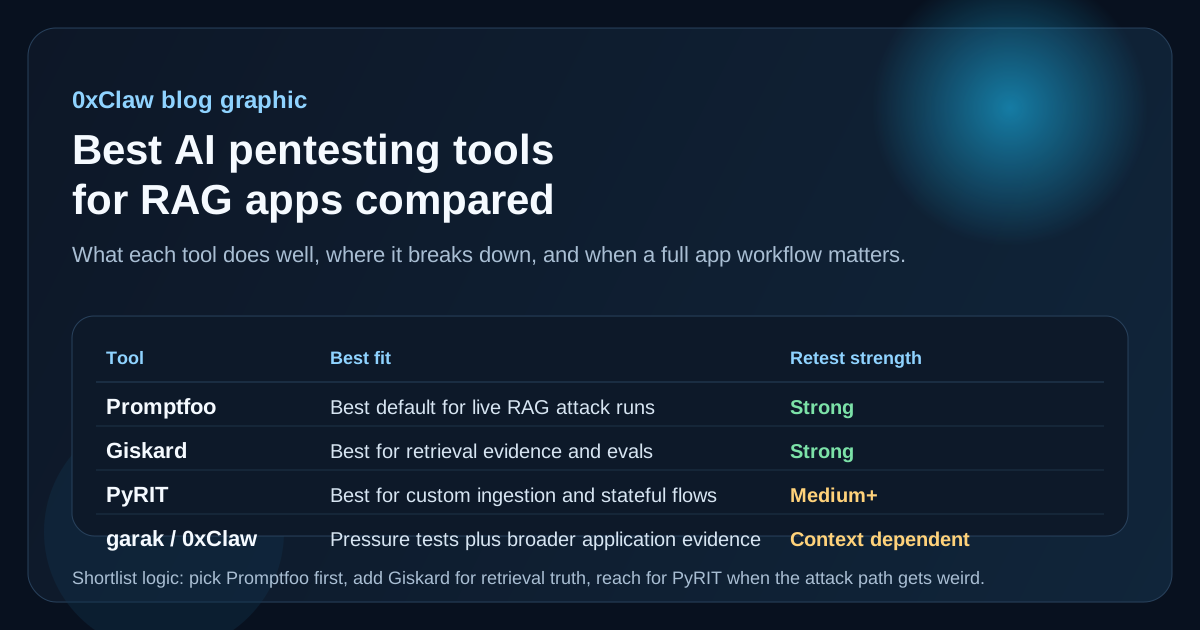
If you need the broader buyer context first, start at /compare. If your team is still sorting out the retrieval-specific attack layer, read best tools for testing prompt injection in RAG apps. If the next question is how to prove fixes after you find a bug, how security teams retest fixes in AI pentest workflows is the more useful follow-up.
Why RAG app pentesting is broader than prompt injection testing
Prompt injection still matters, but it is only the visible part of the problem. OWASP's RAG Security Cheat Sheet treats the retrieval pipeline as a security boundary, not a convenience feature. That is the right framing. A RAG app is usually taking untrusted content from documents, tickets, help-center pages, PDFs, HTML, or third-party connectors and putting some of that content close to system instructions or downstream tools.
That creates several security questions at once:
- Can an attacker poison the corpus during ingestion?
- Can the retriever surface hostile content for unrelated queries?
- Does the app mark retrieved text as untrusted data, or does it let that text compete with system instructions?
- Can the model leak sensitive context, bypass policy, or steer a downstream action?
- Can the team preserve enough evidence to replay the issue after a fix?
OWASP's LLM01 prompt-injection guidance is useful here because it keeps the focus on outcomes. The dangerous part is not the string itself. The dangerous part is what the surrounding system lets that string influence. A RAG pentest worth paying for has to follow that chain all the way through the application, not stop at "the model said something weird."
What to compare before you buy
Most "best tools" pages make the same mistake. They score a mixed pile of products against a bland feature matrix, then act surprised when the winning tool cannot prove the exploit path that the security team actually cares about.
For RAG apps, I would compare tools on five columns instead:
| Tool | Best fit | Retrieval and poisoning coverage | Evidence and retest quality | Main limitation |
|---|---|---|---|---|
| Promptfoo | Best overall starting point | Strong | Strong | Less flexible than a custom harness once the flow gets very strange |
| Giskard | Best evaluation companion | Medium to strong | Strong | Better at evaluation than offensive discovery |
| PyRIT | Best custom harness | Strong | Strong | More engineering setup and more operator burden |
| garak | Best cheap pressure test | Medium | Medium | Too model-centric to stand in for full app testing |
| 0xClaw | Best surrounding local workflow for real app surfaces | Medium | Strong | Not a narrow RAG-only scanner |
That table is more useful than a fake universal ranking because it forces the buyer to answer one uncomfortable question first: are you trying to probe a model, a retrieval pipeline, or a real application that happens to contain both? If you cannot answer that, the purchase process is already off track.
Promptfoo is the best default for most product teams
Promptfoo lands first because it already treats RAG as a live application problem. Its RAG red-team docs show how to test a real retrieval flow rather than a toy prompt box, and its poisoning plugin goes one layer deeper by walking through controlled corruption of a knowledge base before the attack run. That combination is unusually practical.
Here is what Promptfoo gets right for RAG pentesting:
- It can hit a live HTTP target or a local wrapper around the real chain.
- It has RAG-specific attack shapes instead of pretending every failure looks the same.
- It supports poisoned-document testing, which matters because many RAG failures begin before the final prompt is even built.
- It is usable as a regression loop after the fix, not just as a flashy first scan.
That last point is what keeps it at the top for me. Security teams rarely struggle to find one suspicious behavior. They struggle to turn that behavior into something engineering can replay, fix, and rerun without debate. Promptfoo is good at bridging that gap.
I would still keep expectations realistic. Promptfoo is strongest when the workflow can be expressed as a mostly repeatable target-and-assert loop. If your application has messy session state, weird ingestion formats, or a long chain of custom business actions after retrieval, you may outgrow the easy path and need a programmable harness beside it.
Giskard is the best second layer when you need retrieval evidence
Giskard belongs in this comparison for a different reason. Its RAG evaluation flow is not trying to cosplay as an exploit framework. It is better at forcing the team to inspect what the pipeline actually retrieved, whether the answer stayed grounded, and whether the system declined gracefully when the corpus did not support the response.
That matters more than it sounds. Plenty of RAG security bugs are really retrieval-discipline bugs. The model is just the last component to expose them. If your app quietly promotes poisoned chunks or answers confidently from junk context, you need to see that retrieval evidence directly instead of inferring it from the final prose.
This is where Giskard earns its spot:
- It pushes teams to expose retrieved documents in the evaluation flow.
- It helps separate a retrieval failure from a generation failure.
- It is useful for "fail closed" checks when the right answer is to refuse or de-scope.
- It gives product teams a cleaner regression story around groundedness and trust boundaries.
I would not use Giskard alone as the whole pentest motion. It is not built to replace an offensive discovery workflow. But paired with Promptfoo, it helps answer the question that many security reviews skip: what exactly did the app retrieve, and why did that content get trusted?
PyRIT is the right choice when the attack path is too custom for a config-first tool
PyRIT is what I would put in the hands of a security engineer who already knows the target will be awkward. Microsoft's project is a framework, not a tidy product page, and that is precisely why it helps in the cases where simpler tools start to wobble.
RAG apps get messy fast. You may need to model:
- hostile file uploads that are transformed before indexing
- cross-step workflows with authentication and session state
- document connectors that sync external content on a schedule
- custom scoring logic for partial success or multi-stage abuse
- downstream actions that happen after the model consumes poisoned context
That is the territory where PyRIT starts to beat prettier tools. It lets you script the ugly reality of the target instead of flattening everything into a generic prompt test. If the exploit path depends on the application's state or on how content moves across several components, PyRIT is often the tool that lets you reproduce it honestly.
The tradeoff is predictable. More power means more operator work. A rushed harness can become its own source of confusion, and not every product team should inherit that complexity. I would shortlist PyRIT when the environment is custom enough that the easy tools stop mapping cleanly to the real risk.
garak is still valuable, but only as one layer in the stack
garak remains useful because it is simple, cheap, and blunt. Its prompt-injection probes are easy to run, the logs are easy to diff, and it can tell you quickly whether a model or wrapper started folding under known bad patterns after a change.
That makes garak good at questions like:
- Did the new model version regress on basic injection handling?
- Did a prompt-template update quietly weaken the wrapper?
- Can we run a quick pressure test before deeper manual work?
- Are repeated failures showing up across several model builds?
All of that is useful. None of it replaces a RAG pentest.
garak does not know your ingestion path, your retriever behavior, your prompt assembly choices, or your downstream application boundaries unless you build those layers around it. I like it as a fast baseline. I do not like it as the reassuring answer someone gives after being asked whether a real RAG product is secure.
0xClaw fits the outer workflow when the RAG system lives inside a real application
Pure RAG tooling is only part of the picture when the target is a full application. A lot of teams are not testing an isolated retrieval demo. They are testing a customer-support surface, a document assistant, an internal search tool, or an agent workflow that mixes retrieval with auth state, uploads, admin actions, and downstream APIs.
That is where a broader local workflow matters. 0xClaw fits one layer out from the RAG-specific scanners because it helps teams keep the surrounding application behavior visible while they test the AI path. In practice, teams often need to prove more than "the model followed a bad instruction." They need to show:
- which route or state change the attacker used
- what authenticated context was present
- whether the issue depended on a real application side effect
- what evidence survives for triage and retest
- whether the fix held on the same path later
If that broader workflow is your problem, the next useful reads are how to run a local AI pentest workflow, what should an AI pentest report include, and the main product entry points at /download and /pricing. The point is not that one product "wins." The point is that RAG model testing and application evidence are different jobs, and mature teams usually need both.
Proxy-level validation still matters more than vendors admit
PortSwigger's material on web LLM attacks is a good corrective because it keeps pulling the conversation back to exploitability. Once a RAG finding matters, you usually need one more step beyond the AI tool's own output: request-level proof.
That proof is what tells engineering whether the issue is actually:
- a retrieval bug
- a prompt-assembly bug
- a model-policy failure
- a backend authorization problem
- or a downstream action issue that the model merely exposed
This is why I still want a replay or proxy-centric check beside the AI tooling. A clean report should make it possible to capture the request path, verify which attacker-controlled content entered the final context, confirm the side effect, and rerun the exploit after the fix. Without that stage, many RAG findings stay stuck in the "plausible but annoying to close" category.
How I would run a practical proof of concept
If I had to narrow a shortlist for a RAG team in one week, I would not let vendors steer the proof of concept into canned demos. Pick one real application flow and make the tooling survive a slightly unfriendly test.
My POC would include:
- One document-ingestion path with controlled hostile content.
- One retrieval path where the poisoned chunk should not win.
- One prompt-assembly check that proves untrusted context stays untrusted.
- One outcome check for leakage, unsafe answer shaping, or unauthorized action.
- One retest after a fix on the exact same path.
That last step matters more than buyers think. Discovery is easy to demo. Reliable retest discipline is where a tool either becomes part of the team's operating rhythm or turns into shelfware.
If you are comparing adjacent categories too, it is worth reading best AI pentesting tools for APIs compared, best AI pentesting tools for AI agents compared, and AI pentest tool vs vulnerability scanner. Those pieces help keep the layers separate.
FAQ
Which tool is best for pentesting a RAG app overall?
For most teams, Promptfoo is the best first choice because it combines RAG-specific attack coverage, poisoning tests, and repeatable regression value. It is the best default, not the only tool you may need.
Is Giskard better than Promptfoo for RAG security?
Not overall. Giskard is better as an evaluation layer for retrieval quality, groundedness, and fail-closed behavior. Promptfoo is better for adversarial discovery and repeatable attack runs. Many teams should use both.
When should I choose PyRIT instead?
Choose PyRIT when the attack path is too custom for a config-first tool. That usually means stateful workflows, ugly ingestion paths, or multi-step application logic that needs a scripted harness.
Is garak enough for a production RAG pentest?
Usually no. garak is useful for cheap model pressure testing, but it does not replace testing of ingestion, retrieval, prompt assembly, application state, and downstream actions in the real product.
Do I still need request-level validation if the AI tool already found the issue?
Yes. Request-level validation is what turns a suspicious behavior into evidence that engineering can fix and rerun with confidence.
Bottom line
The best AI pentesting tools for RAG apps are not interchangeable. Promptfoo is the best overall starting point. Giskard is the strongest evaluation companion. PyRIT is the best fit for custom attack paths. garak is useful for cheap pressure testing. 0xClaw fits around the outer application workflow when you need evidence, replay, and retest discipline around a real product.
That is the shortlist I would use. Start by deciding whether you are testing a model, a retrieval pipeline, or a full application. Then pick the tool stack that matches the real job instead of the marketing label.
Ready to run your first AI pentest?
Get 0xClaw up and running in under 3 minutes. No infrastructure setup. No cloud dependency.
More AI Pentest Guides
Continue through the local AI pentesting cluster with related guides on workflow, evidence, comparisons, and remediation.
Best AI penetration testing tools 2026
Compare 0xClaw, NodeZero, PentestGPT, Promptfoo, and garak by execution layer. Chat advice is not authorized target testing.
Read next ->AI Pentest CLI Explained | 0xClaw
Learn what an AI pentest CLI is, how local AI penetration testing works, and how to evaluate a safe, authorized workflow.
Read next ->Run a Local AI Pentest Workflow | 0xClaw
Learn how to run a local AI pentest workflow from scope to report across authorized web, API, host, and network testing.
Read next ->