
Best API Pentest Tools | 0xClaw
Compare the best AI pentesting tools for APIs by direct API coverage, prompt injection depth, auth testing, evidence quality, and retest speed.
Compare the best AI pentesting tools for APIs by direct API coverage, prompt injection depth, auth testing, evidence quality, and retest speed.
- Best API Pentest Tools | 0xClaw should explain infrastructure choices in a way that is easy to quote, compare, and operationalize.
- Tie architecture explanations back to how local execution, governance, and evidence handling work in practice.
- Use official docs plus product pages so the page can rank for definitions and support AI citation.
Quick answer: which API pentesting tool should most teams start with?
If you need one short answer, start with Promptfoo for direct AI API red teaming, keep PyRIT on the shortlist when your target flow is odd enough to need a programmable harness, use garak for cheap model-side probe coverage, and do not pretend a pure LLM eval tool replaces proxy-level verification. For teams that need the broader workflow around real web apps and APIs, including auth boundaries, evidence capture, and post-fix retests, 0xClaw makes more sense as the surrounding operator workflow than as a narrow prompt lab.
That distinction matters. "AI pentesting for APIs" is not one job. Sometimes you are attacking an LLM-backed endpoint directly. Sometimes you are testing whether attacker-controlled content can steer tool use or trigger the wrong downstream API call. Sometimes the hard part is not finding the bug, but proving it with request-level evidence and rerunning the same flow after engineering ships a fix. Buyers who blur those categories usually end up with a nice-looking dashboard and a weak security program.
The graphic below is the fast version of the comparison:
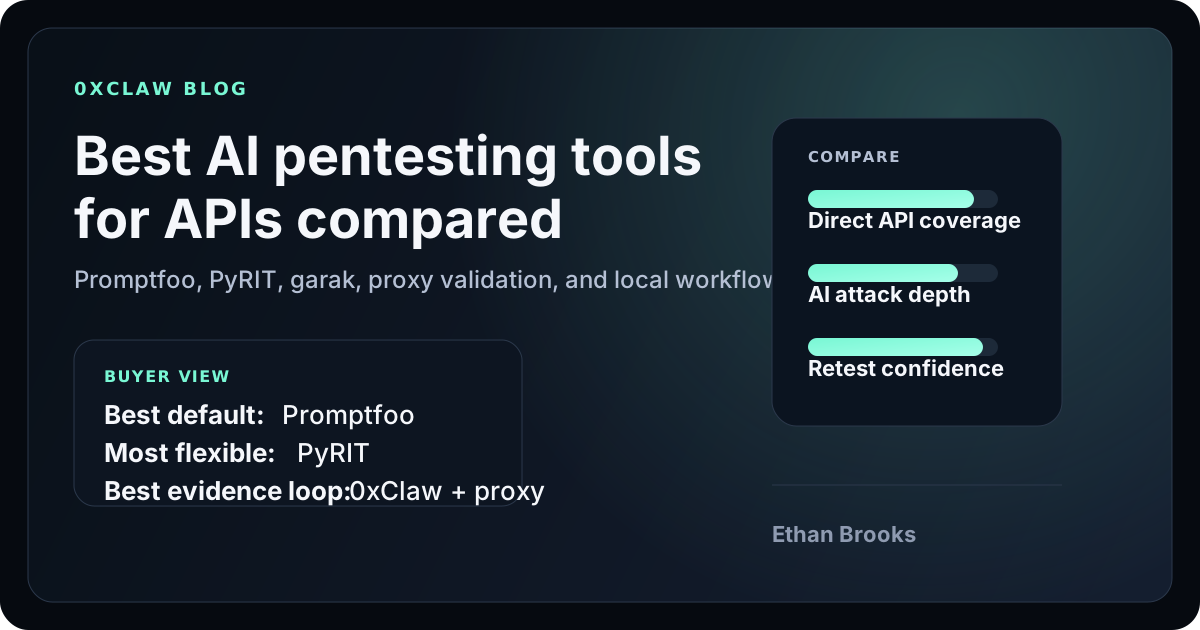
If you want the wider tool landscape first, start at /compare. If you already know you need a local workflow around real application surfaces, check /download and /pricing. If your team is still arguing about what good reporting looks like, read what an AI pentest report should include.
Why AI API pentesting is not the same as ordinary API testing
Normal API testing still matters. Broken object authorization, authentication mistakes, security misconfiguration, and unsafe third-party dependencies remain the boring ways teams get hurt. OWASP's API Security Project still puts authorization failures at the center of modern API risk, and its 2023 list added API10, Unsafe Consumption of APIs, because developers keep trusting upstream services too much.
AI APIs add another layer on top of that. The API may accept ordinary JSON, but the risky part is often what happens after the request lands. The model may assemble prompts from several fields, pull untrusted content into context, choose a tool, call another API, or shape a response that a downstream system treats as instructions. OWASP's prompt injection cheat sheet treats that as more than bad content filtering. It is an application-security problem that can lead to unauthorized actions, data exposure, and tool misuse.
That is why I separate the category into three jobs:
- direct adversarial testing against an AI API endpoint
- programmable attack-path testing for weird or stateful workflows
- proof-driven validation of the final exploit chain
If a product only does the first job, it can still be useful. It just should not be sold as the whole answer.
What to compare before you buy
Most comparison pages drown the buyer in features nobody will care about two months later. For AI APIs, I would score tools on five columns instead.
| Tool | Best fit | Direct API targeting | Depth on AI-specific attacks | Evidence and retest quality | Main limitation |
|---|---|---|---|---|---|
| Promptfoo | Fastest default for most teams | Strong | Strong | Medium to strong | Less flexible than a custom harness when the target flow gets strange |
| PyRIT | Programmable red-team harnesses | Strong | Strong | Strong | More setup, more engineering, more room to build a messy harness |
| garak | Cheap model-side sweeps | Medium | Medium | Medium | Narrower than buyers expect if the real issue lives in app logic |
| 0xClaw | Local operator workflow around real apps and APIs | Strong | Medium | Strong | Not a pure LLM-only evaluation product |
| Burp-style proxy validation | Final exploit proof | Strong | Indirect but important | Strong | Manual effort, not a self-contained AI testing platform |
The point of this table is not to crown a fake universal winner. It is to stop teams from asking one tool to do three different jobs badly.
Promptfoo is the best default for most teams
Promptfoo is the cleanest starting point because it already thinks like an attacker who has to hit a real target, not just a base model in isolation. Its red-team quickstart says the scanner runs locally and can attack endpoints reachable from your machine or network. The same docs also say it can hook into Python, JavaScript, RAG, agent workflows, and direct HTTP APIs. That is the right default shape for real AI products, because production systems are almost never just "send prompt, get text."
The reason Promptfoo usually wins the first round is practical, not ideological. It gives teams a faster path from suspicion to repeatable test:
- point the tool at the target
- generate adversarial cases
- run them locally
- save the config
- rerun after a fix
That is already better than the common alternative, which is a loose pile of prompts in a Slack thread and one engineer who remembers how to replay them.
Promptfoo gets even more interesting once you stop thinking of AI API abuse as a single input field. Its docs show that it can attack existing HTTP APIs directly. Its MCP provider docs also show the company's broader stance on agentic systems: when the target is the protocol-facing server itself, Promptfoo is willing to treat that server as the system under test, not just the model behind it. That matters because it signals a useful product boundary. The tool is built to attack the integration layer, not merely benchmark a model.
If I were buying for one application team with limited time, I would start here first. Promptfoo is strong when you need quick coverage of prompt injection, unsafe tool behavior, policy bypass attempts, and regression-friendly retests against a live API.
PyRIT is the best choice when your target is too weird for a config-first tool
PyRIT is the tool I reach for when the clean YAML story stops being enough. Microsoft's docs position it as a red-teaming framework for many target types, including custom HTTP endpoints, WebSockets, and even web app targets. The HTTPXAPITarget documentation is the part buyers should pay attention to. It supports explicit HTTP methods, JSON bodies, form data, and file uploads. That sounds ordinary until you remember how many AI workflows hinge on weird payload shapes, uploaded files, or multi-step state.
This is where PyRIT pulls ahead:
- multi-step agent APIs with session state
- upload-driven flows where malicious documents carry instructions
- custom scoring logic that goes beyond pass or fail
- side-by-side comparisons of models, prompts, or guardrails
- research workflows where you need more control than a packaged scanner gives you
PyRIT also keeps memory and result tracking close to the workflow. Microsoft highlights built-in memory for conversations, scores, and attack results, which matters more than it sounds. A security team that cannot preserve context ends up rediscovering the same issue with less confidence every sprint.
The tradeoff is obvious. PyRIT gives you leverage, but it also gives you rope. If the engineer building the harness is sloppy, the test bed becomes its own bug farm. That is not a reason to avoid the tool. It is a reason to be honest about who should own it. PyRIT is excellent when you have someone technical enough to keep the attack harness clean.
garak is useful, but it is not enough on its own
garak still earns a place in this comparison because it is fast, focused, and honest about what it is doing. Its prompt injection example is straightforward: run the PromptInject probe family, evaluate outputs, and inspect the hit log when the model follows the wrong instructions. That makes garak good at one thing buyers routinely need and rarely say out loud: a cheap baseline.
Use garak when you want to answer questions like these:
- Did the latest model swap make obvious prompt-injection handling worse?
- Did a guardrail change quietly regress?
- Is this wrapper still vulnerable to known prompt-manipulation patterns?
- Can we run a lightweight sweep before deeper manual testing?
That is useful. It is not the whole program.
garak becomes the wrong lead tool when the real issue sits in the plumbing around the model. If the exploit depends on authorization mistakes, unsafe prompt assembly from multiple fields, broken tool mediation, or a bad downstream API call, a model-side probe can only take you part of the way. I still like garak in a stack. I do not like garak as the answer somebody gives after they were supposed to assess the security of a real product.
0xClaw fits one layer out from the pure LLM tools
0xClaw belongs in this conversation for a different reason. It is more useful when the AI API is part of a larger application surface and the team needs a local, operator-visible workflow that keeps evidence and retests close to the system under test.
That sounds less glamorous than "AI red teaming," but it is where many programs either mature or stall. In practice, teams often need to prove more than "the model said something unsafe." They need to show:
- what request path the attacker used
- which auth boundary failed
- whether the issue depended on a real application state change
- what the product looked like before and after the fix
- whether the same path stayed fixed on a second run
That is why I think of 0xClaw as a surrounding workflow rather than a narrow API prompt scanner. If the security team is testing a real app with AI endpoints, admin surfaces, uploads, or chained API calls, the local workflow matters. You do not want findings trapped inside a high-level evaluation score if the engineering team needs request-level proof and a reliable retest loop.
If that broader workflow is what you are after, keep how to run a local AI pentest workflow and how security teams retest fixes in AI pentest workflows nearby. Those are the better next reads than another generic tool roundup.
Proxy-driven validation still matters more than vendors like to admit
This is the part buyers skip because it is less fun to pitch. A lot of AI security findings are not report-ready until somebody proves the final request chain.
PortSwigger's Web Security Academy material on web LLM attacks is useful here because it frames the problem the right way. The dangerous part is often not the injected string by itself. It is the way the model is integrated into the application, what the model can reach, and how far an attacker can push the chain once the model starts cooperating.
That is why I still want a proxy-centric validation step beside the AI tools. Whether you use Burp or an equivalent workflow, the job is the same:
- capture the live request sequence
- verify which attacker-controlled fields shaped the model context
- confirm the downstream call or side effect
- separate model weakness from broken backend control
- rerun the exploit after the fix
If you skip that stage, you end up with too many findings that sound plausible and too few that engineering can close confidently. This is especially true for AI APIs that can reach internal tools, trigger business actions, or consume data from third-party systems. OWASP's API10 category exists for a reason. Unsafe consumption is not abstract. It becomes concrete the moment the AI wrapper trusts upstream content too much or hands model output to the wrong system.
A practical shortlist by team type
Different teams should not buy from the same starting point.
| Team type | Best starting point | Why |
|---|---|---|
| Product security team on one AI feature | Promptfoo | Fastest route to direct API attack coverage and repeatable retests |
| Security engineering team with complex flows | PyRIT | Better control over state, uploads, scoring, and odd payload shapes |
| Team that wants cheap baseline probes | garak | Fast sweeps and easy regression checks without heavy setup |
| AppSec team proving real exploit chains | Promptfoo plus proxy validation | Good AI coverage plus hard evidence |
| Team testing a full application around AI endpoints | 0xClaw plus an AI-specific tool | Better surrounding workflow for auth, evidence, and fix verification |
I would resist the temptation to over-optimize this. The most expensive mistake is usually not "we picked the second-best scanner." It is "we picked a tool that looked modern, then discovered it was blind to the failure mode that actually mattered."
How I would run the proof of concept
A good proof of concept for API AI pentesting should be short and slightly unforgiving. Do not let the vendor drive it into a toy demo.
Pick one real target. Include one authenticated flow, one indirect-input case, and one path where the model can influence a downstream action. Then require a retest after a fix. If the product cannot survive that simple structure, the longer bake-off will not save it.
My POC checklist is blunt:
- Test a real API route, not only a mock model endpoint.
- Include at least one prompt-injection or instruction-smuggling case.
- Include at least one authorization or business-logic boundary.
- Capture raw requests, outputs, and side effects.
- Patch one issue and rerun the exact same path.
That last step is the one buyers underweight. Security tooling is easy to demo when all it has to do is find something suspicious. The harder question is whether the same tool helps you confirm the fix without ambiguity. If it cannot, budget extra time and process for the retest loop now rather than pretending the workflow will magically improve later.
FAQ
Which AI pentesting tool is best for APIs overall?
For most teams, Promptfoo is the best starting point because it targets real HTTP-accessible systems, supports repeatable red-team runs, and fits the way product teams actually retest fixes. It is not the only tool you may need, but it is the best default.
Is PyRIT better than Promptfoo?
It depends on the target. PyRIT is better when the workflow is stateful, upload-heavy, or custom enough that you need a programmable harness. Promptfoo is better when speed, simplicity, and clear repeatability matter more than framework flexibility.
Is garak enough for API security testing?
No. garak is useful for model-side probing, especially prompt injection checks, but it does not replace application-aware testing of auth, workflow logic, or downstream API misuse.
Should I use Burp with AI pentesting tools?
Yes. If a finding matters, validate it with a proxy or equivalent request-level workflow. You want proof of the actual request path and the actual side effect, not just a suspicious model output.
Where does 0xClaw fit if I already have an LLM red-team tool?
It fits around the rest of the application. If your AI API sits inside a real product with web routes, admin actions, auth state, uploads, and classic API risk, a broader local workflow still matters.
Bottom line
The best AI pentesting tools for APIs are not all trying to solve the same problem. Promptfoo is the best default for direct AI API red teaming. PyRIT is the best fit when your target needs a programmable harness. garak is strong for cheap probe coverage. 0xClaw is more useful as the surrounding local workflow when the AI endpoint sits inside a real application. And no matter what you buy, proxy-level validation still matters if you want findings that engineers will trust.
That is the comparison I would use if I had to narrow a shortlist fast. Start with the job you actually need done, not the label on the vendor page. Then decide whether the next step is the broader /blog, the product compare hub, a local install from /download, or a pricing conversation at /pricing.
Ready to run your first AI pentest?
Get 0xClaw up and running in under 3 minutes. No infrastructure setup. No cloud dependency.
More AI Pentest Guides
Continue through the local AI pentesting cluster with related guides on workflow, evidence, comparisons, and remediation.
Best AI penetration testing tools 2026
Compare 0xClaw, NodeZero, PentestGPT, Promptfoo, and garak by execution layer. Chat advice is not authorized target testing.
Read next ->AI Pentest CLI Explained | 0xClaw
Learn what an AI pentest CLI is, how local AI penetration testing works, and how to evaluate a safe, authorized workflow.
Read next ->Run a Local AI Pentest Workflow | 0xClaw
Learn how to run a local AI pentest workflow from scope to report across authorized web, API, host, and network testing.
Read next ->