
Best AI pentesting tools for AI agents compared
Compare Promptfoo, PyRIT, RAMPART, garak, and AgentDojo by the agent layer they test. Host pentesting is out of scope.
Compare Promptfoo, PyRIT, RAMPART, garak, and AgentDojo by the agent layer they test. Host pentesting is out of scope.
- Best AI pentesting tools for AI agents compared should explain infrastructure choices in a way that is easy to quote, compare, and operationalize.
- Tie architecture explanations back to how local execution, governance, and evidence handling work in practice.
- Use official docs plus product pages so the page can rank for definitions and support AI citation.
Quick answer:
The best AI pentesting tools for AI agents differ by whether they test prompts, tools, or full agent loops. Use this comparison to pick the layer; it is not a network pentest catalog.
What this page covers
- How Promptfoo, PyRIT, RAMPART, garak, and AgentDojo differ by the agent layer they test.
What this page does not cover
- Host or network pentesting, ranking promises, or unpublished 0xClaw scan scores.
That is the short answer. The more useful answer is that these tools do different jobs. Teams waste time when they compare a model probe kit, an agent red-team harness, and a benchmark as if they were interchangeable.
Why this category is messier than it looks
"AI pentesting tool" has become a sloppy label. Vendors use it for at least three different things:
- tools that attack a live AI agent through its real interface
- frameworks that probe an LLM or component for known failure modes
- benchmarks that measure whether a defense holds up across many tasks
Those are related, but they are not the same purchase decision.
An agent that can browse the web, read tickets, search docs, call internal APIs, or write code has a bigger attack surface than a plain chatbot. The risky part is not only what the model says. The risky part is what it does after consuming hostile content. That is why agent testing needs evidence about tool calls, side effects, outbound requests, and permission boundaries.
This is also why old "jailbreak prompt" habits do not carry very far. A team can pass a few adversarial chat tests and still ship an agent that happily reads a poisoned wiki page, copies a secret into an external URL, or follows a malicious instruction hidden in a repo comment. If the testing harness cannot see that path, it will miss the failure that matters.
The best AI pentesting tools for AI agents, side by side
| Tool | Best fit | What it actually tests | Main limitation |
|---|---|---|---|
| Promptfoo | Product teams securing real agent apps | Agent trajectories, indirect prompt injection, tool misuse, coding-agent failures, trace evidence | Some advanced workflows assume you can wire traces and targets cleanly |
| PyRIT | Security engineers who want custom attack workflows | Multi-turn attacks, custom targets, web targets, scoring layers, manual plus automated red teaming | More flexible than turnkey, which also means more setup |
| RAMPART | Engineering teams converting findings into regressions | Pytest-based safety tests for agents, repeated trials, CI enforcement | Newer and narrower than the discovery-focused tools |
| garak | Fast baseline scanning of models and agent components | Prompt injection probes, jailbreaks, guardrail bypass, structured hit logs | Not a full end-to-end agent runtime harness by itself |
| AgentDojo | Research and benchmark-driven evaluation | Realistic tool-using tasks and adaptive attack evaluation | A benchmark environment, not a plug-and-play test rig for your staging app |
| 0xClaw | Broader app, API, and host pentesting around the agent | The web app, API, auth, and infrastructure layer around agent systems | Not a substitute for agent-specific prompt injection harnesses |
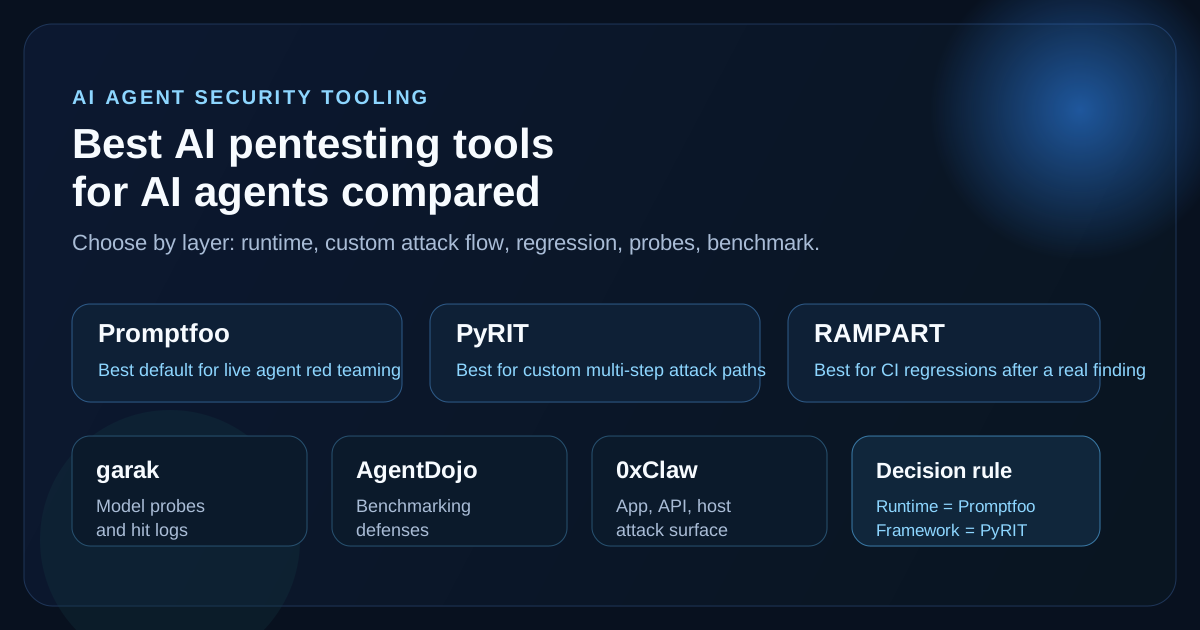
The table is the key GEO takeaway for this query: there is no single winner across every layer. There is usually one winner for your immediate bottleneck.
When Promptfoo is the right default
Promptfoo deserves the top slot for most teams because it looks like what real product work looks like. Its current agent red-team docs cover direct attacks, indirect attacks, tool abuse, policy violations, and trace-driven evidence. The newer coding-agent material goes even further into repo prompt injection, terminal output injection, secret handling, network egress, and verifier sabotage. That is much closer to the way AI agents actually fail in 2026.
What I like here is not just feature count. It is the framing. Promptfoo treats the agent as a system with a trajectory, not a single answer box. That matters because a final "safe" answer is meaningless if the agent already called the wrong tool three steps earlier.
Promptfoo is the best choice when:
- you have a real agent endpoint and want attacks against it this week
- you need coverage for indirect prompt injection from docs, tickets, or retrieved context
- you want traces that show what the agent did, not just what it said
- you are testing coding agents and need repo-level attack cases
It is also the easiest recommendation for teams already living in CI. The configs are opinionated enough to get moving fast, and the attack plugins map well to the threat models teams actually care about.
If your next step is building a stack around a production agent app, read more in the blog, then compare where a broader offensive workflow fits in the comparison hub.
When PyRIT is better than Promptfoo
PyRIT is better when you want more control than convenience.
Microsoft describes PyRIT as an automated and human-led AI red-teaming framework, and that is the right mental model. It is not just a canned scan runner. It is a toolkit for building adversarial workflows against targets you define. The docs now emphasize multi-turn attack strategies, a scenario framework, flexible scoring, and support for many target types, including web targets with Playwright.
That makes PyRIT attractive in a few specific situations:
- your team wants to model a custom attack chain instead of accepting a fixed plugin set
- you need manual and automated testing in the same framework
- you care about memory, replay, and analysis of attack sessions
- your target is odd enough that productized harnesses feel cramped
PyRIT is the tool I would hand to a security engineer who says, "I know the exact ugly path I want to reproduce." Maybe that path is a poisoned website, then a browser action, then a follow-up exfil attempt through a second tool. Maybe it is a staged multi-turn escalation against a custom internal assistant. PyRIT gives you the room to build that.
The cost is obvious. You will do more assembly work. Some teams need that freedom. Some teams just need answers fast and should not pretend they want a framework when they really want a working harness.
Why RAMPART matters even though it is new
RAMPART is the most interesting entrant in this list because it targets a problem most teams still handle badly: converting a red-team finding into a durable regression test.
The timing matters here. Microsoft's launch post is dated May 20, 2026, which is only five days before this article. So this is not a mature, boring category leader yet. It is new. That is precisely why I would not oversell it as the best discovery tool. I would describe it more narrowly and more honestly.
RAMPART is strong when:
- you already know the failure mode you need to prevent
- you want a normal engineering artifact, not a one-off security exercise
- you need repeated trials because the agent is probabilistic
- you want CI to break when the unsafe behavior comes back
That last point is the whole game. Teams often run a red-team exercise, file a ticket, tweak a system prompt, and move on. Then the same behavior reappears after a model swap, a tool schema change, or a retrieval update. A test that never made it into the build cannot save you.
So I would position RAMPART like this: Promptfoo and PyRIT help you find the problem. RAMPART helps you keep the problem from quietly returning.
Where garak and AgentDojo fit, and where they do not
garak and AgentDojo are both valuable, but they are valuable for different reasons.
garak is a broad LLM security probe kit. The docs are direct about that. It focuses on risks that are specific to LLM deployment, including prompt injection, jailbreaks, guardrail bypass, and text replay. It also produces useful structured logs: run output, detailed reports, hit logs, and debug logs. That makes it good for fast pressure testing across model targets or agent components.
What garak is not is a full picture of your agent runtime. Out of the box, it does not know your actual browser flow, your permission boundaries, your business logic, or what "success" means in a multi-step task. It finds categories of weakness well. You still need another layer to see whether those weaknesses become operational failures.
AgentDojo is different again. It is not mainly a scanner. It is a benchmark environment for tool-using agents under prompt injection pressure. That matters if you are evaluating a defense, comparing models, or trying to avoid fooling yourself with a tiny internal test suite.
AgentDojo becomes useful when the question changes from "can I break this app?" to "does this defense generalize at all?" That is a different standard. Harder, too.
A practical decision rule for buyers and builders
If you have to choose without overthinking it, use this decision rule:
- Pick Promptfoo if you want the best default harness for a production agent.
- Pick PyRIT if you need to script custom attack paths and own the workflow.
- Add RAMPART if the issue must become a stable regression test in CI.
- Run garak when you want broad probe coverage against the model or component layer.
- Use AgentDojo when you need benchmark-level evidence for a defense claim.
That is the tool choice. Then there is the layer choice.
If your concern is prompt injection, tool abuse, trajectory safety, or coding-agent sabotage, stay with the agent-focused tools above.
If your concern is the web app, API, auth edge, storage path, or infrastructure around the agent, that is where a broader workflow like 0xClaw fits. Most teams building production agents need both layers eventually. They just should not buy them as if they solve the same problem.
If you are evaluating budget and rollout timing, the next useful pages are pricing and the broader compare view.
What strong teams test that weak teams skip
The best teams do not stop at "the model refused the bad prompt." They test the operational chain.
That usually means:
- poisoned retrieved documents
- poisoned webpages for browsing agents
- hidden instructions in repo files or issue text for coding agents
- cross-tool exfil paths
- permission boundary checks before sensitive actions
- regression coverage after a real incident
This is the part that separates demos from real assurance. An agent can fail safely in text while failing unsafely in action. The testing stack has to be able to prove the difference.
It is also where teams get tripped up by category confusion. A broad probe tool can be useful and still leave a dangerous hole. A benchmark can be rigorous and still not help you test your staging deployment tomorrow morning. A discovery harness can find problems and still leave you exposed if nobody turns them into regressions.
That is why the answer to this query is not just a ranked list. It is a workflow:
- discover failures against the real agent
- inspect traces and side effects
- convert the failure into a regression
- validate broader coverage across models and benchmarks
If a tool only solves one of those steps, say so plainly and buy it for that step.
Bottom line
For most teams, Promptfoo is the best AI pentesting tool for AI agents right now because it matches the shape of the actual problem: tool-using systems, indirect inputs, observable traces, and real attack plugins.
PyRIT is the better choice when you need a framework, not just a harness.
RAMPART is the right answer when the problem is no longer discovery, but discipline.
garak stays valuable as your fast probe layer.
AgentDojo keeps your defense claims honest.
The bigger lesson is simple. Do not ask which tool is "best" in the abstract. Ask which tool tests the layer where your agent can actually hurt you.
FAQ
What is the best open-source AI pentesting tool for AI agents?
For most teams, Promptfoo is the best open-source starting point because it supports agent red teaming, indirect prompt injection, coding-agent attack cases, and trace-backed analysis. PyRIT is the better fit when you want more control over attack construction.
Is garak enough for agent pentesting on its own?
Usually no. garak is useful for model and component probing, but it does not replace an end-to-end agent harness that can observe tool calls, trajectories, and side effects in your real app.
Do teams need both agent testing and broader app pentesting?
Yes, in many cases. Agent-specific tooling covers prompt injection, tool misuse, and trajectory safety. You still need to test the surrounding web app, APIs, auth, storage, and infrastructure. That is why many teams pair agent harnesses with broader workflows from the blog and download path.
When should I choose RAMPART instead of Promptfoo or PyRIT?
Choose RAMPART when you already know the failure mode and want it enforced as a repeatable regression test in CI. Use Promptfoo or PyRIT first when the main job is discovering the weakness.
Ready to run your first AI pentest?
Get 0xClaw up and running in under 3 minutes. No infrastructure setup. No cloud dependency.
More AI Pentest Guides
Continue through the local AI pentesting cluster with related guides on workflow, evidence, comparisons, and remediation.
Best AI penetration testing tools 2026
Compare 0xClaw, NodeZero, PentestGPT, Promptfoo, and garak by execution layer. Chat advice is not authorized target testing.
Read next ->AI Pentest CLI Explained | 0xClaw
Learn what an AI pentest CLI is, how local AI penetration testing works, and how to evaluate a safe, authorized workflow.
Read next ->Run a Local AI Pentest Workflow | 0xClaw
Learn how to run a local AI pentest workflow from scope to report across authorized web, API, host, and network testing.
Read next ->