
Best RAG Prompt Injection Tools | 0xClaw
Compare the best tools for testing prompt injection in RAG apps, from Promptfoo and Giskard to PyRIT, garak, and proxy-led evidence.
Compare the best tools for testing prompt injection in RAG apps, from Promptfoo and Giskard to PyRIT, garak, and proxy-led evidence.
- Best RAG Prompt Injection Tools | 0xClaw should explain infrastructure choices in a way that is easy to quote, compare, and operationalize.
- Tie architecture explanations back to how local execution, governance, and evidence handling work in practice.
- Use official docs plus product pages so the page can rank for definitions and support AI citation.
Quick answer
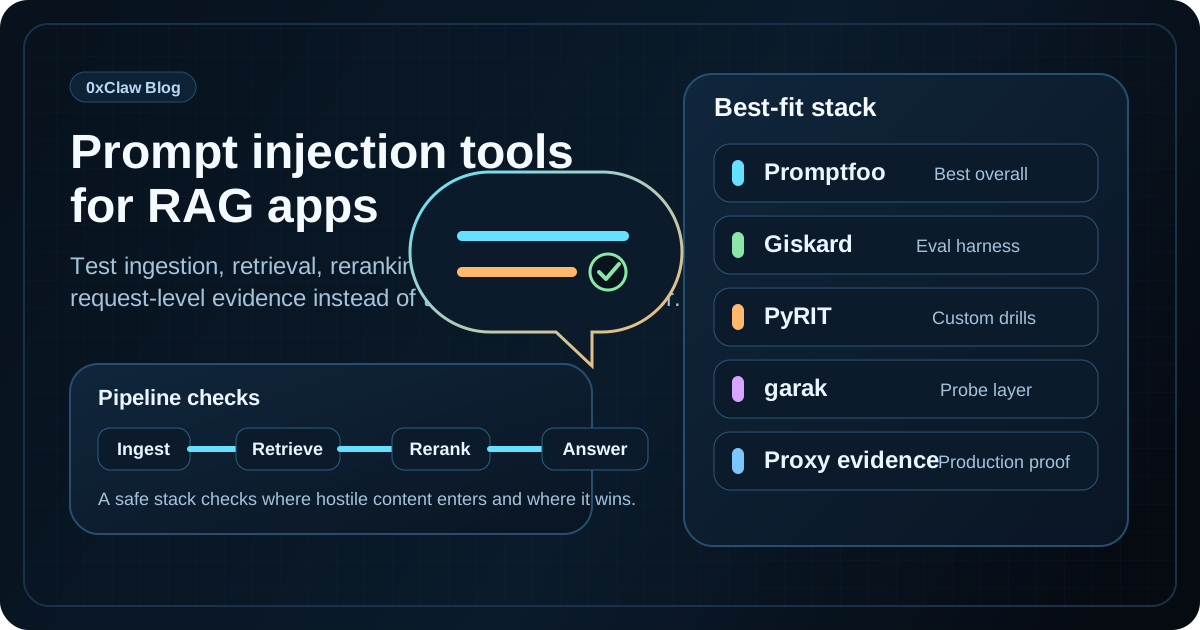
For most teams, Promptfoo is the best tool for testing prompt injection in RAG apps because it can attack the real retrieval pipeline, inject adversarial content into untrusted context, simulate RAG poisoning, and turn the results into repeatable checks. Giskard is the best companion when you need a cleaner eval harness for retrieval quality, groundedness, and "did the app fail closed?" behavior. PyRIT is the right tool when you want to script uglier attack chains yourself, especially ingestion poisoning and cross-domain flows that look like real abuse. garak still matters, but mostly as a model-pressure layer, not a full RAG pipeline rig. And when a finding matters, you still want a proxy or replay workflow to prove the production request path.
That ranking only makes sense if you keep the category straight. Testing prompt injection in a RAG app is not the same as asking a chatbot to resist "ignore previous instructions." You are testing a chain: ingestion, chunking, embedding, retrieval, reranking, prompt assembly, and the final answer or tool action. If your harness cannot tell you which stage trusted poisoned content, it will miss the bug that matters.
If you want the one-screen version first, the comparison graphic summarizes the stack.
Why RAG prompt injection testing is a different job
RAG changes the attack surface. The model is no longer working from a single user prompt and a fixed system prompt. It is reading content pulled from documents, tickets, wikis, PDFs, customer notes, HTML pages, or whatever else your retriever can reach. OWASP's RAG Security Cheat Sheet says the risk gets redistributed across the whole pipeline, from document ingestion to downstream agent integration. OWASP's LLM01:2025 Prompt Injection makes the same point from the model-risk side: RAG can improve relevance, but it does not remove prompt injection.
That is why a serious RAG test has to answer questions like these:
- Can a poisoned document get into the corpus at all?
- Does the retriever pull it back for the wrong query?
- Does the reranker promote it over cleaner chunks?
- Does prompt assembly preserve a trust boundary, or does retrieved text land next to privileged instructions like it owns the place?
- Does the model follow the injected instruction, leak hidden context, or call a downstream tool it should never touch?
If your current tooling only grades the final answer, you are leaving most of that chain untested.
What the best tool needs to prove in a retrieval pipeline
The best tool for this job is not the one with the longest payload list. It is the one that gives you evidence at the pipeline boundary where trust actually broke.
For RAG apps, that usually means five things:
- Ingestion evidence. Can you seed or mutate a document in a controlled way and keep track of what changed?
- Retrieval evidence. Can you see which chunks were returned for a given query?
- Ranking evidence. Can you tell whether poisoned content rose during search or reranking?
- Prompt-boundary evidence. Can you inspect how untrusted context was inserted into the final model input?
- Outcome evidence. Can you prove whether the model leaked data, followed the hostile instruction, or stayed inside policy?
That reranker point deserves emphasis. None of the tools below magically "secure the reranker." The useful ones let you surface pre-rerank and post-rerank evidence so you can see whether adversarial chunks are winning because of retrieval, because of reranking, or because your prompt assembly treats them as trusted instructions. That is an engineering inference from the eval and RAG-security docs, but it is the practical boundary that determines whether a fix will hold up.
Best tools for testing prompt injection in RAG apps compared
| Tool | Best fit | What it really gives you | Where it falls short |
|---|---|---|---|
| Promptfoo | Best overall for production RAG teams | Red-team workflows for RAG apps, indirect injection tests, RAG poisoning, HTTP or code-level targets, CI-friendly regressions | Grading can still depend on model judges unless you wire in stricter deterministic assertions |
| Giskard | Best eval harness for retrieval quality and trust boundaries | Retrieval checks, groundedness checks, out-of-scope handling, prompt injection datasets and metrics | Less opinionated for offensive discovery than Promptfoo or PyRIT |
| PyRIT | Best for custom poisoning labs and ugly edge cases | Scriptable attacks, cross-domain prompt injection flows, custom HTTP targets, multi-step orchestration | More assembly required, slower to hand to a product team |
| garak | Best for broad model-level pressure | Fast prompt-injection probes and repeatable hit logs | Not a full end-to-end RAG pipeline harness |
| Proxy and replay workflow | Best for production proof | Request/response evidence, real traffic inspection, exact downstream impact | Manual work; not a RAG-specific scanner by itself |
My working stack is straightforward. Promptfoo is the best first choice. Giskard is the best second layer. PyRIT is what you reach for when the clean, config-first path is no longer enough.
Promptfoo is the best overall choice
Promptfoo's red-team quickstart now calls out RAG workflows directly, and that matters. It is not pretending every AI app is just a chat box. The more useful signal is in the RAG-specific docs. The RAG guide shows how to test both prompt injection and context injection against a real retrieval flow. The newer RAG Poisoning utility goes further by walking through a controlled poisoning process: generate poisoned documents, add them to the knowledge base, then run the red team against the live system.
That is exactly the shape of test most teams need.
Promptfoo is strongest when you care about operational coverage:
- It can hit a live HTTP endpoint or a local provider script that wraps your real RAG chain.
- It can test indirect injection against fields like
context,documents, orretrieved_chunks. - It can simulate document poisoning, retrieval hijacking, and exfiltration-style outcomes.
- It fits CI better than most security-team-only tooling.
The biggest reason it lands at number one is that it bridges discovery and regression. You can use it to find a weakness, then keep the same test shape around after the fix. That is a practical advantage, not a philosophical one.
Giskard is the best eval harness for retrieval and fail-closed behavior
If Promptfoo is the best offensive starting point, Giskard's RAG evaluation workflow is the best answer to a different question: what exactly did the pipeline retrieve, and did the system handle it sanely?
That sounds softer than red teaming, but it is not. A lot of RAG prompt injection failures are really failures of retrieval discipline and failure-mode design. Giskard's examples push teams to return both the final answer and the retrieved documents, which is the right contract if you want to test groundedness separately from retrieval quality. The out-of-scope checks are especially useful because they force a sharp question: when the corpus does not support the answer, does the app gracefully decline, or does it retrieve junk and keep talking?
This is where Giskard earns a place in the stack:
- It gives you a structured way to inspect
retrieved_docs. - It helps separate "bad answer" from "bad retrieval."
- It supports prompt-injection-oriented datasets and security rules through its evaluation flow.
- It is well suited to regression tests around trust boundaries and retrieval hygiene.
If your pipeline includes a reranker, Giskard becomes more useful when you expose rank metadata in the response trace. That last step is an implementation choice, not a built-in miracle, but it is how you turn vague concerns about reranking into an actual test.
PyRIT is the best option for custom poisoning drills
Sometimes a tidy config file is not enough. You need to model the actual ugly path.
That is where PyRIT's framework docs are still one of the most useful public references. The docs explicitly call out cross-domain prompt injection attacks where one target stores poisoned content and a later target processes it. That same pattern maps cleanly to RAG ingestion: poisoned uploads, compromised connectors, resume parsers, email summarizers, or document analysis flows.
PyRIT is the better fit when you need to answer questions like:
- What happens if the hostile content arrives through an upload instead of a prompt box?
- Can I model file conversion, storage, retrieval, and generation as separate attack stages?
- Do I need custom scoring logic instead of a canned pass/fail?
- Am I testing a weird enterprise workflow that nobody else's out-of-the-box templates understand?
The downside is obvious. PyRIT asks more from the operator. That is why I would not hand it to every product team as the first tool. But if you are the person who has to reproduce a poisoning path with believable evidence, PyRIT is often the right instrument.
garak still helps, but it is not enough on its own
garak's prompt injection probes are still worth running. The project remains strong at model-level pressure testing, and its hit logs are useful when you want a quick read on whether a model or wrapper is folding under common prompt-injection patterns.
What garak does well:
- Broad model-facing coverage
- Repeatable probe sets
- Logs that are easy to diff across releases
- Cheap baseline regression work
What garak does not do by itself is prove that your RAG app is safe. It does not know your ingestion pipeline, your vector store boundaries, your reranker behavior, or your prompt-construction logic unless you build that around it. I would keep garak in the stack, but I would not mistake a clean garak run for a clean RAG security review.
Proxy and replay workflows still matter for production evidence
There is a point in every real investigation where a glossy security dashboard stops being enough.
PortSwigger's Web LLM attacks material is useful here because it keeps the focus on exploitability. When a RAG bug matters, you usually need to show more than "the model said the wrong thing." You need to show the exact request path, the retrieval source, the downstream API call, or the data that crossed a boundary.
That is why I still like a proxy or replay workflow in the stack:
- It proves whether the model actually triggered the sensitive request.
- It helps separate model behavior from broken backend controls.
- It gives engineering a reproducible artifact instead of a vague red-team score.
- It forces honesty about where the bug really lives.
This is especially important in RAG systems that can call tools after retrieval. A poisoned chunk that changes the final answer is bad. A poisoned chunk that changes the request the app makes on the user's behalf is worse.
How to test ingestion, retrieval, reranking, and generation separately
This is the operational split I recommend for most teams.
1. Test ingestion poisoning
Use Promptfoo or PyRIT to introduce controlled hostile documents into a test corpus. Track the exact payload, who added it, and how it was transformed. If your ingestion pipeline strips markup, OCRs PDFs, or normalizes whitespace, test that path directly. Hidden content often survives in places teams never inspect.
2. Test retrieval behavior
Ask whether the retriever pulls the poisoned document for queries it should not dominate. Promptfoo's RAG eval guidance and Giskard's retrieved_docs pattern both support this stage well. This is where you catch retrieval hijacking before you even argue about model behavior.
3. Test reranker behavior
If your stack uses a reranker, expose enough trace data to compare candidate chunks before and after reranking. This is not a separate vendor feature so much as a requirement you should impose on your harness. Without that evidence, "the reranker seems fine" is just wishful thinking.
4. Test prompt assembly and trust boundaries
OWASP's RAG guidance is blunt here: retrieved content should be treated as data, not as commands. Test whether the app uses delimiters, whether system instructions are reinforced after untrusted context, and whether long chunks can crowd out the real policy. This is where indirect prompt injection often stops being theoretical.
5. Test the final outcome
Only now should you grade the answer, tool call, or exfiltration attempt. A RAG app passes when it keeps hostile content from changing privileged behavior, not when it merely sounds calm in the final paragraph.
Common mistakes that make teams feel safer than they are
The first mistake is treating prompt injection as a prompt-writing problem. It is a pipeline problem. If your trust boundary is wrong, no clever sentence in the system prompt will save you for long.
The second mistake is over-trusting "groundedness" metrics. A system can be perfectly grounded in a poisoned document. That is not success. That is obedient failure.
The third mistake is skipping rank and trace evidence. If you cannot say whether the bad chunk won in retrieval, reranking, or prompt assembly, you will probably fix the wrong layer.
The fourth mistake is treating discovery as closure. Once you find a real failure, convert it into a repeatable test. That is where Promptfoo and Giskard are especially useful together.
The fifth mistake is forgetting the outer app. RAG prompt injection testing does not replace testing of the API, auth model, storage layer, or surrounding web app. If your team is sorting out those adjacent layers too, the next useful reads are best tools for testing prompt injection in APIs, best tools for testing prompt injection in AI agents, and the broader workflow guidance at /compare, /download, and /pricing.
Bottom line
If you want one recommendation, start with Promptfoo. It has the best mix of RAG-specific attack coverage, poisoning support, indirect injection testing, and regression value.
Add Giskard when you need cleaner evals around retrieval quality, groundedness, and fail-closed behavior.
Use PyRIT when you need to model a custom ingestion or cross-domain attack path that would be awkward in a config-first tool.
Keep garak around for broad model pressure, but do not confuse that with a full RAG review.
And when the finding matters, prove it with request-level evidence.
FAQ
What is the best tool for testing prompt injection in RAG apps?
For most teams, Promptfoo is the best first choice because it covers RAG-specific red teaming, indirect injection, and poisoning workflows while still fitting a normal engineering regression loop.
Is Giskard better than Promptfoo for RAG security?
Not overall. Giskard is better as an eval harness for retrieval quality, groundedness, and fail-closed behavior. Promptfoo is better for offensive discovery and adversarial testing. Many teams should use both.
How do I test rerankers for prompt injection risk?
Expose rank evidence in your harness and compare candidate chunks before and after reranking. The real question is whether poisoned content gets promoted and then treated as trusted context. No tool can answer that if your pipeline does not emit the evidence.
Is garak enough for a production RAG app?
Usually no. garak is useful for model-facing probes, but it does not replace tests against the actual ingestion, retrieval, reranking, and prompt-assembly path of your app.
What should a passing RAG prompt injection test prove?
A good passing test should prove that hostile content did not change privileged behavior. That means no unsafe answer, no system-prompt leakage, no secret exfiltration, no unauthorized tool use, and no silent trust-boundary break in retrieval or prompt assembly.
Ready to run your first AI pentest?
Get 0xClaw up and running in under 3 minutes. No infrastructure setup. No cloud dependency.
More AI Pentest Guides
Continue through the local AI pentesting cluster with related guides on workflow, evidence, comparisons, and remediation.
Best AI penetration testing tools 2026
Compare 0xClaw, NodeZero, PentestGPT, Promptfoo, and garak by execution layer. Chat advice is not authorized target testing.
Read next ->AI Pentest CLI Explained | 0xClaw
Learn what an AI pentest CLI is, how local AI penetration testing works, and how to evaluate a safe, authorized workflow.
Read next ->Run a Local AI Pentest Workflow | 0xClaw
Learn how to run a local AI pentest workflow from scope to report across authorized web, API, host, and network testing.
Read next ->