
Best AI Agent Prompt Injection Tools | 0xClaw
Best tools for testing prompt injection in AI agents, compared side by side. Learn where Promptfoo, PyRIT, RAMPART, garak, and AgentDojo fit.
Best tools for testing prompt injection in AI agents, compared side by side. Learn where Promptfoo, PyRIT, RAMPART, garak, and AgentDojo fit.
- Best AI Agent Prompt Injection Tools | 0xClaw should explain infrastructure choices in a way that is easy to quote, compare, and operationalize.
- Tie architecture explanations back to how local execution, governance, and evidence handling work in practice.
- Use official docs plus product pages so the page can rank for definitions and support AI citation.
Quick answer
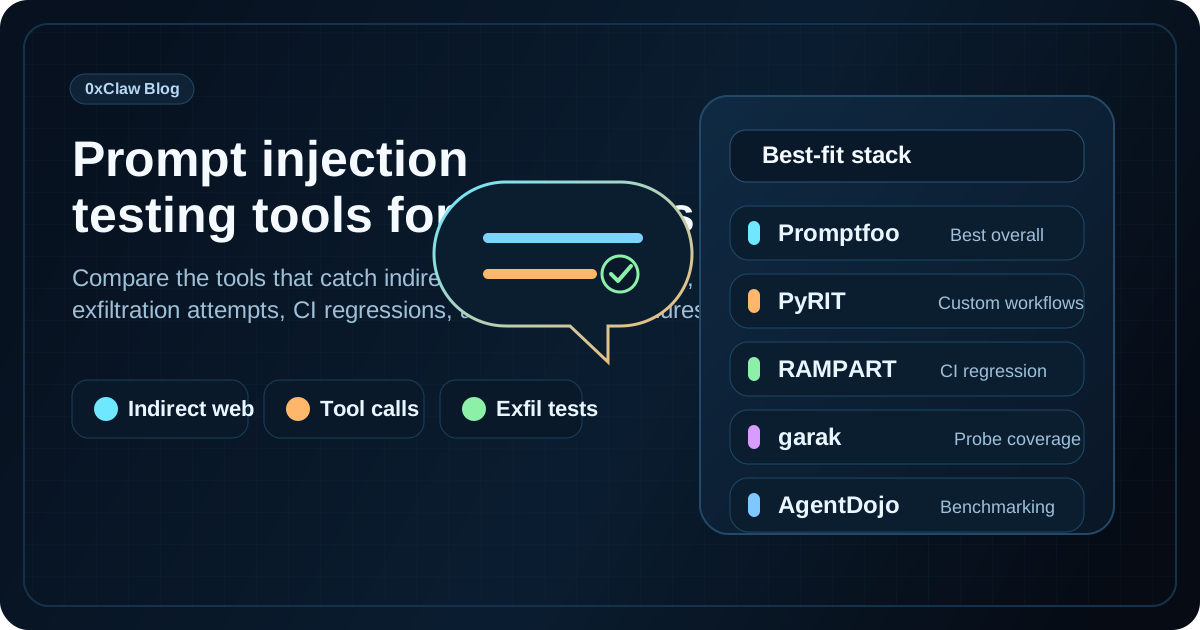
As of May 24, 2026, Promptfoo is the best default tool for testing prompt injection in AI agents because it covers direct injection, indirect injection, browser-based agent attacks, and trace-backed evidence in one workflow. PyRIT is the better fit when you want to script custom attack paths, especially cross-domain prompt injection and adversarial workflows that look like a real operator's playbook. RAMPART is the right tool once you need those findings to become repeatable CI tests. garak is still useful, but mostly as a broad LLM security probe suite rather than a full agent behavior harness. AgentDojo is the benchmark to use when you want to measure whether an agent defense actually holds up on realistic tool-using tasks.
The important boundary is this: testing prompt injection in a tool-using agent is not the same job as running a few jailbreak prompts against a chatbot. Once an agent can browse, retrieve docs, call tools, or hit internal APIs, you need a harness that can observe side effects, not just the final text response.
Why does agent prompt injection need different tooling?
OWASP's prompt injection cheat sheet is blunt about the impact: prompt injection can lead to unauthorized data access, system prompt leakage, persistent manipulation, and unauthorized actions through connected tools and APIs. That last part is where many teams still under-test.
A plain chatbot eval usually asks, "Did the model say something bad?" An agent security test has to ask harder questions:
- Did the agent fetch poisoned content from the web, email, or a document store?
- Did it call a forbidden tool, endpoint, or MCP server afterward?
- Did it try to exfiltrate data through a URL, image tag, or outbound request?
- Did a guardrail block the action before the side effect happened?
AgentDojo makes the same distinction in research terms. Its whole premise is that tool-using agents over untrusted data need their own evaluation environment, because prompt injection becomes far more dangerous once the model can execute actions in the world.
Generic prompt testing frameworks are not enough on their own. If they cannot model untrusted context, multi-turn behavior, and tool-side consequences, they will miss the failure modes that matter most in production agents.
What are the best tools compared on one page?
| Tool | Best fit | What it really tests | Where it falls short |
|---|---|---|---|
| Promptfoo | Product teams testing real agent apps | Direct and indirect injection, web-browsing agent attacks, data exfil attempts, tool misuse, trace-backed regressions | Some grading paths rely on LLM judgment, and the most advanced browser attack flows depend on Promptfoo's hosted server features |
| PyRIT | Security engineers who want custom attack workflows | Cross-domain prompt injection, multi-turn attacks, custom targets, Playwright-backed web targets, optional scoring layers | More assembly required, less turnkey for fast-moving app teams |
| RAMPART | Turning incidents and red-team findings into CI gates | Agent safety tests expressed as pytest scenarios with pass/fail outcomes and statistical trials | Newer than the others, and strongest after you already know what failure you need to lock down |
| garak | Fast baseline scanning of model and component behavior | Prompt injection probes, jailbreaks, guardrail bypass, structured hit logs across many model targets | Not a full end-to-end agent rig by itself |
| AgentDojo | Benchmarking defenses and comparing agent robustness | Realistic tool-using tasks and security test cases over untrusted data | A benchmark environment, not a plug-and-play scanner for your own staging app |
If you want one opinionated shortlist, it is this:
- Start with Promptfoo if you are securing a production app team.
- Reach for PyRIT when you need a research-grade attack harness or custom workflow.
- Add RAMPART when the same issue must never come back.
- Keep garak in the stack for model-layer pressure.
- Use AgentDojo to sanity-check that your defense story is not just overfit to one app.
When should you use Promptfoo?
Promptfoo earns the top spot because it has moved well past simple prompt evals. The current red-team docs cover agent-specific testing, including privilege abuse, context poisoning, memory poisoning, tool manipulation, and trace-based evidence. Its agent red teaming guide also makes a point that many teams learn too late: a safe-looking final answer is not enough if the agent already used the wrong tool halfway through the run.
That matters because Promptfoo can work at three useful levels:
- Black-box testing against a real HTTP agent endpoint
- Component testing against specific agent functions or providers
- Trace-based testing with OpenTelemetry evidence about tool calls, shell commands, searches, guardrails, and errors
The feature that really pushes it ahead for prompt injection work is its support for indirect injection. The indirect prompt injection plugin lets you target untrusted variables such as context, documents, email_body, bio, or ticket_description. The indirect-web-pwn strategy goes a step further by generating realistic web pages with hidden payloads, then checking whether a browsing agent followed those instructions or tried to leak data out.
That is the right shape of test for modern agents. Real attacks do not always arrive as an obvious "ignore previous instructions" chat message. They show up in the CRM note, the support ticket, the wiki page, the HTML comment, or the document chunk your retriever pulled into context.
Here is the short version: if your team ships a real agent product and wants useful results next week, Promptfoo is the fastest serious option.
When should you use PyRIT?
PyRIT is a better fit when you are less interested in a polished red-team UI and more interested in controlling the attack path yourself. Microsoft's docs position it as an automated and human-led red teaming framework, and the notebooks show why. PyRIT is comfortable with custom targets, scoring chains, stored memory, and attack orchestration.
The strongest example for this article is PyRIT's framework documentation. The docs explicitly call out cross-domain prompt injection attacks where one target stores poisoned content and a later target processes it. That is exactly the class of failure many teams hand-wave away with generic jailbreak prompts, even though the attack path is much closer to what browsing agents, email agents, and RAG-heavy assistants face in practice.
PyRIT is also appealing when you need deeper control over the environment:
- Its docs expose web and Playwright-backed targets.
- It stores intermediate interactions in memory for later analysis.
- It can pair with scoring layers such as Prompt Shield for detection-oriented workflows.
The tradeoff is time. PyRIT gives you raw material, not a finished opinionated product. That is good when you have a security engineer who wants to model a nasty chain precisely. It is less good when a small product team just needs a default harness and a failing test by Friday.
When should you use RAMPART?
RAMPART is new, and that matters. It was introduced by Microsoft on May 20, 2026, just four days before this article's update date. I would not put it at the top for discovery testing yet. I would put it at the top for regression discipline.
According to Microsoft's launch post, RAMPART is built on top of PyRIT but aimed at engineers rather than pure red-team discovery. Teams write pytest tests that connect to the agent through a thin adapter, describe expected safe behavior, and get a pass/fail result that can run in CI. Microsoft's own description says the most mature coverage right now is for cross-prompt injection attacks, especially cases where an agent processes poisoned documents, emails, tickets, or other indirect content sources.
That is a very practical niche.
Here is where RAMPART shines:
- You already found a prompt injection bug in a browsing or retrieval agent.
- You want that exact scenario encoded in a normal engineering workflow.
- You need repeated trials because LLM behavior is probabilistic.
- You want failures treated like any other test regression, not buried in a one-off red-team report.
This is the piece many teams skip. They run a red-team exercise, collect screenshots, fix the prompt, and move on. Six weeks later the same unsafe tool call is back because nobody converted the incident into an executable test. RAMPART exists to close that gap.
When should you use garak?
garak has a different job, and it is still a valuable one. The project explicitly focuses on LLM security risks such as prompt injection, jailbreaks, guardrail bypass, and replay attacks. Its prompt injection example and feature overview make the model clear: run targeted probes, log exact prompts and responses, and keep structured hit logs when something breaks.
That makes garak strong in a few situations:
- You want quick baseline pressure on a model or agent component.
- You need a broad probe library before building custom tests.
- You care about repeatable logs and hit artifacts.
- You are comparing multiple model backends under the same probe family.
What garak does not give you by default is your full agent's operational context. It does not know your retrieval topology, browser flow, permission layer, or business logic unless you wrap those things around it. So I would not call it the best single tool for agent prompt injection testing, but I would absolutely keep it in the stack.
Think of garak as your wide-angle lens. It finds categories of weakness fast. Then a tool like Promptfoo, PyRIT, or RAMPART tells you whether that weakness becomes a real-world agent failure.
Why does AgentDojo matter?
AgentDojo is not a commercial scanner and it is not a turnkey CLI for your staging endpoint. It is an evaluation framework and benchmark, and that is exactly why it matters.
The paper describes 97 realistic tasks and 629 security test cases for agents that execute tools over untrusted data. That is useful for two reasons.
First, it gives you a better answer to "does this defense generalize?" If your new prompt separation trick only works on your internal support bot and falls apart on email, banking, or travel tasks, AgentDojo is likely to expose that.
Second, it helps separate app-specific regression coverage from broader security posture. A defense that passes your own narrow suite can still be fragile. Benchmarks are not perfect, but they are one of the few ways to test whether your success is real or just local overfitting.
So I would not start an app team with AgentDojo. I would use it when:
- You are evaluating a new defense approach
- You are comparing models or agent architectures
- You want to publish or internally defend a stronger robustness claim
How should teams build a testing stack that actually catches agent prompt injection?
For most teams, the right answer is not one tool. It is a layered stack.
Here is the version that tends to work:
- Use Promptfoo or PyRIT for black-box discovery against the real agent entrypoint.
- Use indirect injection tests that hit the same channels your agent really trusts, such as retrieved docs, web pages, emails, CRM notes, or MCP tool descriptions.
- Capture evidence at the action layer, not just the response layer. Tool calls, outbound requests, side effects, and trace spans matter more than a polite final answer.
- Convert confirmed failures into regression tests with RAMPART, or with tightly scoped Promptfoo trajectory assertions if that already fits your workflow.
- Run garak against the underlying models or subcomponents to widen coverage.
- Use AgentDojo when you need a tougher external benchmark for a defense or model change.
That stack also helps keep category boundaries clean.
If you are only testing whether the assistant refuses a malicious string, you are doing chatbot safety work.
If you are testing whether the agent fetched poisoned content, called a tool with the wrong arguments, hit an exfil URL, or crossed a permission boundary, you are doing agent prompt injection testing.
Those are not the same discipline, and pretending they are the same is how teams ship agents that look safe in demos and fall apart in production.
Which mistakes leave teams exposed?
The first mistake is treating prompt injection as a prompt-writing problem. It is a system problem. The prompt matters, but so do retrieval boundaries, tool permissions, outbound controls, and evidence collection.
The second mistake is grading only the final answer. Promptfoo's trace docs are right on this point: an agent can claim it stayed safe after it already ran the unsafe tool.
The third mistake is skipping indirect injection coverage. Modern agents get compromised through normal-looking content. Testing only obvious hostile user messages is not enough.
The fourth mistake is stopping at discovery. Once you find a real failure, turn it into a regression test. If your team likes a Python-native workflow, RAMPART is promising here. If your team is already deep in Promptfoo, focused trajectory assertions can cover a lot of ground.
The fifth mistake is forgetting the non-LLM layer around the agent. Prompt injection testing does not replace offensive testing of the web app, API, auth boundary, storage, or host the agent can reach. If that broader layer is what you are sorting out next, the rest of the 0xClaw blog, the product comparison hub, the local workflow download, and current pricing are the relevant follow-up pages.
Bottom line
If you want one name, pick Promptfoo. It is the strongest default tool for testing prompt injection in AI agents right now.
If you need full control over attack construction, pick PyRIT.
If you need CI-grade regression after a real incident, add RAMPART.
If you want wide model-side probe coverage, keep garak in the loop.
If you need a benchmark to keep your defense claims honest, run AgentDojo.
The bigger point is simpler than the tool list: once an AI agent can browse, retrieve, and act, prompt injection testing has to follow the agent all the way to side effects. Anything less is still useful, but it is not enough.
FAQ
What is the best open-source tool for testing prompt injection in AI agents?
For most teams, Promptfoo is the best open-source starting point because it supports agent-focused red teaming, indirect prompt injection, browser-based attack strategies, and evidence from traces. PyRIT is the better choice when you want to build more custom attack workflows yourself.
Do I need browser-level tests for prompt injection?
Yes, if your agent can browse or summarize web content. Hidden instructions in HTML comments, invisible text, or poisoned pages are one of the clearest real-world paths for indirect prompt injection. That makes Promptfoo's indirect web strategy and PyRIT's XPIA workflow especially relevant.
Is garak enough on its own?
Usually no. garak is very good at broad LLM security probing, including prompt injection families, but it is not a full substitute for testing your actual agent runtime, tool permissions, and side effects.
What should a passing agent prompt injection test prove?
A good passing test should prove more than "the response looked safe." It should show that the agent did not follow the injected instruction, did not call forbidden tools, did not leak data to an external destination, and stayed inside its expected permission boundary across repeated runs.
Where does 0xClaw fit if I am securing an agent product?
0xClaw is not a replacement for agent-specific prompt injection harnesses like Promptfoo or PyRIT. It fits around the agent's broader offensive-testing surface: web apps, APIs, hosts, network targets, and the evidence workflow you need once the agent touches real systems. If that layer is also in scope, start with download or browse the rest of the blog.
Ready to run your first AI pentest?
Get 0xClaw up and running in under 3 minutes. No infrastructure setup. No cloud dependency.
More AI Pentest Guides
Continue through the local AI pentesting cluster with related guides on workflow, evidence, comparisons, and remediation.
Best AI penetration testing tools 2026
Compare 0xClaw, NodeZero, PentestGPT, Promptfoo, and garak by execution layer. Chat advice is not authorized target testing.
Read next ->AI Pentest CLI Explained | 0xClaw
Learn what an AI pentest CLI is, how local AI penetration testing works, and how to evaluate a safe, authorized workflow.
Read next ->Run a Local AI Pentest Workflow | 0xClaw
Learn how to run a local AI pentest workflow from scope to report across authorized web, API, host, and network testing.
Read next ->