
Best Prompt Injection Tools for APIs | 0xClaw
Compare the best tools for testing prompt injection in APIs, including Promptfoo, PyRIT, garak, and proxy-driven workflows for AI API security testing.
Compare the best tools for testing prompt injection in APIs, including Promptfoo, PyRIT, garak, and proxy-driven workflows for AI API security testing.
- Best Prompt Injection Tools for APIs | 0xClaw should explain infrastructure choices in a way that is easy to quote, compare, and operationalize.
- Tie architecture explanations back to how local execution, governance, and evidence handling work in practice.
- Use official docs plus product pages so the page can rank for definitions and support AI citation.
Quick answer: which tool is best for testing prompt injection in APIs?
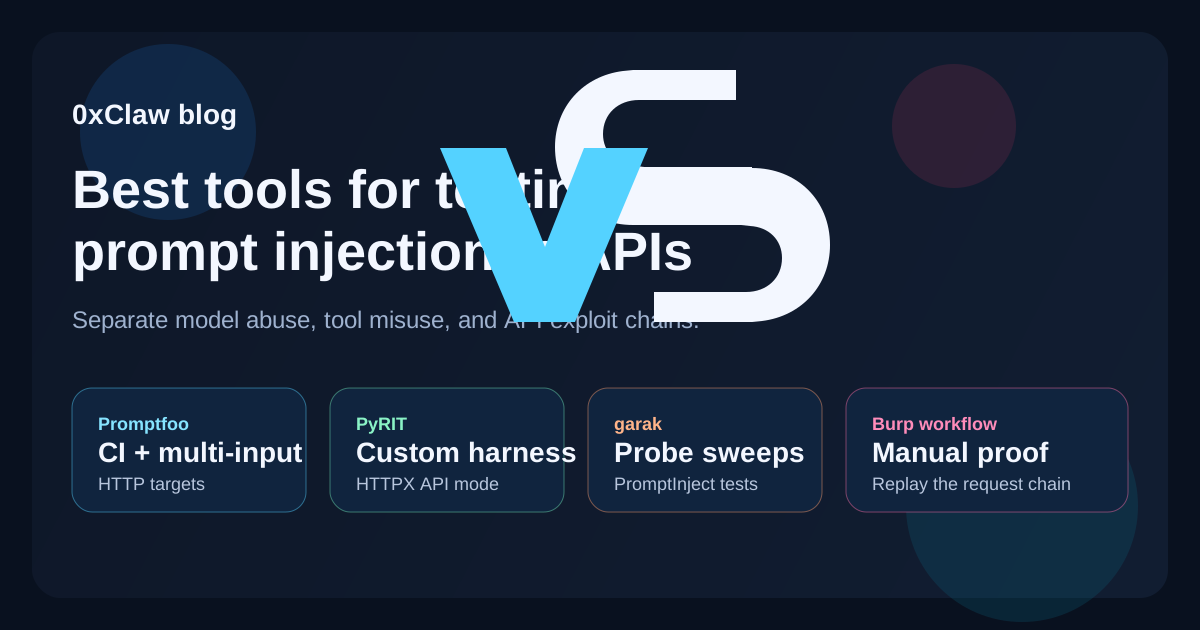
For most teams, Promptfoo is the best tool for testing prompt injection in APIs because it can hit HTTP endpoints directly, generate red-team cases, and model multi-input attacks that look like real production abuse. If you need a more programmable harness with custom targets, attack orchestration, and scoring, Microsoft PyRIT is the better fit. If you want broad model-side probe coverage and fast baseline sweeps, garak is useful. If you are chasing a real exploit chain through a live application, you still want Burp Suite or an equivalent proxy workflow beside the LLM-specific tools.
That split matters because prompt injection testing for APIs is not the same job as generic REST fuzzing. You are testing whether attacker-controlled content can bend model behavior, change tool use, leak system prompts, trigger unsafe API calls, or pivot into classic bugs through the LLM layer. OWASP's LLM01:2025 Prompt Injection and its prompt injection prevention cheat sheet both center that risk around unauthorized actions, exfiltration, and tool misuse, which is exactly why ordinary endpoint scanners are not enough here. If you are comparing broader offensive-testing stacks around AI apps, start with /compare. If you want a local operator workflow for surrounding web and API surfaces, see /download and /pricing.
Why API prompt injection testing is its own category
A lot of teams still approach this like old-school API security with a new payload list. That misses the real problem.
Classic API testing asks questions like:
- Can I break input validation?
- Can I bypass auth?
- Can I trigger SSRF, SQL injection, or command injection?
Prompt injection testing asks a different set:
- Can untrusted text change the model's behavior?
- Can the model be talked into using the wrong API or the right API with the wrong arguments?
- Can indirect content from documents, email, CRM notes, or upstream APIs smuggle instructions into the reasoning loop?
- Can prompt manipulation chain into a normal application bug that the model then reaches for me?
That last point is where things get ugly. PortSwigger's Web LLM attacks and LLM API lab show both indirect prompt injection through API-delivered content and exploit chains where an LLM can be pushed into abusing an exposed downstream API. The test surface is no longer just POST /chat. It is the full path from untrusted content, to prompt assembly, to tool selection, to the final API call.
The better tools in this category do more than fire payloads. They understand conversational context, multi-turn state, structured API requests, and model behavior under adversarial input.
What the best prompt injection testing tool needs to do
Before you pick a tool, check whether it can handle the attack you actually care about. A decent API prompt injection tool should cover four jobs.
1. Hit real API targets
The tool needs to send requests to the same HTTP endpoints your app uses, or to a faithful test harness in front of them. If it only talks directly to a base model, it is good for model behavior checks but weak for application-layer abuse cases.
2. Model indirect and multi-input attacks
Prompt injection is often not a single text box problem. Promptfoo's own multi-input tutorial uses an invoice workflow where the attacker controls both vendor_id and description. That is much closer to production than a toy "ignore previous instructions" string.
3. Preserve evidence
You need prompts, API inputs, responses, and a clear record of what the model attempted to do. If the tool only gives you a pass-fail score, it is fine for rough CI gates and weak for security review.
4. Separate model weakness from app weakness
This is the part most tool roundups blur. A tool can be good at finding prompt-following failures and still be bad at proving authorization abuse through a live API chain. You want coverage across both layers, but you should not confuse them.
Best tools for testing prompt injection in APIs compared
| Tool | Best for | API testing depth | Strength | Limitation |
|---|---|---|---|---|
| Promptfoo | Most teams and CI pipelines | Strong | Direct HTTP targeting, red-team plugins, multi-input workflows | Less flexible than a fully custom harness for oddball targets |
| PyRIT | Custom attack harnesses and security research | Strong | HTTP targets, attack orchestration, scoring, memory | More setup and engineering effort |
| garak | Model-side baseline scans | Medium | Large probe library, quick sweeps, good for regression baselines | Not built around full business-flow API abuse |
| Burp Suite plus manual replay | Live exploit chains and edge cases | Strong | Best for seeing the actual request path and proving impact | Manual effort; no built-in LLM attack orchestration |
If you only want one answer, pick Promptfoo first. If your environment is weird, your targets are custom, or you need to stitch attacks into a more programmable lab, use PyRIT. If you want a fast sanity pass on model susceptibility, add garak. If a finding matters, validate it through a proxy-based manual path before you ship the report.
Promptfoo is the best default choice for most teams
Promptfoo has the most practical starting point for API-connected AI systems. Its red-team quickstart is explicit that it can test through HTTP APIs, and its docs say it can hook into LLM apps through Python, JavaScript, RAG or agent workflows, and direct HTTP requests. That matters because many production AI systems are bigger than "send one prompt to one model." They wrap models with session state, tool calls, retrieval, validation layers, and application logic.
The bigger reason I rate Promptfoo first is its multi-input support. The multi-input tutorial is one of the clearest examples of real prompt injection testing against an API-backed app: an attacker can combine a trusted-looking identifier with malicious free text to push an AI invoice workflow into the wrong decision. That is exactly the kind of attack generic LLM eval tools often miss.
Use Promptfoo when:
- Your AI system exposes an HTTP API.
- You want repeatable prompt injection tests in CI.
- You need to test more than one attacker-controlled field.
- You want readable config files instead of building a harness from scratch.
- You care about regression testing after a fix.
Promptfoo is especially strong when security and engineering need to share the same test artifact. The YAML is understandable. The target shape is explicit. The test can move from "red team experiment" to "permanent regression check" without a rewrite.
PyRIT is the best choice when you need a programmable attack harness
PyRIT is what I reach for when the app under test does not fit cleanly inside someone else's opinionated workflow. Microsoft's docs frame it as a red-teaming framework with attacks, targets, converters, scoring, memory, and scenario support. More importantly for API work, PyRIT supports HTTP endpoints and exposes an HTTPXAPITarget that is built for API mode with JSON, form data, file uploads, and headers.
That makes PyRIT a serious tool for cases like:
- Multi-step agent APIs with session state.
- File or document ingestion flows that can carry indirect prompt injection.
- Attack chains where you need custom scoring logic.
- Labs where you want to compare several models or guardrails against the same target.
- Security research that needs more control than a config-first product gives you.
The tradeoff is obvious: you will do more engineering. Promptfoo is easier to hand to a product team. PyRIT is better when a security engineer wants to instrument the whole pipeline, not just fire a stock plugin pack at it.
If your API attack surface includes uploads, hidden metadata, or document-driven workflows, PyRIT's target model is a better fit than tools that assume every attack is plain text sent to a chat endpoint.
garak is good for baseline coverage, but it is not enough on its own
garak remains useful because it gives you fast probe coverage against model behavior. Its prompt injection example shows the built-in PromptInject probe family and makes it easy to run a sweep against a target model. That is valuable when you want to answer a narrow question fast: "Does this model or wrapper still fall for known prompt injection patterns?"
Where garak helps:
- Establishing a baseline before deeper testing.
- Comparing behavior across models or releases.
- Catching obvious regressions after prompt or guardrail changes.
- Adding a lightweight model-focused check to a broader test stack.
Where garak falls short:
- It does not understand your business workflow by default.
- It will not prove a cross-field authorization-plus-injection flaw the way a purpose-built API harness can.
- It is weaker for end-to-end evidence around live application abuse.
So yes, use garak. Just do not stop there and tell yourself you tested the API. You tested a model-facing slice of the problem.
Burp and proxy-based replay still matter
The LLM-native tools are better than they were a year ago, but none of them replace a proxy when you need to prove exploitability.
PortSwigger's Web Security Academy material is a good reminder of why. Their LLM API labs focus on mapping what APIs the model can reach, then pushing that path until it does something unsafe. In one example, the attacker first proves the model can drive a newsletter API, then escalates to command injection by passing shell syntax through the LLM-mediated call chain.
That is the part glossy tool roundups skip: sometimes the only honest way to validate a prompt injection issue is to watch the exact HTTP requests, replay them, tweak them, and confirm what changed. Burp Repeater, Intruder, or an equivalent proxy workflow is still the fastest route for:
- Verifying the final API call the model actually made.
- Separating prompt manipulation from downstream injection.
- Capturing evidence that engineering can reproduce.
- Checking whether an apparent LLM issue is really a broken backend control.
If the finding is high impact, do not ship a report that only says "the eval failed." Show the request chain.
A practical testing stack for real API-connected AI systems
Most teams should not bet on one tool. They should use a stack.
Here is the stack I recommend for AI API security testing:
- Start with Promptfoo for direct and indirect prompt injection coverage against real HTTP targets.
- Add garak for broad model-side probe coverage and cheap regression sweeps.
- Use PyRIT when the target has custom state, uploads, or a non-standard workflow that needs a programmable harness.
- Validate important findings with Burp or another proxy so you can prove the final request path and impact.
That stack keeps the category boundaries clean. Prompt injection testing for APIs is about instruction smuggling, model steering, unsafe tool use, and cross-boundary abuse. Generic REST fuzzing still matters, but it solves a different problem. You still need your usual API auth, BOLA, SSRF, and injection coverage on the endpoints themselves.
For broader offensive-testing guidance beyond the model layer, browse more workflow content on /blog. If you are deciding between tool categories rather than individual products, the comparison hub at /compare is the better next stop. For a head-to-head look at where garak-style model scanners stop and a target-layer workflow starts, see Garak vs 0xClaw.
Where 0xClaw fits in this workflow
0xClaw is not trying to be a pure prompt injection scanner. It fits one layer out from that.
If your system under test is an AI application with real surrounding attack surface, you still need to test the ordinary web and API plumbing around it: authorization, exposed admin routes, insecure upload paths, webhook misuse, internal API reachability, and exploit chaining once the model is tricked into the wrong action. That is where a broader offensive-testing workflow matters.
So the honest stack looks like this:
- Use Promptfoo or PyRIT to test prompt injection and unsafe model-mediated API behavior.
- Use garak to keep broad model-side checks cheap.
- Use Burp to validate exploit chains.
- Use 0xClaw when you need a local, operator-visible workflow around the rest of the application and API attack surface.
That is also why you should be skeptical of tools that claim to "cover AI API security" with one dashboard. They usually mean one slice.
FAQ: best tools for testing prompt injection in APIs
Is prompt injection testing the same as API fuzzing?
No. API fuzzing looks for parser and validation failures in the endpoint itself. Prompt injection testing checks whether attacker-controlled content can change model behavior, influence tool selection, or trigger unsafe downstream API calls. You often need both.
Which tool is best for CI regression testing?
Promptfoo is the best default for CI because it already treats red-team cases as repeatable tests against HTTP targets and multi-input workflows. garak also works well as a lightweight regression layer, but it is narrower.
Which tool is best for custom agent or document workflows?
PyRIT is the best fit when the target has custom orchestration, uploads, or odd request shaping. Its HTTP target model and programmable framework make it more flexible than config-first tools.
Can I test prompt injection in APIs with Postman alone?
You can send requests with Postman, but you will miss the model-aware parts unless you build a lot of custom logic around it. Postman is fine for endpoint validation. It is not a strong dedicated prompt injection testing tool.
Do I still need manual testing if the automated tools pass?
Yes. Automated tools are good at scale and regression. Manual testing is still better for weird exploit chains, business-logic abuse, and proving the final impact through the live request path.
Bottom line
If you want one recommendation, start with Promptfoo. It is the best mix of real API targeting, multi-input attack coverage, and team-friendly regression testing. Add PyRIT when your workflow is more custom than a config file can handle. Add garak when you want cheap model-side sweeps. Keep Burp nearby, because the final proof usually lives in the request chain, not the pretty report.
The mistake to avoid is category drift. Prompt injection testing for APIs is about how untrusted content changes model-driven behavior around connected systems. It is a different job from a REST scan with a new payload wordlist.
Ready to run your first AI pentest?
Get 0xClaw up and running in under 3 minutes. No infrastructure setup. No cloud dependency.
More AI Pentest Guides
Continue through the local AI pentesting cluster with related guides on workflow, evidence, comparisons, and remediation.
Best AI penetration testing tools 2026
Compare 0xClaw, NodeZero, PentestGPT, Promptfoo, and garak by execution layer. Chat advice is not authorized target testing.
Read next ->AI Pentest CLI Explained | 0xClaw
Learn what an AI pentest CLI is, how local AI penetration testing works, and how to evaluate a safe, authorized workflow.
Read next ->Run a Local AI Pentest Workflow | 0xClaw
Learn how to run a local AI pentest workflow from scope to report across authorized web, API, host, and network testing.
Read next ->