
Best Prompt Injection Tools for MCP | 0xClaw
Compare the best tools for testing prompt injection in MCP servers, including Promptfoo, MCP Inspector, PyRIT, RAMPART, garak, and AgentDojo.
Compare the best tools for testing prompt injection in MCP servers, including Promptfoo, MCP Inspector, PyRIT, RAMPART, garak, and AgentDojo.
- Best Prompt Injection Tools for MCP | 0xClaw should explain infrastructure choices in a way that is easy to quote, compare, and operationalize.
- Tie architecture explanations back to how local execution, governance, and evidence handling work in practice.
- Use official docs plus product pages so the page can rank for definitions and support AI citation.
Quick answer
As of May 24, 2026, Promptfoo is the best default tool for testing prompt injection in MCP servers because it can target the server itself, cover both local and remote MCP deployments, and probe MCP-specific failures such as hidden tool discovery, parameter injection, unauthorized tool invocation, and tool metadata injection. If I had to build a serious stack instead of pick a single logo, I would pair Promptfoo with MCP Inspector. Promptfoo finds the attack path. Inspector shows the transport, tool schema, prompt template, resource metadata, and raw execution results you need to verify what actually happened.
Then I would add PyRIT for custom poisoned-content workflows, RAMPART for CI regression after a real finding, garak for broad model-side probe coverage, and AgentDojo when I want to test whether a defense generalizes beyond one server. That layered answer is less tidy than a one-tool recommendation, but it is the honest one for MCP work.
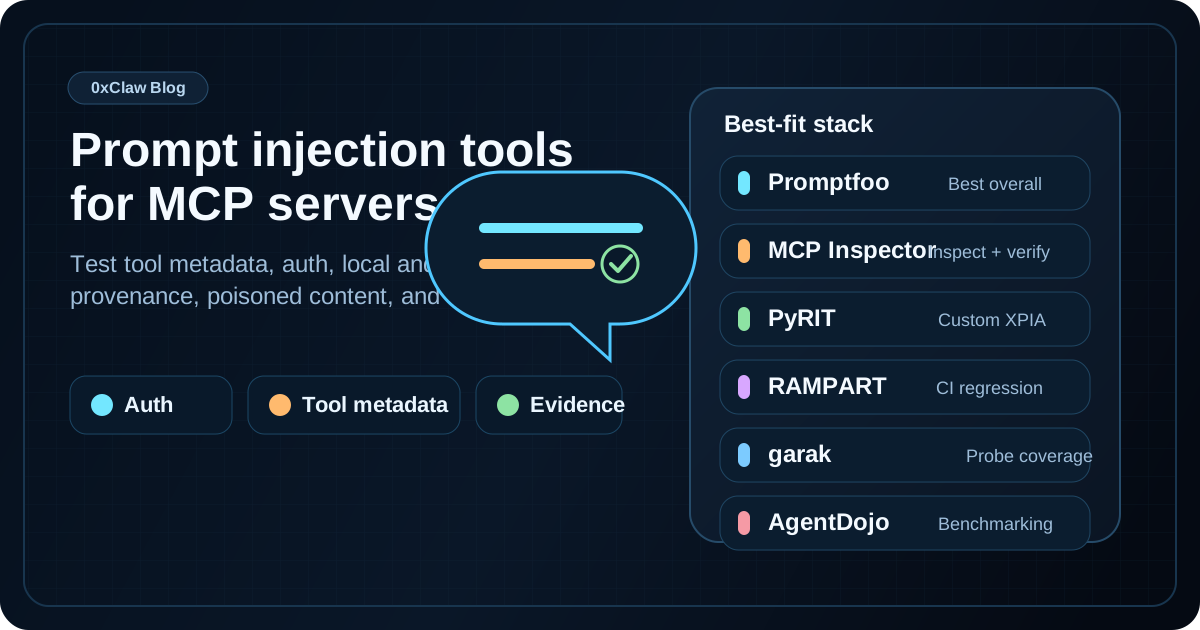
If you want the shortlist at a glance, the one-page map in this SVG matches the comparison table below.
Why MCP prompt injection needs a different tool stack
Testing prompt injection in an MCP server is not the same job as jailbreaking a chatbot. MCP adds a protocol layer, a tool layer, and usually an auth layer. That changes what "success" looks like for an attacker.
The official MCP security best practices are blunt about the risks. They call out token passthrough as forbidden, warn that OAuth metadata discovery can become SSRF, describe session hijack prompt injection, and spend a long section on local MCP server compromise. That is not abstract policy language. It is a threat model.
This is why generic prompt-eval tooling often feels thin on MCP systems. You need to answer questions like these:
- Can poisoned tool descriptions or resource content steer the model into a bad call?
- Can a remote server smuggle unsafe URLs into auth discovery or metadata fetches?
- Can a local server hide a risky startup command or broader filesystem access than the user expected?
- Can a server with good provenance still expose dangerous tool metadata or sloppy authorization?
- Do you have evidence from the action layer, not just the final text reply?
Provenance matters here too. The official MCP Registry says namespace authentication ties published server names to verified GitHub accounts or domains, but it also says the registry delegates code scanning to package registries and downstream aggregators. That means "authentic" is not the same thing as "safe." Your testing stack has to check both.
If you want background before the tooling comparison, start with what MCP is. If you are already thinking about evidence and remediation, this MCP pentest report template is the right companion piece.
What are the best tools compared on one page?
| Tool | Best fit | What it really helps you test in MCP | Where it falls short |
|---|---|---|---|
| Promptfoo | Best overall starting point | Local and remote server targeting, MCP-specific attack prompts, hidden tool discovery, parameter injection, tool metadata injection, unauthorized tool invocation, evidence on attack success | It still benefits from a second tool for deep protocol inspection |
| MCP Inspector | Best for inspection and verification | Transport behavior, capability negotiation, resource metadata, prompt templates, tool schemas, custom inputs, raw tool execution results | It is an inspection tool, not a full adversarial harness |
| PyRIT | Best for custom indirect injection workflows | Cross-domain prompt injection, poisoned HTML or document flows, multi-step attack chains that look like real operator behavior | More assembly, less turnkey coverage for app teams |
| RAMPART | Best for regression | Reproducing findings as pytest tests, repeated trials for probabilistic behavior, pass/fail gates in CI | Newer, and strongest after discovery rather than before it |
| garak | Best for quick baseline pressure | Prompt injection probe families, repeatable logs, fast model or component checks around the MCP workflow | Not a full MCP runtime harness on its own |
| AgentDojo | Best benchmark | Whether your defense survives realistic tool-using prompt injection tasks beyond your own lab setup | Benchmark, not a direct scanner for your server |
The practical stack looks like this. Use Promptfoo to attack the system, Inspector to understand the system, PyRIT when you need to script a nastier chain, RAMPART to keep a fixed bug fixed, garak to widen probe coverage, and AgentDojo to keep your claims honest.
When Promptfoo is the right first choice
Promptfoo deserves the top spot because it is not just "LLM eval tooling with an MCP bullet on the pricing page." Its current MCP provider docs say the MCP provider treats the MCP server itself as the target system under test. The same docs also show both command-based local servers and URL-based remote servers, which is exactly the split you need in real MCP deployments.
The more interesting piece is the MCP red-team plugin. Promptfoo documents attack vectors that map closely to real MCP abuse paths: hidden function discovery, parameter injection, unauthorized function calls, function output manipulation, and tool metadata injection through names or descriptions. That last one matters more than many teams admit. Tool poisoning in MCP often starts as metadata poisoning.
Promptfoo is also good at category hygiene. Its docs recommend pairing the MCP plugin with pii, bfla, bola, and sql-injection. That is a useful reminder that MCP prompt injection is rarely just a prompt problem. The model can be socially engineered into calling a tool, but the real damage often depends on function-level auth, object-level auth, or sloppy parameter handling after the call.
I would start with Promptfoo when:
- You have an MCP server running already, locally or remotely.
- You want failing tests this week, not a research project next month.
- You need evidence that a prompt actually led to hidden tool discovery, unauthorized invocation, or leaked system details.
- You want one config that can grow into broader red-team coverage.
It is not perfect. Some teams still need a deeper protocol microscope right after a failure. That is where Inspector earns its keep.
Why MCP Inspector is more important than people think
MCP Inspector is not the flashy answer, but it is probably the most underused tool in this category. The official docs describe it as an interactive developer tool for testing and debugging MCP servers. More importantly, the feature list is exactly what prompt injection investigations need.
Inspector lets you:
- choose the transport used to connect to the server
- customize command-line arguments and environment for local servers
- inspect resource metadata and content
- inspect prompt templates and their arguments
- inspect tool schemas and descriptions
- execute tools with custom inputs and view results
- monitor notifications and message logs
That set of capabilities matters because many MCP prompt injection bugs are half protocol bug and half product bug. Maybe the model followed a poisoned tool description. Maybe the server exposed a broader schema than you thought. Maybe the resource looked harmless in the UI but carried a hidden instruction in the raw content. Maybe the prompt template itself invited the model to over-trust tool output. Inspector helps you separate those cases.
It is also the quickest way to review local-versus-remote behavior. The docs show both local repository launches and packaged servers from npm or PyPI. For infrastructure teams, that is useful on day one. You can look at a community server's actual tools and prompts before you ever give it production traffic.
If your workflow includes community or marketplace servers, pair Inspector with a provenance check. The MCP Registry gives you namespace authenticity and standardized metadata, but it explicitly leaves code scanning to package registries and downstream aggregators. I would treat Inspector as the next step after provenance, not a substitute for it.
When PyRIT is the better choice
PyRIT is the tool I would reach for when the prompt injection path does not look like a toy. Its framework docs are still one of the clearest public references for the problem. Microsoft explicitly calls out cross-domain prompt injection attacks where an attacker plants poisoned content and a later target processes it.
That pattern maps neatly onto MCP systems because the instruction carrier does not have to be a website. It could be a resource returned by a remote MCP server. It could be a document fetched through a retrieval tool. It could be a ticket body or a prompt template with attacker-controlled arguments. If you need to model those paths precisely, PyRIT gives you more room than a turnkey red-team UI.
PyRIT is a better fit when:
- you need a custom poisoned-content workflow
- you care about intermediate interactions, not just final output
- your team wants to chain together multiple steps and custom scoring
- you want to approximate how a real operator would stage the attack
The cost is obvious. You trade speed for control. Small product teams usually do not need that on day one. Security engineers and red teams often do.
When RAMPART earns a permanent place in the stack
RAMPART is too new to be the first thing I would hand a team for discovery. Microsoft introduced it on May 20, 2026, and the launch post is explicit about the intended job: encode adversarial and benign scenarios as repeatable tests that can run in CI. That is a different job from exploratory red teaming.
The interesting part is how directly Microsoft frames it around prompt injection. The same post says RAMPART's most mature coverage today focuses on cross-prompt injection attacks and that findings from red-team exercises should become runnable engineering assets. That is the right instinct.
If you already found an MCP prompt injection bug, RAMPART is where discipline starts:
- Turn the incident into a pytest scenario.
- Run it across repeated trials instead of trusting one lucky green run.
- Fail the build if the agent slips back into the bad behavior.
- Add a second test when a new tool or data source enters the system.
I like that the Microsoft post treats side effects as first-class evidence. The tool is built around what the agent actually did, not what it claimed after the fact. That matches the real problem in MCP servers. A server can look polite in the final response after it already called the wrong tool.
Where garak still helps
garak is not a full MCP server test rig, and pretending otherwise would be sloppy. What it does give you is cheap pressure. The prompt injection example shows the PromptInject probe family, and the broader garak docs position the project as a way to find weaknesses that are specific to LLM deployments.
That makes garak useful in a few narrow, practical cases:
- comparing multiple model backends behind the same MCP workflow
- checking whether a policy or system prompt change made the model easier to steer
- widening coverage before you write more expensive scenario tests
- generating logs that help you decide where to spend human time next
I would use garak before or alongside Promptfoo, not instead of it. garak tells you whether the model layer looks soft. Promptfoo, Inspector, or PyRIT tell you whether that softness turns into a real MCP failure.
Why AgentDojo is still worth your time
AgentDojo is not a scanner for your staging endpoint. That is exactly why it matters. The paper describes 97 realistic tasks and 629 security test cases for agents that execute tools over untrusted data. The value is not convenience. The value is distance from your own assumptions.
Teams overfit their defenses all the time. They fix the bug they saw once, then write a test so close to the incident that the green result stops meaning much. AgentDojo gives you a harder question: does your approach still work when the tool-using environment changes?
For MCP teams, I would use AgentDojo when:
- you are evaluating a defense pattern, not just one server bug
- you want to compare models or orchestration strategies
- you are about to claim that your tool poisoning or indirect injection defense generalizes
That last point matters for buyers too. If a vendor says they "solve prompt injection for agents," I would want to know whether that statement survives anything like AgentDojo before I believed it.
If the bigger vendor-evaluation question is on your desk, this MCP vendor guide is the next read.
What should a passing MCP prompt injection test actually prove?
A good MCP prompt injection test should prove more than "the assistant refused." That is table stakes.
The useful checks are these:
- The model did not follow the injected instruction in resource content, tool metadata, or prompt arguments.
- The server did not expose hidden tools, broader schemas, or unsafe outputs because of the attack.
- The agent did not invoke a forbidden tool, call an over-scoped function, or forward the wrong token.
- The workflow did not exfiltrate data through a URL, tool response, or auth-discovery side path.
- The result is backed by replayable evidence, such as message logs, tool-call results, request traces, or repeated statistical trials.
For MCP, auth is part of prompt injection testing whether people like it or not. The official security guidance spends real time on token passthrough, scope minimization, and session verification because those boundaries decide how much damage a poisoned instruction can cause. If you are only testing text behavior, you are leaving the important half untouched.
That is also why infrastructure teams should keep their tool chain layered. If the broader attack surface around the server matters too, the rest of the blog, the compare hub, the local workflow download, and current pricing pages are the next places to look.
FAQ
What is the best open-source tool for testing prompt injection in MCP servers?
For most teams, Promptfoo is the best open-source starting point because it now has an MCP provider that targets the server directly and an MCP red-team plugin that covers discovery, parameter injection, metadata injection, and unauthorized tool use. It is the fastest serious option for real MCP systems.
Can I test MCP prompt injection with only jailbreak prompts?
Usually no. MCP prompt injection often arrives through tool descriptions, resources, prompt templates, retrieved documents, auth metadata, or local server setup flows. Chat-box jailbreak prompts only cover one slice of the problem.
Do local MCP servers need different tests than remote ones?
Yes. Remote servers raise auth, transport, and metadata-fetch issues. Local servers add startup commands, filesystem reach, localhost exposure, and workstation trust. The MCP security docs treat local server compromise as its own class for a reason.
Does registry verification make an MCP server safe?
No. Registry verification helps prove who published the metadata. The official registry docs also say code scanning is delegated to package registries and downstream aggregators. Authenticity is useful. It is not the same as runtime safety.
What is the best pair of tools if I only have time for two?
Use Promptfoo and MCP Inspector. Promptfoo finds the prompt injection path. Inspector helps you verify the tool schema, metadata, prompt, resource content, and execution result that made the failure possible.
Bottom line
If I had to name one tool, I would name Promptfoo.
If I had to pick the most practical pair, I would pick Promptfoo plus MCP Inspector.
If I needed a mature stack for an infrastructure team running real MCP servers, I would add PyRIT for custom poisoned-content flows, RAMPART for regression, garak for cheap baseline pressure, and AgentDojo for harder benchmark work.
That stack is less marketable than a single winner, but it lines up with how MCP systems actually fail. Prompt injection in MCP is tied to auth, tool metadata, server provenance, local-versus-remote runtime behavior, and evidence quality after the call. Pick tools that let you see all of that. Otherwise you are testing the prompt and missing the server.
Ready to run your first AI pentest?
Get 0xClaw up and running in under 3 minutes. No infrastructure setup. No cloud dependency.
More AI Pentest Guides
Continue through the local AI pentesting cluster with related guides on workflow, evidence, comparisons, and remediation.
Best AI penetration testing tools 2026
Compare 0xClaw, NodeZero, PentestGPT, Promptfoo, and garak by execution layer. Chat advice is not authorized target testing.
Read next ->AI Pentest CLI Explained | 0xClaw
Learn what an AI pentest CLI is, how local AI penetration testing works, and how to evaluate a safe, authorized workflow.
Read next ->Run a Local AI Pentest Workflow | 0xClaw
Learn how to run a local AI pentest workflow from scope to report across authorized web, API, host, and network testing.
Read next ->