
MCP Server Vendor Guide | 0xClaw
Use this MCP vendor guide to compare testing depth, auth design, prompt injection coverage, evidence quality, and proof-of-concept rigor.
Use this MCP vendor guide to compare testing depth, auth design, prompt injection coverage, evidence quality, and proof-of-concept rigor.
- MCP Server Vendor Guide | 0xClaw should explain infrastructure choices in a way that is easy to quote, compare, and operationalize.
- Tie architecture explanations back to how local execution, governance, and evidence handling work in practice.
- Use official docs plus product pages so the page can rank for definitions and support AI citation.
Quick answer: how should you evaluate an AI pentesting vendor for MCP servers?
Use a scorecard, not a sales demo. A credible AI pentesting vendor for MCP servers should be able to test five things clearly: the server's auth model, prompt injection and tool poisoning paths, local and remote runtime exposure, least-privilege controls, and evidence quality after the finding is discovered. If the vendor cannot show how they test token audience validation, scope minimization, malicious tool metadata, unsafe local server startup, and retest workflow, you are probably buying generic AppSec wrapped in MCP language.
The shortest buying rule is this: prefer vendors that can show a repeatable attack path, a bounded proof-of-concept, and replayable evidence over vendors that mostly talk about "agent security" in the abstract.
If you want the protocol background first, read what MCP is. If you already know you are comparing security tooling, the broader comparison hub gives the category context around local workflows, platforms, and adjacent products.
Why MCP server vendor evaluation is different
MCP changed the shape of the problem. A normal web application pentest asks familiar questions: can an attacker break auth, reach internal services, steal data, or escalate privileges? An MCP security review still asks those questions, but it adds a second layer: what happens when a model can invoke tools, read resources, chain calls, and act on untrusted instructions flowing through that tool layer?
That is why the buying process needs its own rubric. Some vendors are strong at infrastructure and application pentesting but thin on agent-specific abuse paths. Some understand prompt injection and agent misuse but do not have a disciplined testing workflow for auth boundaries, transport exposure, or privileged tool handlers. Some are really selling advisory workshops, not adversarial testing.
Anthropic's introduction to MCP frames the protocol as a standard way to connect models to tools and data. That is useful context, but it is not a security guarantee. OpenAI's MCP guidance is more blunt: custom MCP servers are third-party services, prompt injection can drive unintended tool use, and a malicious or careless server can become a path for data exfiltration. OpenAI also recommends using official servers hosted by the provider when possible instead of unofficial lookalikes. The official MCP Security Best Practices page goes even further by calling out token passthrough, SSRF, insecure local servers, consent failures, and over-broad scopes.
So the evaluation question is not "Does this vendor understand MCP?" Almost everyone will say yes in 2026. The real question is whether they understand how protocol, runtime, model behavior, and operational controls fail together.
What a credible MCP pentest vendor should actually test
An MCP engagement should feel like a structured red-team exercise, not a checklist review. NIST's AI 100-2e2025 publication is a useful anchor here because it treats adversarial AI testing as a discipline with defined attack classes and mitigations, not a vibe.
At minimum, the vendor should test four layers.
1. protocol and authorization design
The official authorization spec is clear that implementations should follow OAuth 2.1 security practices. The vendor should inspect token audience handling, scope elevation, consent flow, and whether the server behaves like a clean trust boundary or a sloppy proxy.
This matters because token passthrough is not a minor implementation detail. The current MCP security guidance explicitly forbids it. If a vendor cannot explain why token passthrough breaks auditability and control boundaries, that is a warning sign.
2. tool and resource abuse paths
MCP servers do not just expose APIs. They expose actions the model can choose. That changes the testing model. The vendor should try prompt injection through resources, malicious tool descriptions, unsafe parameter handling, and indirect instruction smuggling through retrieved content.
The recent paper Breaking the Protocol is useful here because it focuses on protocol-specific attack surfaces rather than generic LLM anxiety. You do not need the vendor to cite that paper in the meeting. You do need them to show they are testing the same class of problems.
3. local and remote runtime exposure
This is where many buyers get surprised. Local MCP servers are not just tiny helper apps. The official security guidance calls out command execution risk, localhost exposure, DNS rebinding, and weak consent flows for one-click installs. A good vendor should be able to test both remote HTTP deployments and local server workflows, especially if your developers run MCP tools on their own machines.
If the vendor only talks about remote transport hardening, they are missing half the operational risk.
4. evidence, replay, and retest
MCP security testing should end with artifacts another engineer can review. You want request and response traces, affected tool handlers, reproduction steps, scope notes, and retest evidence after a fix. A screenshot-heavy report with no replay path is not enough.
This is one reason many teams now want local-first evaluation workflows before they sign a bigger platform deal. If you are comparing productized options rather than only service firms, it helps to review pricing, the download path, and the relevant articles in the blog side by side instead of starting with vague vendor decks.
A practical scorecard for comparing MCP security testing vendors
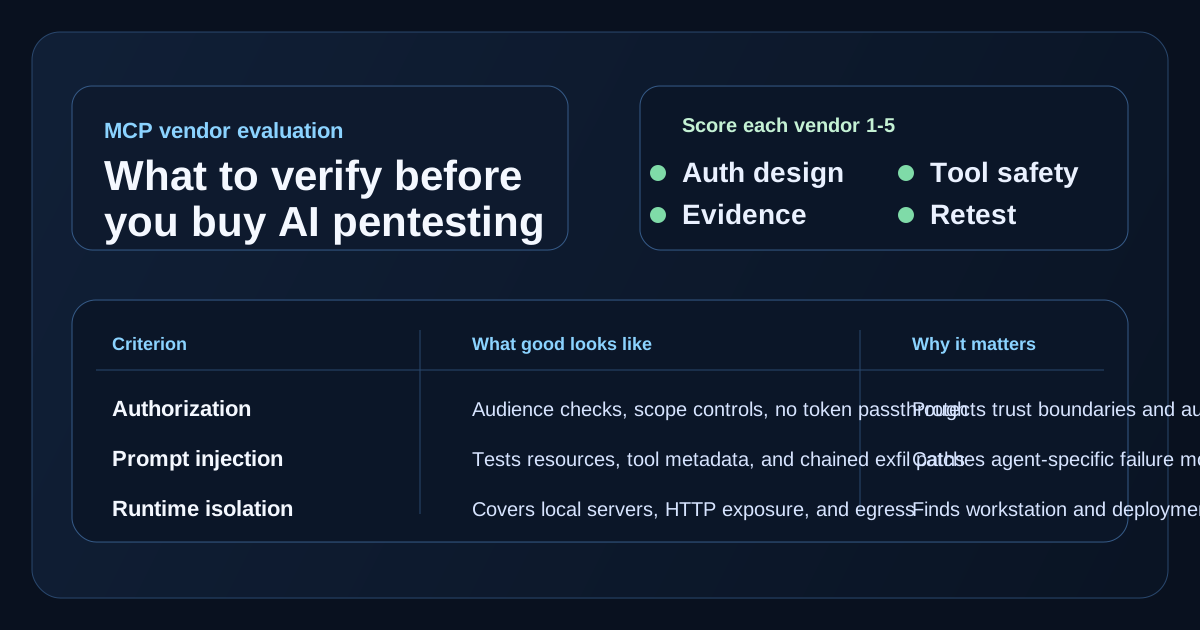
You can keep the scorecard simple. Score each vendor from 1 to 5 in the categories below, then force them to defend the score in the proof-of-concept.
| Criterion | What to look for | Why it matters |
|---|---|---|
| MCP-specific threat coverage | Tests auth, prompt injection, tool poisoning, local server abuse, and retest | Separates true MCP work from generic pentest language |
| Authorization rigor | Understands token audience, consent, scope elevation, and no-token-passthrough rules | Protects trust boundaries and audit trails |
| Runtime isolation knowledge | Can test local servers, remote transports, localhost exposure, and egress paths | MCP risk often lives in the runtime, not only the API |
| Evidence quality | Provides traces, handler names, repro steps, and retest artifacts | Makes findings actionable for engineering |
| Safe exploit discipline | Uses bounded targets, approval gates, and clear test windows | Reduces buyer risk during the engagement |
| Server provenance review | Distinguishes official provider-hosted servers from third-party community servers | Reduces supply-chain and trust confusion |
| Spec freshness | Knows current MCP docs and version changes, not only early 2025 blog posts | The protocol is moving fast |
| Fix validation | Can retest after code or config changes without restarting the whole engagement | Lowers remediation friction |
| Operator fit | Works with your deployment model, whether local-first, self-hosted, or vendor-managed | Buying the wrong operating model wastes time |
The scorecard also helps with category hygiene. Some teams are really choosing between a consulting engagement, a local AI pentest workflow, and a cloud platform with MCP coverage. Those are different things. Keep them in separate columns even if the landing pages blur together.
Questions to ask in the demo
Most vendor demos are too polished to be useful. Ask narrower questions and make them show the work.
- Show one finding from first input to final evidence. Do not accept a slide that jumps straight to the conclusion.
- Show how you test prompt injection through retrieved content or tool metadata, not only through a chat box prompt.
- Show how you evaluate token audience validation and how you detect forbidden token passthrough patterns.
- Show what happens when a local MCP server has a risky startup command or broader file access than expected.
- Show how you separate read-only discovery from write-capable actions and how approvals are captured.
- Show how you distinguish official provider-hosted servers from third-party community servers and how that changes your risk rating.
- Show a retest after a fix. If they cannot do that cleanly, their reporting loop is probably weak.
- Show how you keep pace with new MCP spec guidance and what changed in your methodology recently.
You are looking for concrete answers. Names of handlers. Example logs. A sample finding. A retest artifact. If the reply stays abstract for too long, assume the testing method is also abstract.
How to structure the proof of concept
Do not run a month-long bakeoff if the buying decision can be narrowed in a week.
Start with a controlled target that includes the patterns you actually care about. That might be one internal MCP server that wraps a ticketing API, one local developer-focused server with filesystem access, and one remote server using OAuth-based authorization. If your estate does not include all three, pick the closest match. The point is to test realistic trust boundaries, not to create a lab so synthetic that everyone looks good.
Then ask each vendor to work through the same four proof points:
- Threat model summary for the chosen MCP deployment.
- One auth or scope-related abuse case.
- One prompt injection or tool poisoning case.
- One replayable remediation retest after the issue is fixed.
Keep the POC bounded. Give them a clear scope window. Require written assumptions. Require approval before any write action. Require the final deliverable to name what was tested, what was not tested, and what evidence exists for each claim.
This is also where operating model matters. A local-first workflow can be useful when your team wants tighter control over test artifacts and faster retests between engineering changes. A vendor-managed platform may be easier for broader programs. If you are comparing those models, use the same POC target and the same scoring sheet for both. Otherwise you end up comparing workflow polish to technical depth, which is how weak products survive procurement.
Red flags that should slow the deal down
Some red flags show up almost immediately.
- The vendor says they are "MCP compliant" as if that proves security quality.
- They treat prompt injection as a model-only issue and do not connect it to tool use or data exfiltration.
- They cannot explain token audience validation, consent flows, or why token passthrough is forbidden.
- They have no story for local MCP servers, startup commands, or localhost exposure.
- They show findings but not reproduction steps.
- They want broad production credentials before they can demonstrate basic value.
- They cannot tell you what changed in their method after the latest MCP security guidance.
One more red flag is softer but still real: they keep moving back to general AI strategy. That usually means the testing muscle is not there yet.
Where 0xClaw fits in the buying process
0xClaw fits buyers who want a practical, local-first way to evaluate AI pentest workflows around MCP-adjacent systems. That is different from claiming it replaces every outside assessment. It does not. Third-party review still matters, especially for regulated environments and independent sign-off.
Where 0xClaw is useful is earlier in the cycle and again during remediation. It can help teams pressure-test how an AI-assisted workflow handles real tool execution, human approvals, evidence capture, and retest loops without jumping straight into a heavyweight platform rollout. That is often enough to narrow the shortlist and expose whether a vendor's claims line up with how your team actually works.
If you want that operating-model comparison first, start with the compare hub. If you want to see the product boundary, go to pricing. If you want to test the local workflow directly, use download. If you still need category background, stay in the blog and read the MCP, local workflow, and AI pentest buyer guides in sequence.
FAQ
Do I need a vendor that specializes in MCP, or can a normal pentest firm handle it?
A strong general pentest firm can handle it if they have already built a real MCP testing method. Ask them to prove that. If they mostly talk about web testing plus "some prompt injection," that is not enough.
What evidence should I demand before signing?
Ask for a sanitized sample deliverable that includes reproduction steps, request and response traces, affected handlers or scopes, and a retest section. A nice summary page without underlying evidence is not a buying asset.
Are remote MCP servers riskier than local ones?
They are riskier in different ways. Remote servers raise internet-facing auth, transport, and exposure questions. Local servers add startup command risk, workstation trust issues, and localhost abuse paths. Many organizations have both.
Does MCP spec compliance mean the implementation is secure?
No. Protocol compliance can reduce ambiguity, but it does not prove safe authorization, clean consent handling, proper sandboxing, or resilient tool logic. You still need adversarial testing.
Should the contract include retest rights?
Yes. MCP bugs often sit at the boundary between code, config, and operator behavior. If you cannot get a retest after a fix, the initial finding is less useful.
Bottom line
The best AI pentesting vendor evaluation guide for MCP servers is a simple one: insist on MCP-specific testing depth, insist on evidence, and insist on a proof-of-concept that ends with a retest. Buyers get into trouble when they reward smooth AI language instead of attack-path clarity.
If the vendor can show how they break trust boundaries safely, document the failure, and verify the fix, keep talking. If they mostly talk about the future of agent security, keep them out of the final round.
Ready to run your first AI pentest?
Get 0xClaw up and running in under 3 minutes. No infrastructure setup. No cloud dependency.
More AI Pentest Guides
Continue through the local AI pentesting cluster with related guides on workflow, evidence, comparisons, and remediation.
Best AI penetration testing tools 2026
Compare 0xClaw, NodeZero, PentestGPT, Promptfoo, and garak by execution layer. Chat advice is not authorized target testing.
Read next ->AI Pentest CLI Explained | 0xClaw
Learn what an AI pentest CLI is, how local AI penetration testing works, and how to evaluate a safe, authorized workflow.
Read next ->Run a Local AI Pentest Workflow | 0xClaw
Learn how to run a local AI pentest workflow from scope to report across authorized web, API, host, and network testing.
Read next ->