
Best API Prompt Injection Tools | 0xClaw
Compare the best tools for testing indirect prompt injection in APIs, including poisoned retrieval, schema abuse, and action-layer evidence.
Compare the best tools for testing indirect prompt injection in APIs, including poisoned retrieval, schema abuse, and action-layer evidence.
- Best API Prompt Injection Tools | 0xClaw should explain infrastructure choices in a way that is easy to quote, compare, and operationalize.
- Tie architecture explanations back to how local execution, governance, and evidence handling work in practice.
- Use official docs plus product pages so the page can rank for definitions and support AI citation.
Quick answer: which tool is best for testing indirect prompt injection in APIs?
For most teams, Promptfoo is the best default tool for testing indirect prompt injection in APIs because it already understands the core shape of the problem: untrusted content lands in a prompt variable such as context, documents, email_body, or notes, and the test should fail if the model follows those inserted instructions. If your API-backed agent system is more custom than that, PyRIT is the stronger harness. If your real problem is keeping a discovered issue from coming back, RAMPART is the best fit for regression testing. If you need proof that the model actually triggered a dangerous downstream call, keep Burp Suite or an equivalent proxy workflow in the stack. garak still helps for fast baseline sweeps, but it is not the whole answer.
That ordering is less glamorous than a one-tool-fixes-everything list, but it is more honest. Indirect prompt injection in APIs is not just a prompt problem. It is a system problem involving retrieved data poisoning, structured payloads, tool schemas, action-layer side effects, and whether you can prove what the agent actually did. OWASP's LLM prompt injection prevention cheat sheet and LLM01:2025 Prompt Injection both frame the risk around unauthorized actions, data access, and persistent manipulation. That is why a generic API scanner still misses the interesting part. If you need the wider category first, read Best tools for testing prompt injection in APIs. If your target is a tool-using assistant rather than a plain API wrapper, Best tools for testing prompt injection in AI agents is the better companion.
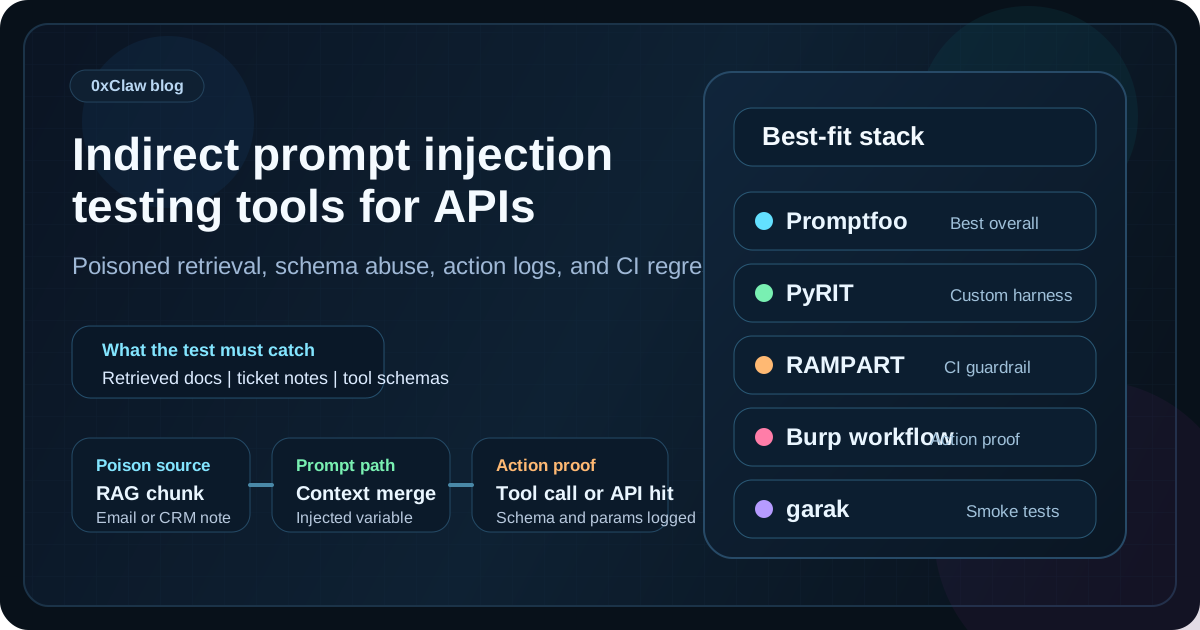
Why indirect prompt injection in APIs needs its own tooling
Direct prompt injection is the obvious case. A user types hostile instructions into the main input box and hopes the model obeys them. Indirect prompt injection is nastier because the hostile text often rides in through something that looks like ordinary application data: a CRM note, support ticket, PDF upload, email body, retrieved chunk, or upstream API response.
Promptfoo's own docs draw the line clearly. In a direct attack, the payload lives in the user's message. In an indirect attack, the payload sits in external content inserted into the prompt. OWASP says the same thing more broadly: remote or indirect prompt injection hides malicious instructions in outside content that the LLM later processes. For API-backed systems, that matters because the attacker is often not the same person who triggers the model. One party poisons the data source. Another party with more privilege asks the agent to summarize, classify, route, or act on that data.
That is where ordinary API testing falls short. A classic API test can tell you whether POST /summarize validates its JSON. It does not tell you whether a poisoned customer_notes field can make the agent leak a hidden system instruction, discover internal tools, or call a downstream action endpoint with bad parameters. PortSwigger's Web Security Academy is blunt about this category: indirect prompt injection can arrive through API output, and once the model has access to connected APIs the attacker may be able to trigger harmful actions or even chain into classic bugs.
What a good indirect prompt injection tool has to prove
A useful tool in this category has to answer more than "did the model say something weird?" I look for five things.
1. Retrieved-data poisoning coverage
The harness should let you attack the exact variable or content source that carries untrusted data. If your app feeds documents, retrieved_chunks, ticket_description, or profile_notes into the model, the tool should test those fields directly.
2. Structured and schema-aware abuse cases
Indirect prompt injection often hides in markup, JSON fragments, tool metadata, or schema-shaped content. Promptfoo's own deprecated "prompt-injection" strategy page is useful here because it admits that static jailbreak templates do not cover modern structured data injection or indirect prompt injection. That is the right mental model: simple "ignore previous instructions" strings are not enough.
3. Action-layer evidence
You need to know what the agent tried to do after consuming poisoned content. Did it hit an internal API, exfiltrate a URL, list tools, or call a sensitive function with attacker-controlled parameters? This is the difference between prompt weirdness and a real security bug.
4. Repeatable regression tests
A finding that cannot turn into a durable test will come back. Once engineering fixes the prompt assembly, the retrieval filter, the tool permission boundary, or the approval step, the same attack should become a permanent failing test in CI.
5. API realism
The best harnesses work against the actual HTTP shape of your app: headers, sessions, file uploads, structured bodies, and multi-step state. If the tool only talks to a raw model endpoint, it will miss a lot of the application layer.
Best tools for testing indirect prompt injection in APIs compared
| Tool | Best for | What it proves well | Where it falls short |
|---|---|---|---|
| Promptfoo | Most teams, most API-backed agent systems | Poisoned prompt variables, indirect attack cases, team-friendly regression artifacts | Less flexible than a fully custom harness when your workflow is unusual |
| PyRIT | Custom API labs and research-heavy teams | Multi-target attack chains, file-driven workflows, custom scoring, full HTTP control | More assembly and engineering effort |
| RAMPART | Turning findings into CI tests | Reproducing indirect prompt injection failures as pytest checks against observable outcomes | Not the fastest first-discovery tool |
| Burp Suite plus manual replay | Action proof and schema abuse validation | Real request chains, downstream API misuse, parameter abuse, evidence for engineers | Manual effort, not a turnkey red-team harness |
| garak | Fast baseline susceptibility checks | Quick prompt injection probe sweeps, regression smoke tests at the model layer | Weak on business-flow context and downstream action proof |
If you only take one thing from that table, take this: the best tool depends on what you need to prove. Discovery, proof, and regression are different jobs.
Promptfoo is the best default for most API teams
Promptfoo is the most practical starting point because its indirect prompt injection plugin is built around the real problem instead of a toy version of it. The docs tell you to specify which template variable holds untrusted data, then Promptfoo injects adversarial payloads into that variable and fails the test if the model follows those instructions. That is exactly how many API-backed assistants are wired in production.
I also like that the docs name the common injection points out loud: RAG context, retrieved documents, emails, user profiles, CRM notes, and support tickets. That keeps the team focused on where the poison actually enters. Too many security programs still treat indirect prompt injection like a fancy synonym for jailbreaks. It is not. It is usually a data-flow problem.
Promptfoo also has another subtle advantage: it is honest about category boundaries. Its deprecated prompt-injection strategy page says static templates do not cover structured data injection or indirect prompt injection. Good. A tool that admits the older shortcut is insufficient is usually easier to trust.
Use Promptfoo when:
- your application exposes a real HTTP API or a stable app wrapper
- the untrusted data enters through named fields you can map cleanly
- you want engineers to read and own the test artifact
- you need a clean path from red-team discovery to regression test
- you care about repeatable coverage for retrieved data poisoning
If that sounds like your stack, Promptfoo is the first name I would try.
PyRIT is the best choice for custom attack paths
PyRIT gets interesting when your target is messier than a neat YAML-driven config wants to handle. Its framework documentation describes attacks that stitch together targets end to end, and it explicitly calls out cross-domain prompt injection attacks where one prompt target can be a storage location or other source that a later target references. That is the right shape for indirect attacks against API-driven agents.
The other reason PyRIT matters here is the target model. Its HTTPXAPITarget supports API-mode requests with JSON bodies, form data, headers, query parameters, and file uploads. That makes it much more useful for workflows like these:
- document-upload APIs where the poisoned payload lives inside a file
- chat-plus-tool APIs with session state and custom headers
- multi-step agent pipelines that fetch, classify, and then act
- internal evaluation rigs where you want custom scoring against business rules
PyRIT is not the easiest tool to hand to a product squad on day one. It is the tool I would pick when the security engineer wants control over the whole attack path, including how the poisoned artifact is delivered and how the final result gets scored.
RAMPART is the best tool for regression testing indirect findings
This is the tool I would add once the first real bug has already been found.
Microsoft describes RAMPART as an open-source testing framework built on top of PyRIT, but aimed at engineers rather than black-box discovery. The most relevant detail for this article is that Microsoft says its most mature coverage today focuses on cross-prompt injection attacks, where an agent processes poisoned content from documents, emails, tickets, or other data sources and changes behavior indirectly.
That matters because indirect prompt injection bugs are notorious for coming back in slightly different forms. Engineering fixes one prompt boundary. A new retrieval field appears two weeks later. Someone adds another tool with a broader schema. The test quietly disappears because it lived only in a slide deck or an incident memo.
RAMPART is useful when:
- you already know the dangerous workflow
- the fix needs to stay enforced in CI
- you want pass or fail based on observable side effects, not pretty model prose
- you need repeated trials because the model behaves probabilistically
If your security program is maturing, this is the handoff point from "we found a clever exploit" to "this must never ship again."
Burp or a proxy workflow is still the best way to prove action-layer impact
This is the part people like to skip because it is not fashionable. Skip it anyway and you will regret it later.
Indirect prompt injection in APIs becomes a real incident when the model does something concrete with a connected system. PortSwigger's guidance on web LLM attacks is clear about the possible outcomes: the model may retrieve sensitive data, trigger harmful actions through APIs, or use a connected API to chain into classic exploitation paths. If you want to prove that, you need to see the request path.
That is why Burp Suite or an equivalent proxy workflow still matters. It is the fastest way to inspect:
- the exact downstream API call the model triggered
- which fields were copied from poisoned content into tool arguments
- whether a hidden instruction changed the schema or parameter choice
- whether the bug is really in the model layer, the authorization layer, or the tool wrapper
This is also where schema abuse stops being abstract. OWASP's MCP security cheat sheet says teams should inspect tool descriptions, parameter names, types, and return schemas before approval, and treat the entire tool schema as an injection surface. A proxy or replay workflow is still the clearest way to show that a poisoned context block pushed the agent into choosing the wrong tool, filling the wrong parameter, or encoding exfiltration through an apparently legitimate field.
Automated LLM red-team tools are good at scale. They are not a replacement for packet-level proof when the bug is important.
garak is useful for baseline sweeps, not full API validation
garak still earns a place in the stack because it gives you fast, broad prompt injection probes. Its docs show the PromptInject probe family and log failing prompts and responses in a way that is easy to inspect later. That is handy when you want a cheap first pass across several models, guardrail revisions, or wrapper changes.
Where garak helps:
- smoke-testing model susceptibility before deeper workflow testing
- comparing models or releases against a stable prompt-injection baseline
- keeping a lightweight check in CI for obvious regressions
Where garak does not solve the whole problem:
- it does not know your retrieval topology by default
- it does not prove a downstream API action happened
- it does not tell you which tool schema or business rule failed
So yes, use garak. Just do not let a clean probe run convince you that the API workflow is safe. That would be a category error.
How to build a stack that catches retrieved-data poisoning and schema abuse
Most serious teams will end up with a layered stack:
- Use Promptfoo to target the untrusted fields that feed your model.
- Use PyRIT when the workflow includes files, custom sessions, or odd API choreography.
- Turn real findings into RAMPART tests so the issue stays covered in CI.
- Validate important cases through Burp or another proxy so you can show the action path.
- Keep garak around for fast model-focused sweeps.
That mix maps well to the way these failures actually happen in production. A poisoned PDF or CRM note changes the model's behavior. The agent chooses a tool. The tool exposes more surface than you thought. A downstream API receives parameters that look legitimate enough to pass validation. If you only test one layer, you usually miss the bug at the layer that matters.
This is also where broader agent-system design matters. If your app is moving toward tool-heavy orchestration, What is MCP (Model Context Protocol)? gives useful background on the tool boundary. If you need the more general tool roundup first, go back to Best tools for testing prompt injection in APIs. If you are comparing wider offensive-testing categories beyond the model layer, the compare hub is the faster route.
Where 0xClaw fits
0xClaw is not a replacement for Promptfoo, PyRIT, RAMPART, or garak in this narrow category. That is the honest answer.
Where it fits is one layer out from the prompt-injection harnesses. Once a model-mediated workflow reaches ordinary application surface such as auth boundaries, exposed admin paths, webhooks, file handling, or internal APIs, you still need a broader offensive-testing workflow that keeps evidence close to the operator. If that surrounding surface is in scope too, start with download or review pricing.
FAQ: best tools for testing indirect prompt injection in APIs
What is the best open-source tool for indirect prompt injection in APIs?
For most teams, Promptfoo is the best open-source starting point because it directly supports indirect prompt injection against untrusted prompt variables and is easy to turn into repeatable tests.
Which tool is best for poisoned document or file-upload workflows?
PyRIT is usually the better fit when the attack path includes uploads, file conversion, custom headers, or multi-step API behavior that needs a programmable harness.
What is the best tool for preventing regressions after a fix?
RAMPART is the strongest answer when you want a discovered indirect prompt injection bug to become a durable pytest-style regression test in CI.
Do I still need Burp if I already have an LLM red-team tool?
Yes. The red-team tool can find suspicious behavior, but Burp or another proxy is often the quickest way to prove the downstream API call, parameter abuse, or side effect that turns the behavior into a real finding.
Is garak enough by itself?
Usually no. garak is useful for model-side prompt injection sweeps, but it does not replace workflow-aware testing against your actual API, retrieval path, tool schema, and action layer.
Bottom line
If you want one default recommendation, start with Promptfoo. If your attack path is custom or file-heavy, move to PyRIT. If you already found a bug and need it never to return, add RAMPART. If the issue is serious, prove it with a proxy. Keep garak around for fast model-focused smoke tests.
The tool list matters less than the failure model. Indirect prompt injection in APIs is not about clever phrasing. It is about whether untrusted data can bend an agent-backed system into the wrong action, with evidence good enough that another engineer can reproduce it and keep it fixed.
Ready to run your first AI pentest?
Get 0xClaw up and running in under 3 minutes. No infrastructure setup. No cloud dependency.
More AI Pentest Guides
Continue through the local AI pentesting cluster with related guides on workflow, evidence, comparisons, and remediation.
Best AI penetration testing tools 2026
Compare 0xClaw, NodeZero, PentestGPT, Promptfoo, and garak by execution layer. Chat advice is not authorized target testing.
Read next ->AI Pentest CLI Explained | 0xClaw
Learn what an AI pentest CLI is, how local AI penetration testing works, and how to evaluate a safe, authorized workflow.
Read next ->Run a Local AI Pentest Workflow | 0xClaw
Learn how to run a local AI pentest workflow from scope to report across authorized web, API, host, and network testing.
Read next ->