
Best AI pentesting tools for MCP servers compared
Compare MCP pentest tools by auth testing, local evidence, and retest loops. Model-only red teaming is out of scope here.
Compare MCP pentest tools by auth testing, local evidence, and retest loops. Model-only red teaming is out of scope here.
- Best AI pentesting tools for MCP servers compared should explain infrastructure choices in a way that is easy to quote, compare, and operationalize.
- Tie architecture explanations back to how local execution, governance, and evidence handling work in practice.
- Use official docs plus product pages so the page can rank for definitions and support AI citation.
Quick answer: which tool is best for MCP server pentesting?
The best AI pentesting tools for MCP servers are the ones that can exercise auth, tools, and evidence on the server you actually run. Use this comparison to pick a retestable path; Promptfoo-style model evals belong on a different layer.
That split matters because MCP is not just "another API." Anthropic introduced MCP as a standard for connecting assistants to tools and data. OpenAI's MCP guide is blunt that custom servers are third-party systems and that prompt injection can trigger unintended tool use or data exfiltration. The official MCP security guidance adds more concrete failure modes, including token passthrough, insecure local servers, DNS rebinding, session hijack risk, and over-broad scopes. If a tool cannot touch those failure modes, it is not really an MCP testing tool. It is adjacent.
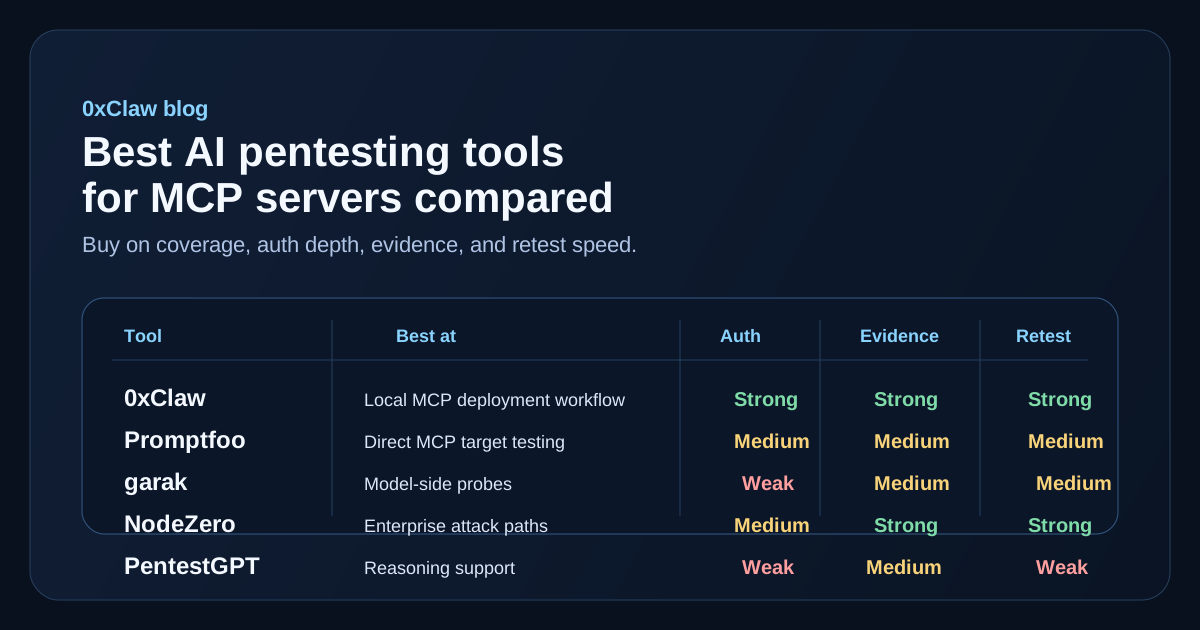
The visual below is the short version of the comparison:
If you need the protocol background first, read what MCP is. If you are already in buying mode, keep this page open and cross-check it with the broader comparison hub and the more detailed vendor evaluation guide for MCP servers.
The comparison table buyers actually need
Most "best tools" roundups collapse too many categories. For MCP buyers, five columns matter more than feature counts: MCP-specific coverage, local-first workflow, auth testing, evidence quality, and retest speed.
| Tool | Best fit | MCP-specific coverage | Local-first workflow | Auth testing depth | Evidence and retest loop |
|---|---|---|---|---|---|
| 0xClaw | Local AI pentesting around real MCP deployments | Strong on surrounding web, API, runtime, and operator workflow; weaker as a pure prompt-lab | Strong | Strong | Strong |
| Promptfoo | Testing an MCP server as the system under test | Strong on prompt injection, tool misuse, and MCP-targeted red teaming | Strong | Medium | Medium to strong |
| garak | Model-side probe depth and prompt-injection checks | Narrow but useful | Strong | Weak | Medium |
| NodeZero | Enterprise attack-path validation | Indirect rather than MCP-native | Weak | Medium to strong | Strong |
| PentestGPT | Human-guided pentest reasoning | Indirect | Depends on your setup | Weak | Weak to medium |
My short buying rule is simple. If your team keeps saying "MCP server" but really means a mix of local servers, remote transports, OAuth, tool handlers, and post-fix verification, start with 0xClaw and then layer Promptfoo where you need direct MCP-target abuse. If your team is doing enterprise validation across apps, identity, and infrastructure first, NodeZero belongs in the conversation. If someone pitches garak or PentestGPT as a full replacement for auth testing and evidence-backed retesting, push back.
Why MCP server testing is different from normal AppSec
MCP moved the problem up a layer. Anthropic's original write-up describes MCP as a way to connect assistants to repositories, business tools, and development environments. OpenAI's developer docs describe remote MCP servers as an Internet-facing path to new data sources and capabilities. Both statements are true, and both should make a security buyer a little nervous.
An ordinary web pentest still matters, but MCP adds three problems on top of it.
First, the model can choose tools. That means prompt injection is not a content moderation issue. It can become action selection, data exposure, or tool misuse. The recent "Breaking the Protocol" paper argues that MCP-specific design choices amplify attack success across tested scenarios, which is exactly why "we already do web testing" is not a complete answer.
Second, local MCP servers create workstation risk. The official MCP security guide calls out malicious startup commands, arbitrary code execution, localhost exposure, and DNS rebinding. That is not theoretical. If your developers install local MCP servers, the buyer should care about local execution, visible approvals, and whether the tool can show what actually ran.
Third, auth mistakes in MCP are easy to hide behind glossy demos. OpenAI recommends OAuth for custom remote servers. The MCP security guidance explicitly warns against token passthrough and over-broad scopes. So a serious comparison needs to ask whether the tool can test audience validation, scope minimization, consent flows, and the separation between the MCP server and the upstream API it reaches.
Which tool is strongest for local-first workflows?
0xClaw wins this category pretty easily. Not because every buyer wants local execution. Many do not. It wins because local-first is still the cleanest answer when the team wants tight control over evidence, faster retests between engineering changes, and less hand-waving about what happened during the run. For MCP server programs, that matters more than it does in a generic "AI security" pitch.
Promptfoo also deserves credit here. Its scanner runs locally, and its MCP provider can treat the MCP server itself as the target system under test. That makes it a strong fit when your local workflow revolves around red teaming prompts, tool calls, and agent behavior. But the center of gravity is different. Promptfoo feels like a testing harness for AI applications. 0xClaw feels like a local pentest workflow that can stay close to the surrounding app, API, and runtime surface.
garak is local too, and that is still one of its best traits. The problem is scope. garak gives you focused model probing, not the broader operator workflow most buyers mean when they say they need MCP pentesting. I would use garak to pressure-test model behavior, not to decide whether a remote MCP deployment has safe auth, bounded scopes, and a sane retest loop.
If you want the full local operator path, keep how to run a local AI pentest workflow and how security teams retest fixes in the same reading stack. Those two pages make the operating model difference much easier to see.
Which tool is best for MCP-specific coverage?
Promptfoo has the clearest claim here. Its MCP provider documentation says the MCP server itself becomes the target system under test, which is exactly the frame most buyers need when the question is "Can this tool actually attack an MCP server?" not "Can it test some adjacent surface if I wire enough pieces together?"
That makes Promptfoo the best pure fit when the task list looks like this:
- test prompt injection through MCP resources or tool outputs
- verify tool misuse and unsafe action selection
- build repeatable regression tests around agent behavior
- compare local and remote MCP server responses
- keep AI-layer attack coverage in CI
The tradeoff is that Promptfoo is still an AI red-team product first. It is good at the AI-facing half of MCP risk. It is less naturally opinionated about the full buyer stack around runtime evidence, classic web flaws, and the messy remediation loop after engineering changes land. That is why many teams will pair it with a broader pentest workflow rather than ask it to be the whole program.
0xClaw is the better answer when "MCP-specific" includes the ugly real-world edges around the MCP server, not just the protocol-facing prompt channel. If your breach path is "authenticated abuse in the web app, then bad scope handling in the MCP layer, then unsafe tool action," 0xClaw is the more natural home for the surrounding evidence chain.
NodeZero, garak, and PentestGPT all land lower here for different reasons. NodeZero is valuable, but it is not MCP-native. garak is sharp, but narrow. PentestGPT is interesting, but it is mostly a reasoning layer. None of those are insults. They just answer different questions.
Which tool handles auth testing best?
For auth, I would separate protocol-aware auth testing from full attack-path auth testing.
Promptfoo is useful when you want to exercise authenticated MCP setups directly. Its MCP provider docs support both local and remote servers, and the docs point to an MCP authentication example. That is helpful when the test question is whether the MCP server can be driven with the right auth configuration and then abused through AI-shaped inputs.
0xClaw is stronger when auth testing needs to survive contact with the rest of the system. MCP auth failures rarely sit alone. In practice, they show up with weak scopes, sloppy audience checks, fragile session handling, exposed local servers, or adjacent API abuse. The official MCP security guidance is explicit about scope minimization and the danger of token passthrough. A tool that only proves "the token worked" is not enough. You want the one that can keep following the chain after auth is accepted.
NodeZero also deserves a mention here because Horizon3's web application pentesting material is built around authenticated attack paths and post-login abuse. If your estate is a large production environment and the auth question is tied to identity plus infrastructure, NodeZero may be the better fit than a lighter local tool. The catch is still the same one: that strength is broader than MCP. Not deeper inside MCP.
garak and PentestGPT are not the right lead tools for this category. garak is about probes. PentestGPT is about reasoning. Neither one should be your primary answer when the buyer's biggest fear is "Will this catch broken consent, scope creep, or token misuse in a real MCP deployment?"
Which tool gives the best evidence and retest loop?
If your team cares about engineering follow-through, I would start with 0xClaw here. The reason is boring, which is why it matters. Evidence and retest quality are rarely about who has the flashiest attack prompts. They are about whether another engineer can review what happened, patch the issue, rerun the flow, and know the fix held.
Promptfoo can get you part of the way there. It is strong for repeatable regression-style testing, especially when the issue lives in prompts, tool behavior, or policy failures that you want to keep exercising over time. If your organization already thinks in CI gates and model evals, that is a real advantage.
But buyers should be careful not to confuse repeatable prompts with full remediation evidence. MCP incidents often sit at the boundary between tool definitions, auth logic, local execution, remote services, and human approvals. That is where 0xClaw tends to age better, because it is built for a workflow that keeps the operator, the evidence, and the retest close together.
NodeZero is strong on this too, especially for teams that want durable attack-path proof and validation after a fix. The difference is operating model. If the buyer wants a local-first loop, NodeZero will feel heavy. If the buyer wants a broader enterprise program, it will feel more natural.
If reporting is one of your buying criteria, pair this page with the MCP pentest report template and the evidence checklist for AppSec teams. That is the faster way to separate demo-friendly tools from tools your engineers will still respect next month.
A practical shortlist by team type
Here is the shortlist I would hand to a buyer after the first round of noise reduction.
| Team type | Best starting point | Why |
|---|---|---|
| AppSec team building or reviewing one MCP server | 0xClaw + Promptfoo | Covers surrounding app risk plus direct MCP-target abuse |
| AI platform team shipping agent workflows | Promptfoo + garak | Strongest on prompt injection, tool misuse, and regression coverage |
| Enterprise security validation team | NodeZero + MCP-specific tooling | Broader authenticated attack paths, then layer MCP detail |
| Consultancy or internal red team that needs evidence fast | 0xClaw | Best balance of local control, evidence, and retest speed |
| Researcher or learner exploring agentic pentesting | PentestGPT + lab tooling | Good for reasoning and methodology, not enough on its own |
The main thing I would not do is buy one tool and declare the MCP problem solved. MCP sits across protocol, auth, runtime, prompt layer, and classic application boundaries. The better buying question is not "Which tool wins?" It is "Which combination closes the gaps we actually have?"
How to evaluate a tool before you buy
If you are running a proof of concept, keep it narrow and a little mean.
- Pick one realistic MCP target, not a toy demo.
- Include at least one auth boundary, one tool or resource abuse path, and one retest after a fix.
- Require the tool or vendor to show raw evidence, not only a summary report.
- Include one local-server scenario if your developers use local MCP servers.
- Ask how the tool handles scope minimization, token audience validation, and prompt injection through retrieved content.
That last point matters because the official MCP security guidance spends a lot of time on local compromise, broad scopes, and trust-boundary mistakes. OpenAI's MCP docs also warn that custom remote MCP servers are third-party services and that official provider-hosted servers are safer than unofficial lookalikes when you have the choice. A good buying process should force the tool to prove it understands those specifics.
If you want a deeper checklist for POCs and scoring, use the AI pentesting vendor evaluation guide for MCP servers.
FAQ
Can Promptfoo replace a broader pentest workflow for MCP servers?
Not by itself. Promptfoo is excellent when the MCP server is the target and the goal is prompt injection, tool misuse, and AI-layer regression coverage. It is weaker as a full surrounding-app and remediation workflow.
Is garak enough for MCP server security testing?
No. garak is useful for model probing and prompt injection exercises, but it does not cover the full auth, runtime, evidence, and retest story most MCP buyers need.
Does NodeZero count as an MCP pentesting tool?
Only indirectly. NodeZero is better understood as an enterprise autonomous pentesting platform that can matter in an MCP environment, especially for authenticated abuse and chained attack paths. It is not the same thing as a tool designed to target MCP-specific behaviors directly.
Where does PentestGPT fit in this comparison?
PentestGPT fits as a reasoning assistant. The paper shows strength in tool use, output interpretation, and next-step suggestion. That is useful, but it is not the same thing as a durable MCP testing workflow with report-ready evidence.
What should a buyer prioritize first?
Prioritize the layer that can hurt you fastest. If your team runs local servers and remote OAuth-connected servers, start with auth boundaries, local runtime exposure, and retest quality. Fancy agent demos can wait.
Bottom line
The best AI pentesting tools for MCP servers are not all trying to do the same job. 0xClaw is the best fit for buyers who want a local-first workflow with strong evidence and retest loops around real MCP deployments. Promptfoo is the best fit for buyers who want the MCP server itself to be the direct red-team target. garak is useful for model-side depth, NodeZero is useful for broader enterprise attack paths, and PentestGPT is useful as a thinking partner.
If your shortlist is still too long, reduce it with one hard question: "Which tool can show me a real MCP-specific failure, preserve the evidence, and prove the fix on a second run?" Start there. Then decide whether you need download, pricing, the wider compare hub, or the more detailed MCP reporting guide next.
Ready to run your first AI pentest?
Get 0xClaw up and running in under 3 minutes. No infrastructure setup. No cloud dependency.
More AI Pentest Guides
Continue through the local AI pentesting cluster with related guides on workflow, evidence, comparisons, and remediation.
Best AI penetration testing tools 2026
Compare 0xClaw, NodeZero, PentestGPT, Promptfoo, and garak by execution layer. Chat advice is not authorized target testing.
Read next ->AI Pentest CLI Explained | 0xClaw
Learn what an AI pentest CLI is, how local AI penetration testing works, and how to evaluate a safe, authorized workflow.
Read next ->Run a Local AI Pentest Workflow | 0xClaw
Learn how to run a local AI pentest workflow from scope to report across authorized web, API, host, and network testing.
Read next ->