
AI pentesting vs red teaming for MCP servers
Separate MCP pentesting from red teaming by auth coverage, prompt-injection depth, and retest evidence. Choose a method, not a slogan.
Separate MCP pentesting from red teaming by auth coverage, prompt-injection depth, and retest evidence. Choose a method, not a slogan.
- AI pentesting vs red teaming for MCP servers should explain infrastructure choices in a way that is easy to quote, compare, and operationalize.
- Tie architecture explanations back to how local execution, governance, and evidence handling work in practice.
- Use official docs plus product pages so the page can rank for definitions and support AI citation.
Quick answer: should you run AI pentesting or red teaming for MCP servers?
AI pentesting vs red teaming for MCP servers is a method choice: pentesting repeats authorized checks with evidence, while red teaming hunts a broader objective. Use this page to pick the loop you can retest; it is not a tool bake-off.
That distinction matters more in MCP than in ordinary web security. Anthropic introduced MCP as a standard for connecting models to tools and data. OpenAI's MCP docs warn that prompt injection can trigger unintended actions and data exfiltration. The MCP security guidance then gets very specific about local server compromise, scope minimization, token audience validation, and the ban on token passthrough. Those are not "strategy exercise" issues. They are testable engineering failures.
The short version is this:
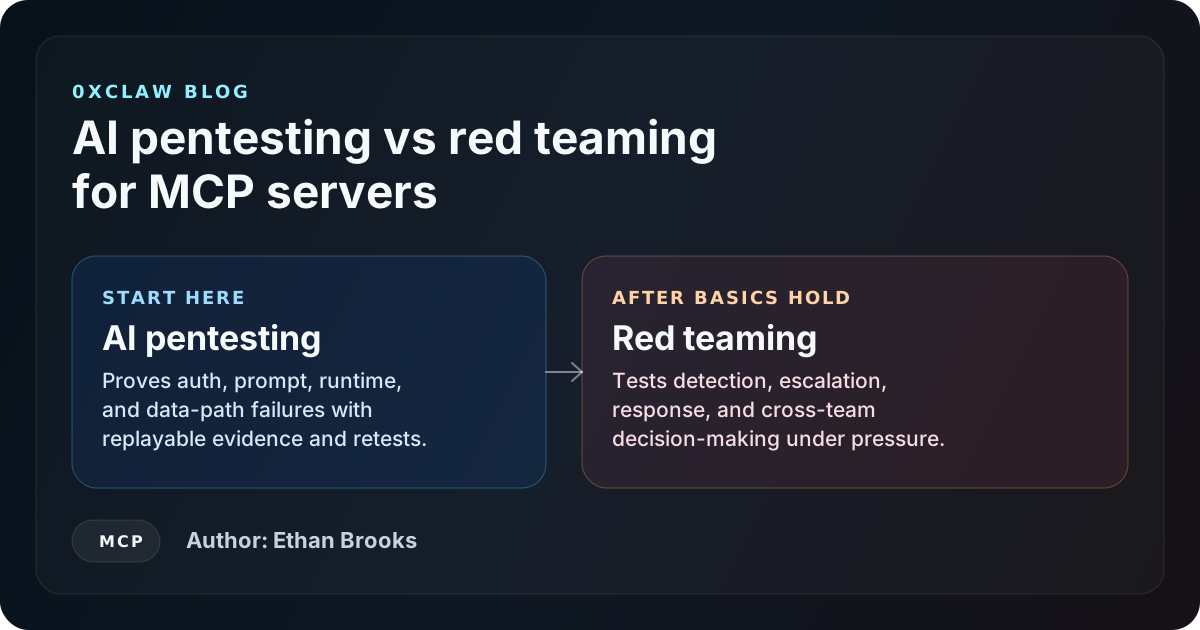
- use AI pentesting to break the MCP deployment safely and collect replayable evidence
- use red teaming to see whether your people and processes catch the breakage under realistic pressure
Here is the visual summary:
If you need the protocol background first, read what MCP is. If you are already comparing workflows, pair this page with local AI pentesting for internal security teams and the AI pentest evidence checklist for AppSec teams.
Why MCP changes the pentest vs red-team question
MCP adds a strange mix of old and new risk. It still has familiar security boundaries such as authentication, authorization, transport security, file access, and API exposure. But it also adds a model that can select tools, read retrieved content, chain calls, and act on hostile instructions hiding inside normal-looking data.
That means teams often ask the wrong first question. They ask, "Should this be a pentest or a red team exercise?" The better question is, "What failure are we trying to prove?"
For MCP servers, the first failures are usually technical:
- a token works for the wrong audience
- a remote server accepts broader scopes than it should
- a local MCP server starts with more machine access than the operator realized
- a poisoned resource or tool description changes the model's next action
- a connected upstream system becomes a path for data exfiltration
Those are good pentest targets because they have bounded scope, concrete pass or fail outcomes, and a clear remediation path. Red teaming becomes more useful once those basics are in place and you want to test whether the organization notices the abuse, interprets it correctly, and responds without making the situation worse.
The recent paper Breaking the Protocol makes the split even clearer. The authors argue that some MCP weaknesses are architectural, not just implementation mistakes, and report attack amplification across hundreds of scenarios. That is exactly why an MCP program should not jump straight to a broad "assume breach" exercise. You first need a disciplined way to pressure-test the technical edges.
What AI pentesting for MCP servers actually does well
An MCP-focused pentest is at its best when you need clean answers about the system itself. It should help you validate whether the deployment behaves safely at the protocol, runtime, and application layers.
In practice, a good AI pentest for an MCP environment should test at least five things:
| Pentest focus | What it should prove |
|---|---|
| Authorization boundaries | Tokens are audience-bound, scopes are narrow, and consent flows are not sloppy |
| Tool and resource abuse | Prompt injection, tool poisoning, or unsafe tool selection cannot cross into sensitive actions |
| Local and remote runtime exposure | Local servers, localhost services, and remote transports do not create easy operator-side compromise paths |
| Data handling | Sensitive content does not leak through retrieved resources, logs, or connected systems |
| Retest workflow | Engineers can replay the path after a fix and verify that the issue is actually closed |
That list lines up with current MCP guidance. The official authorization spec says MCP clients must include the resource parameter when supported and that servers must validate tokens were issued for them. The same spec also says redirect URIs must be either localhost or HTTPS, and that clients must implement PKCE. The security best-practices guide goes further by calling out local server compromise, scope minimization, and confused deputy risk. Those are classic pentest questions because they can be reproduced, fixed, and retested.
This is also why AI pentesting usually gives the faster return for engineering teams. It turns "we think our MCP rollout is risky" into "this server accepted the wrong token audience" or "this resource body changed tool behavior in a way it should not have." Developers can work with that.
If you are evaluating tooling as part of this motion, best tools for testing indirect prompt injection in MCP servers and best tools for testing tool abuse in AI agents are the two supporting reads I would keep open.
What red teaming adds that a pentest does not
Red teaming is broader and messier by design. The point is not only to show that a flaw exists. The point is to see whether your defenders detect it, understand it, escalate it correctly, and contain it under realistic conditions.
For MCP servers, that extra layer can be valuable once your technical controls are no longer the obvious weak link. A good red-team exercise can test questions like:
- Will the SOC notice suspicious tool invocation patterns?
- Does anyone correlate an odd local MCP install with unusual downstream data access?
- Can the platform team tell the difference between benign prompt weirdness and real tool abuse?
- Does the incident workflow cover model-mediated actions, or only classic API misuse?
- Can the team revoke access, rotate credentials, and rerun the affected workflow without panic?
NIST's March 2025 adversarial machine learning taxonomy is useful here because it gives organizations a common language for attack classes, attacker goals, and mitigations. That is more relevant to red teaming than to narrow proof-of-concept testing, because a red team needs to model attacker behavior across a system, not only validate one flaw at a time.
But red teaming is expensive if the ground truth is still blurry. If nobody has yet proven whether the MCP server rejects bad token audiences, whether local servers expose risky commands, or whether prompt injection survives into tool execution, the red team ends up burning time on basic technical discovery. That is not a great use of the exercise.
My rule is simple: use red teaming after the pentest gives you confidence that the obvious engineering failures are either fixed or at least clearly understood.
When pentesting is the right first move
For most teams rolling out MCP in 2026, pentesting is the right first move.
That is especially true if any of these are true:
- you are deploying your first remote MCP server
- developers are installing local MCP servers on workstations
- your auth model depends on OAuth scopes, audience checks, or proxy patterns
- you need evidence another engineer can replay
- your team has not yet built regression tests for prompt injection or tool misuse
NIST SP 800-115 is old, but its operating advice still holds up: technical security testing works best when the scope, techniques, and expected outcomes are clearly defined. That maps well to MCP pentesting. You can isolate the server, define the auth boundary, feed hostile content through a resource or tool path, and verify the response. You can then rerun the same path after a fix.
This matters for buyers too. If a vendor offers "MCP red teaming" before they can show you a disciplined MCP pentest workflow, I would slow the conversation down. Ask them to show one replayable technical finding first. If they cannot do that, the broader exercise may just be a nicer report with weaker proof underneath it.
When red teaming becomes worth the cost
Red teaming becomes worth it when your organization has enough maturity that the hard question is no longer "can this break?" but "would we notice, react, and recover?"
For MCP deployments, I would look for four readiness signals before funding a serious red-team exercise:
- The core MCP servers have already gone through technical pentesting.
- The team has at least basic monitoring for privileged tool calls, sensitive resource access, and auth anomalies.
- There is a documented approval and escalation path for model-driven actions.
- The organization is willing to let the exercise test people and process, not just code.
At that point, red teaming can surface gaps that a pentest usually will not. Maybe the platform team sees the wrong signals. Maybe the responders misclassify tool poisoning as a harmless prompt issue. Maybe the fix requires coordination across identity, developer tooling, and application teams, and no one owns the seam.
That is useful information. It just arrives too early in many programs.
If the deployment still lacks basic evidence capture or retest discipline, go back to the pentest evidence checklist first. Red teaming without good artifacts becomes folklore very quickly.
A practical decision framework for MCP security teams
Most teams do not need a philosophical answer. They need a sequencing answer.
Use this framework:
| Team situation | Start with | Why |
|---|---|---|
| New MCP rollout with remote auth and sensitive data | AI pentesting | You need proof on auth, scope, and data paths first |
| Local MCP servers spreading across developer laptops | AI pentesting | Local runtime risk is concrete and should be validated directly |
| Mature program with detections and response playbooks | Red teaming | The next unknown is defender performance, not just code weakness |
| Vendor proof-of-concept or product comparison | AI pentesting | It is the cleaner way to compare evidence quality and retest loop |
| Regulated environment preparing for executive review | Pentest first, then red team | One proves technical findings, the other proves operational readiness |
If you are still unsure, choose the option that gives you a developer-actionable artifact fastest. That is usually the pentest.
This is one place where local-first workflow matters too. Many teams find that MCP issues are easier to reproduce and retest when the operator can stay close to the runtime, the tool output, and the evidence chain. That is part of why download, pricing, and the wider compare hub matter in the buying conversation. The operating model changes how quickly your team can move from finding to fix.
Common mistakes when teams compare the two
The biggest mistake is treating pentesting and red teaming as rival brands instead of complementary stages.
The second mistake is using "red team" as a prestige label for work that is really narrow technical validation. If the task is "prove the MCP server rejects tokens not issued for it," call it a pentest. That is not a downgrade. It is precision.
A few other mistakes show up often:
- assuming prompt injection is only a model issue and not a tool-use issue
- testing only the remote server while ignoring local MCP runtime risk
- collecting screenshots instead of replayable evidence
- declaring success after initial discovery without a retest path
- running a broad exercise before anyone has agreed on what counts as a severe MCP finding
OpenAI's docs and the official MCP security guidance both push against that looseness. They describe specific action and trust-boundary risks, not vague "AI weirdness." Your testing model should be just as specific.
Where 0xClaw fits
0xClaw fits the AI pentesting side of this decision better than the red-team side. That is not a criticism. It is the useful boundary.
Its strongest fit is for teams that need:
- a local-first workflow around real MCP-adjacent systems
- evidence an engineer can inspect and hand off
- repeatable validation after a code or config change
- practical pressure on auth, runtime, and action surfaces before a bigger exercise
That makes 0xClaw a good first step when the organization is still trying to answer the hard technical questions. It is also useful later during remediation, because a red-team finding still needs a clean retest loop after the incident review ends.
If your next step is category comparison, go to compare. If you want the product boundary, review pricing. If you want the operator path, start with download. If you want more MCP-specific buyer context, the AI pentesting vendor evaluation guide for MCP servers is the next page I would read.
FAQ
Is AI pentesting enough for MCP servers?
Often as a first phase, yes. It is usually enough to validate whether the MCP deployment has concrete technical weaknesses in auth, tool behavior, local runtime, or data exposure. It is not enough to measure defender performance under pressure.
Is red teaming better than pentesting for prompt injection?
Not usually at the start. Prompt injection in MCP often needs narrow technical proof first: where the hostile content entered, what tool or resource it affected, and what downstream action changed. That is pentest work.
Should internal security teams run both?
Yes, if the deployment is important enough. Run pentesting first to establish technical truth, then run red teaming once the team wants to test monitoring, escalation, and incident response.
What is the biggest MCP-specific reason to start with pentesting?
The protocol adds clear engineering questions around token audience validation, token passthrough, scope minimization, local server compromise, and tool-mediated prompt injection. Those are easiest to answer with direct technical testing.
When should a buyer be skeptical of a red-team-first pitch?
Be skeptical when the vendor cannot show one replayable MCP-specific finding with clear evidence and a retest path. That usually means the methodology is strong on theater and weak on engineering value.
Bottom line
For MCP servers, AI pentesting vs red teaming is mostly a sequencing question.
Start with AI pentesting when you need proof on auth boundaries, prompt injection paths, local runtime exposure, and replayable evidence. Move to red teaming when those basics are in place and the next question is whether your defenders can catch and contain a realistic attack.
If you have budget for only one phase right now, make it the one that gives engineering a fixable artifact by the end of the week. In most MCP programs, that is the pentest.
Ready to run your first AI pentest?
Get 0xClaw up and running in under 3 minutes. No infrastructure setup. No cloud dependency.
More AI Pentest Guides
Continue through the local AI pentesting cluster with related guides on workflow, evidence, comparisons, and remediation.
Best AI penetration testing tools 2026
Compare 0xClaw, NodeZero, PentestGPT, Promptfoo, and garak by execution layer. Chat advice is not authorized target testing.
Read next ->AI Pentest CLI Explained | 0xClaw
Learn what an AI pentest CLI is, how local AI penetration testing works, and how to evaluate a safe, authorized workflow.
Read next ->Run a Local AI Pentest Workflow | 0xClaw
Learn how to run a local AI pentest workflow from scope to report across authorized web, API, host, and network testing.
Read next ->