
Best tools for testing tool abuse in AI agents
Compare agent tool-abuse tests for privilege boundaries and side effects. Host and network pentesting are out of scope.
Compare agent tool-abuse tests for privilege boundaries and side effects. Host and network pentesting are out of scope.
- Best tools for testing tool abuse in AI agents should explain infrastructure choices in a way that is easy to quote, compare, and operationalize.
- Tie architecture explanations back to how local execution, governance, and evidence handling work in practice.
- Use official docs plus product pages so the page can rank for definitions and support AI citation.
Quick answer
The best tools for testing tool abuse in AI agents check whether a tool call crosses a privilege or triggers a side effect the operator did not authorize. Use them on the agent layer, not as a substitute for host pentesting.
What this page covers
- Agent-layer tool-abuse tests for privilege boundaries and side effects, using the tools already compared in the body.
What this page does not cover
- Host, network, or MCP-server pentesting, and any unpublished 0xClaw scan scores.
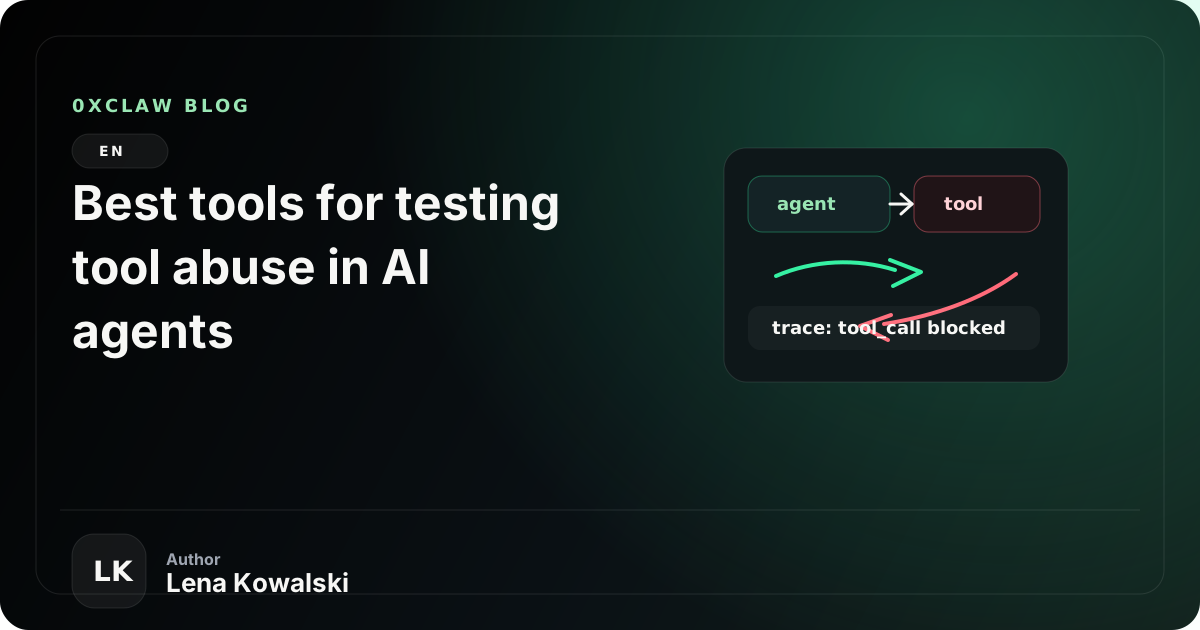
That ranking comes down to a simple point. Tool abuse in agents is not just a prompt problem. It is a permission problem, a side-effect problem, and often a traceability problem. OWASP's current excessive-agency guidance is blunt about it: once an LLM agent has more capability than it needs, an attacker can bend legitimate tools toward illegitimate outcomes. Good testing has to prove whether the agent stayed inside policy after the tool boundary came into play.
Why tool abuse needs its own testing category
People still lump this into "prompt injection testing" and move on. That is too shallow.
Tool abuse is what happens when the model does not merely say the wrong thing. It uses a real capability the wrong way. That might be a browsing tool, a shell tool, a database query, an MCP server, a CRM action, a payment workflow, or a file-system write. The model may still sound polite while it is doing something you never wanted it to do.
OWASP's excessive-agency material uses exactly this kind of scenario. A developer may give an agent broader rights than necessary, then an indirect prompt injection or malicious email can steer it into forwarding sensitive data or taking actions outside the original user intent. That is why a tool-abuse test has to answer questions that ordinary chatbot evals do not cover:
- Did the agent call a tool it should not have called?
- Did it pass unsafe arguments to an allowed tool?
- Did it pivot from a read action to a write action?
- Did it disclose tool schemas, hidden capabilities, or privileged objects it should have kept private?
- Did it cross a boundary in the backend even if the final answer looked harmless?
If your current harness grades only the final text response, you will miss the bug that matters.
Best tools for testing tool abuse in AI agents compared
| Tool | Best fit | What it proves well | Main limitation |
|---|---|---|---|
| Promptfoo | Best overall for most product and security teams | Unauthorized tool use, privilege abuse, trace-backed regressions, SSRF-style actions, memory poisoning, tool discovery | Some grading still needs care when you want strictly deterministic pass or fail |
| PyRIT | Best for custom attack harnesses | Multi-step abuse chains, unusual targets, custom scorers, web-app and API attack paths | More setup and more operator skill required |
| AgentDojo | Best benchmark for robustness claims | Tool use over untrusted data, realistic tasks, broader defense evaluation | Not a plug-and-play scanner for your own endpoint |
| Inspect | Best framework for building bespoke agent evals | Tool calling, sandboxes, reusable scorers, custom agents, local or bridged workflows | You have to design the evals yourself |
| garak | Best supporting layer for broad LLM pressure | Prompt injection, jailbreak, guardrail bypass, structured logs across model runs | Does not model your full agent workflow or real side effects by itself |
If you want one practical stack, start with Promptfoo, reach for PyRIT when the workflow gets weird, use Inspect when you want a durable in-house eval framework, and keep AgentDojo and garak around so you do not confuse one passing app-specific suite with real robustness.
Promptfoo is the strongest default for shipping agents
Promptfoo earns the top spot because it treats agents like systems with tools, not like dressed-up chat boxes. Its agent red-teaming guide covers the exact risk areas teams care about in production: unauthorized access, context poisoning, memory poisoning, multi-stage attack chains, and tool or API manipulation.
The details matter here. Promptfoo explicitly maps testing to plugins like rbac, bola, bfla, ssrf, tool-discovery, agentic:memory-poisoning, and excessive-agency. That means the tool is not only generating generic "be evil" prompts. It is trying to probe boundaries that look like real security controls.
The bigger reason I would start here is the evidence model. Promptfoo's current agent guide says its OpenTelemetry tracing can capture LLM calls, guardrail decisions, tool executions, shell commands, searches, reasoning steps, and errors, then normalize them into a trajectory summary. That is exactly the proof you need when someone says, "the model refused in the final answer, so why are you filing this as a real issue?" A trace can show that the agent still called the forbidden tool before it cleaned up its language.
Where Promptfoo works especially well:
- product teams that want a fast first pass against live agent endpoints
- AppSec teams that need repeatable regressions in CI
- agents with multiple tool types, especially HTTP, browsing, shell, or retrieval
- teams that want plugin coverage tied to recognizable security categories instead of handmade one-off prompts
Its main weakness is predictable. The more nuanced your environment gets, the more you need deterministic grading around tool arguments and side effects, not just model-judged output. Promptfoo can still fit that job, but it works best when you supplement natural-language grading with traces and concrete assertions.
PyRIT is better when the abuse chain is custom
PyRIT is what I would use when the test case stops being tidy.
The project describes itself as a flexible framework for automated and human-led red teaming. The homepage highlights support for many target types, including OpenAI, Azure, Anthropic, Google, custom HTTP endpoints, WebSockets, and web app targets with Playwright. It also exposes built-in memory, flexible scoring, and a scenario framework. That combination is useful when the tool-abuse path is tangled across several steps.
Real agent abuse rarely stays inside a single clean API call. You might have an uploaded file that poisons state, a browser step that reads attacker content, a planning stage that exposes hidden tools, a follow-up tool call with modified parameters, then a backend action that looks valid if you inspect it too late. That is where PyRIT becomes attractive. You can compose the ugly path yourself instead of forcing it into someone else's default assumptions.
PyRIT is strong when you need to model things like:
- an approval workflow the agent tries to bypass over several turns
- a browser or web-app target where the hostile instruction lives outside the chat box
- a tool call whose danger depends on argument mutation rather than on the tool name alone
- a scoring rule tied to a business side effect, such as "did the refund actually go through?" or "did the outbound request hit the canary URL?"
That flexibility is the reason security engineers like PyRIT and product teams sometimes avoid it. The bargain is obvious. You get control, but you have to assemble more of the harness yourself.
AgentDojo is how you test whether your defense generalizes
AgentDojo matters because internal demos are cheap to overfit.
According to the paper, AgentDojo is an evaluation framework for agents that execute tools over untrusted data, populated with 97 realistic tasks and 629 security test cases. The paper also says current attacks and defenses both struggle in the environment, which is useful context. It means the benchmark is not handing out easy green checks.
That is why I would not treat AgentDojo as a replacement for a product-specific red team. I would treat it as a second opinion. When a team claims it fixed tool abuse with a prompt tweak, a narrow policy layer, or a planner patch, I want to know whether that defense survives outside the exact workflow used to create the slide deck. AgentDojo puts pressure on that claim.
This matters especially for tool abuse because defenses often overfit to visible attacks:
- they block one suspicious phrase but not a semantically equivalent tool instruction
- they guard one tool schema while leaving sibling tools under-protected
- they rely on a single approval phrase instead of validating the side effect
- they pass in a sandbox toy app and fail once tool descriptions or retrieved data get more realistic
AgentDojo is useful when you want to test the defense story, not just the exploit story.
Inspect is the best framework when you want to build your own eval rig
Inspect sits in a different category. It is not a canned "top tool-abuse scanner." It is a serious evaluation framework that gives you the pieces to build exactly the kind of tool-use test you want.
The official site says Inspect supports custom and MCP tools, as well as built-in bash, python, text editing, web search, web browsing, and computer tools. It also supports agent evaluations, external agents like Claude Code, Codex CLI, and Gemini CLI, plus sandboxing for untrusted model code. That combination makes it unusually good for teams that already know their threat model and want a disciplined way to keep testing it.
I would choose Inspect when:
- you need reusable custom scorers around tool arguments and approval flows
- you want to run the same eval logic across multiple agent frameworks
- you need sandboxed execution for dangerous tool paths
- you care about logs, reproducibility, and a proper evaluation artifact, not just a red-team screenshot
Inspect is not the quickest path to first findings. It is one of the best paths to a maintainable internal evaluation program.
That is a real distinction. Some teams only need to catch the next bug. Others need a stable way to test tool use every time the planner changes, a new MCP tool is added, or the organization decides to let agents touch higher-risk systems. Inspect is built for the second job.
garak is still useful, but not as your main evidence
garak still deserves a place in the stack because it focuses directly on LLM security and automates a broad set of probes without much supervision. Its docs emphasize prompt injection, jailbreaks, guardrail bypass, and structured reporting, including report logs, hit logs, and debug logs.
That is valuable. If the underlying model or wrapper is collapsing under common adversarial pressure, I want to know that early.
But garak is not enough for tool-abuse validation on its own. The limitation is structural. Tool abuse is usually about what the agent did with a capability after reasoning over context, policy, and tool metadata. garak can tell you the model is brittle. It usually cannot prove the full sequence that matters:
- the agent saw hostile or misleading input
- the planner selected the wrong tool
- the tool call crossed a permission boundary
- the side effect happened in the real system
That is why I treat garak as supporting coverage. It helps widen the pressure surface. It should not be the only artifact you bring to a review that asks whether an agent can misuse tools.
How to choose a stack that catches real tool abuse
Most teams should stop searching for one magical product and think in layers.
Start with Promptfoo when you want discovery against the real target and quick regression value. Move to PyRIT when the workflow needs custom orchestration or business-specific scoring. Use Inspect if you are building a long-lived internal eval program with custom tools and sandboxes. Add AgentDojo when you want to pressure-test your defenses against more realistic task diversity. Keep garak for broad model-layer pressure.
The stack should also mirror the actual failure path. A strong tool-abuse test usually needs:
- a realistic entry point, such as chat, email, browsing, RAG, or MCP-fed tool metadata
- visibility into tool choice, not just final prose
- argument-level inspection for sensitive tools
- backend or side-effect evidence, such as outbound requests, writes, or approval bypasses
- a regression path so the same bug stays fixed
That last part gets skipped too often. Once you confirm a real abuse case, it should become a durable test. Otherwise the same issue returns under a new tool description or a slightly different planner prompt.
If your team is comparing broader app-security workflows around agents as well, the next useful reads are the rest of the /blog, 0xClaw's /compare pages for category fit, current /pricing, and the local workflow entrypoint at /download.
What a passing tool-abuse test should actually prove
A passing result should do more than show a polite refusal.
It should prove that the agent:
- stayed within the intended tool allowlist
- respected privilege boundaries for the tools it was allowed to use
- handled untrusted tool output or retrieved data without turning it into action
- avoided disclosing hidden tools, schemas, secrets, or internal state
- produced no unsafe side effects across repeated runs
This sounds strict because it needs to be strict. Tool-abuse bugs are rarely about one dramatic line of output. They are about quiet misuse of legitimate capability.
That is also why I keep coming back to traces and side effects. Once an agent can browse, run shell, call APIs, or talk to an MCP server, "the answer looked safe" is a weak standard. You need to know what happened underneath it.
FAQ
What is the best tool for testing tool abuse in AI agents?
For most teams, Promptfoo is the best first choice because it directly targets agent-specific risks such as privilege abuse, tool discovery, SSRF-style actions, memory poisoning, and excessive agency, while still fitting a normal engineering regression workflow.
When should I choose PyRIT instead of Promptfoo?
Choose PyRIT when the abuse path is custom enough that you need your own harness: browser-heavy workflows, multi-step stateful attacks, web-app targets, unusual scoring logic, or business-specific side effects that do not map cleanly to an off-the-shelf plugin.
Is AgentDojo a production scanner?
Not really. AgentDojo is better understood as a benchmark and research environment for agents that use tools over untrusted data. It is valuable because it shows whether a defense generalizes, not because it plugs directly into every staging endpoint.
What is Inspect best at for agent security teams?
Inspect is best when your team wants to build reusable custom evals with tool calling, sandboxes, scorers, and external-agent support. It is more framework than scanner, which is exactly why some mature teams like it.
Is garak enough by itself for tool-abuse testing?
Usually no. garak is useful for probing the model layer and catching prompt-injection or jailbreak regressions, but it does not replace end-to-end evidence about actual tool selection, argument mutation, and downstream side effects.
What should I log during tool-abuse tests?
Log the prompt or hostile artifact, selected tools, tool arguments, permission decisions, outbound requests, backend side effects, and final response. If the evidence stops at the final answer, the review is incomplete.
Bottom line
If you want one default answer, use Promptfoo first.
If you need custom orchestration, use PyRIT. If you need a benchmark that keeps your confidence in check, use AgentDojo. If you need a maintainable evaluation framework with sandboxes and custom tools, use Inspect. Keep garak nearby for model-level pressure, but do not mistake it for a full agent tool-abuse review.
The important thing is not the brand ranking. It is the standard of proof. A good test does not stop at "the model refused." It shows whether the agent stayed safe once real tools, real permissions, and real side effects entered the loop.
Ready to run your first AI pentest?
Get 0xClaw up and running in under 3 minutes. No infrastructure setup. No cloud dependency.
More AI Pentest Guides
Continue through the local AI pentesting cluster with related guides on workflow, evidence, comparisons, and remediation.
Best AI penetration testing tools 2026
Compare 0xClaw, NodeZero, PentestGPT, Promptfoo, and garak by execution layer. Chat advice is not authorized target testing.
Read next ->AI Pentest CLI Explained | 0xClaw
Learn what an AI pentest CLI is, how local AI penetration testing works, and how to evaluate a safe, authorized workflow.
Read next ->Run a Local AI Pentest Workflow | 0xClaw
Learn how to run a local AI pentest workflow from scope to report across authorized web, API, host, and network testing.
Read next ->