
Build vs Buy for AI Agents | 0xClaw
Use this build vs buy template for AI pentesting in AI agents to compare coverage, evidence quality, operator load, and governance risk.
Use this build vs buy template for AI pentesting in AI agents to compare coverage, evidence quality, operator load, and governance risk.
- Build vs Buy for AI Agents | 0xClaw should explain infrastructure choices in a way that is easy to quote, compare, and operationalize.
- Tie architecture explanations back to how local execution, governance, and evidence handling work in practice.
- Use official docs plus product pages so the page can rank for definitions and support AI citation.
Quick answer: should you build or buy AI pentesting for AI agents?
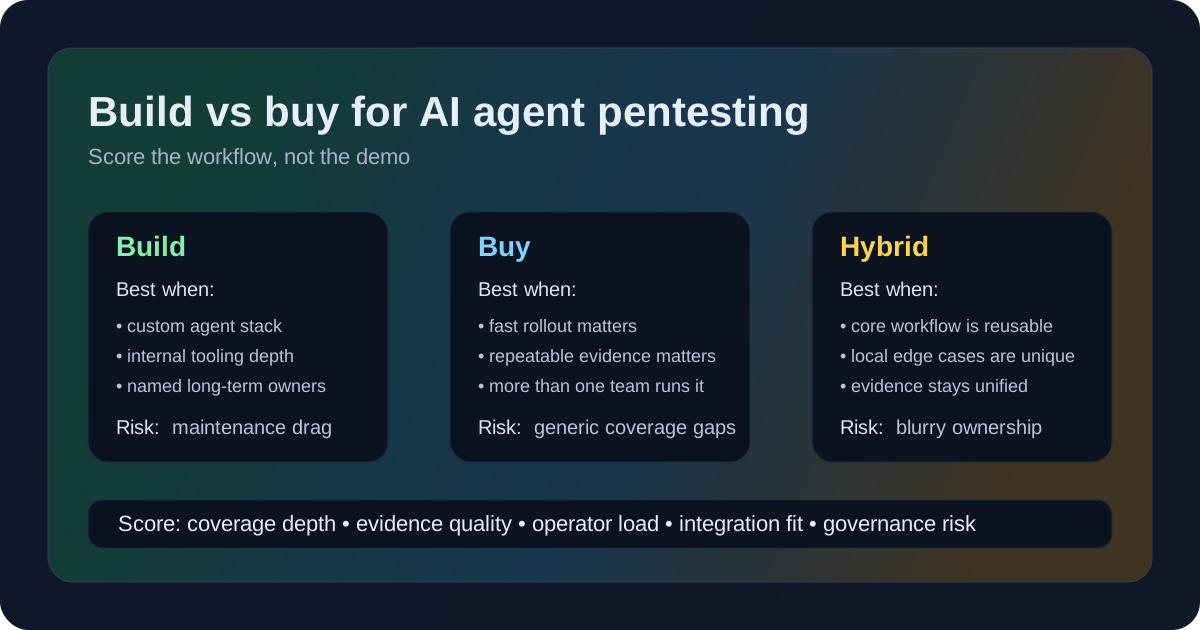
If your AI agent stack can trigger real actions, touch sensitive data, or call tools across trust boundaries, do not treat AI pentesting as a side project. Use a build vs buy template that scores depth of coverage, evidence quality, operator time, integration fit, and governance risk. Build internally when your environment is unusual, your security team already writes reliable adversarial tooling, and you can afford ongoing maintenance. Buy when you need repeatable coverage, faster rollout, and evidence that can survive review by engineering, security leadership, and procurement. Most teams land in the middle: they buy a stable workflow for core coverage and build a few local checks around their specific agent surfaces.
If you are still sorting the category map, start with the broader compare hub. If you already know you need a local-first workflow that exercises real tools instead of mock prompts, the download page is the faster next stop. For adjacent buying decisions, compare this page with best AI pentesting tools for AI agents compared, AI pentesting vendor evaluation guide for AI agents, and AI pentest tool vs vulnerability scanner.
Why this decision got harder once agents started taking action
The old security tooling question was simpler. You bought a scanner, ran a review, or wrote a few internal checks around a known web or API surface. AI agents break that neat boundary. Now the system prompt matters, the tool schema matters, the model's planning behavior matters, and the real-world side effects matter too.
That means a shallow "LLM red team" demo is not enough. A useful evaluation has to cover whether an agent can be pushed into the wrong action, whether the tool boundary is enforced, whether evidence is preserved, and whether the team can rerun the test after a fix. OWASP's Top 10 for LLM Applications is a good reminder here: prompt injection, insecure output handling, excessive agency, and sensitive information disclosure are not abstract risks. They show up as workflow problems in real agent systems.
The pressure is getting worse because buyers are comparing unlike things. One vendor may offer prompt stress tests. Another may focus on code review. An internal team may have a few clever scripts that catch one dangerous pattern. All of those can help. None of them automatically answers the full "can we trust this agent in production?" question.
That is why a template matters. It keeps the discussion grounded in coverage and operating cost rather than demos and slogans.
What a serious build vs buy template should measure
A decent template should force the team to answer five questions.
1. What are we actually testing?
Be concrete. Are you testing chat-only behavior, agent planning, browser automation, MCP tools, internal APIs, retrieval pipelines, or privileged local actions? If the scope is fuzzy, the decision will be fuzzy too.
2. What evidence do we need?
Some teams only need engineering confidence. Others need evidence for audit, customer review, or internal risk sign-off. Those are different standards. A spreadsheet note saying "the agent looked safe" is not enough when a production agent can approve tickets, query customer data, or modify infrastructure.
3. Who will operate the workflow?
This is where many build projects quietly fail. A prototype can look cheap right up until the one staff engineer who understands it goes on vacation. A bought platform can look expensive right up until you price the weeks of maintenance, replay support, and triage overhead needed to keep a homegrown harness usable.
4. How fast does the surface change?
Agent stacks drift. Prompts change. Tool names change. Models change. New connectors appear. If your environment changes weekly, your template should penalize any option that is hard to maintain.
5. What is the cost of a false sense of security?
This is the uncomfortable question, but it matters most. If the workflow misses a tool abuse path or cannot reproduce a high-risk finding, what is the downside? For an internal note-taking bot, maybe the downside is tolerable. For a production support agent with account access, it probably is not.
The five scoring dimensions I would actually use
I prefer a small scorecard over a huge procurement worksheet. Score each dimension from 1 to 5, then write down the evidence behind the score.
| Dimension | What to score | High score means | Low score means |
|---|---|---|---|
| Coverage depth | Prompt injection, tool abuse, auth, memory, retrieval, output handling, action side effects | The option exercises the real agent stack end to end | The option checks one narrow layer |
| Evidence quality | Logs, prompts, tool calls, outputs, screenshots, replay steps | Findings are reproducible and useful after a fix | Results are hard to verify or explain |
| Operator load | Setup, maintenance, triage time, required expertise | Regular teams can run it without heroic effort | It depends on one expert and too much handwork |
| Integration fit | CI, local workflows, repos, issue trackers, compliance flow | The testing loop fits the way the team ships | The workflow stays off to the side and gets skipped |
| Governance risk | Access control, data handling, review model, vendor dependency | The approach fits policy and review needs | It creates new approval or data exposure problems |
This is the scoring pattern I would use for a first pass:
| Option | Coverage depth | Evidence quality | Operator load | Integration fit | Governance risk | Total |
|---|---|---|---|---|---|---|
| Build | ||||||
| Buy | ||||||
| Hybrid |
If you want to make it harder to game, assign weights before discussion starts. For example, a team shipping agent workflows into regulated environments may weight evidence quality and governance risk more heavily than raw operator speed.
A decision template you can lift into your next review
Here is the practical version. I would put this into the meeting doc and force each stakeholder to fill it out independently before the discussion.
Scope block
- Agent type:
- Production or pre-production:
- Highest-risk action the agent can take:
- Data classes touched:
- External tools or MCP servers involved:
- Human approval steps, if any:
Build case
- Do we already have engineers who can maintain adversarial test infrastructure?
- Can we simulate or trigger the real action path, not just the prompt path?
- Can we preserve replayable evidence after every finding?
- Can we keep pace with prompt, tool, and model drift?
- Can we support this for at least the next 12 months?
Buy case
- Does the vendor test real agent behaviors instead of only static prompts?
- Can the workflow run inside our environment without leaking sensitive data?
- Are logs and evidence exportable?
- Can we verify auth boundaries, tool permissions, and downstream side effects?
- Will the workflow still fit when we add more agents, tools, or teams?
Hybrid case
- Which parts are generic enough to buy?
- Which parts are unique enough to keep internal?
- Where does evidence need to converge?
- Who owns the retest loop after fixes?
Decision rule
Choose build if it wins on fit and your team can keep it alive. Choose buy if it wins on time-to-value and evidence quality. Choose hybrid if one side clearly covers the reusable foundation and the other covers your unusual environment.
That sounds obvious written down. In real meetings it helps because it keeps people from drifting into "we can probably script that later."
When building internally makes sense
There are good reasons to build. I would not talk anyone out of it if the facts line up.
Build usually makes sense when the agent environment is deeply custom, the data cannot leave tightly controlled boundaries, and the security team already has a habit of writing reliable validation tooling. It also makes sense when the key value is not a packaged UI but a set of highly specific tests against internal tools, custom approval flows, or nonstandard orchestration logic.
The best internal builds usually have three traits:
- They focus on a narrow threat model instead of trying to be a platform on day one.
- They preserve evidence from the start.
- They are owned like a product, not like a side experiment.
That last point matters more than most people admit. NIST's AI RMF 1.0 is broad on purpose, but one of its practical lessons is simple: risk management needs roles, measurement, and repeatable process. If your build option depends on enthusiasm rather than ownership, it is not really an option yet.
I would lean toward build when the team can answer "yes" to all of these:
- We know the high-risk agent paths we need to test.
- We can exercise those paths in a controlled environment.
- We can store prompts, tool traces, and outcomes safely.
- We can rerun the tests after every meaningful agent or prompt change.
- We have named owners for upkeep.
If one or two of those answers are "not yet," I would downgrade build even if the prototype looks impressive.
When buying is the saner choice
Buying usually wins when the team needs coverage this quarter, not six months from now. It also wins when the real bottleneck is operating discipline rather than raw creativity.
Most organizations do not fail because nobody had an idea for an adversarial prompt. They fail because the testing flow is brittle, evidence is messy, ownership is split, and the retest loop falls apart after the first fix. A strong bought workflow can reduce that chaos, especially if it helps teams move from test input to evidence to remediation without rebuilding the same plumbing every time.
That is also where platform maturity matters. Microsoft's guidance on AI red teaming and OpenAI's Daybreak material both point toward a more operational model: test realistic behaviors, keep the evidence, validate fixes, and make the workflow part of normal software delivery. You do not have to buy from either of those organizations to notice the pattern. The market is moving toward repeatable defensive loops, not one-off prompt stunts.
I would lean toward buy when these are true:
- The team needs a working baseline quickly.
- The environment is important but not wildly unique.
- Multiple teams need to run the same evaluation pattern.
- Security leadership cares about reproducible evidence and reviewability.
- The internal team does not want to become a tooling vendor for the rest of the company.
This is usually the moment when buyers should also look at the surrounding product shape. If you need help placing local-first tooling, report output, and workflow packaging in the same frame, the pricing page is a useful follow-up after the technical review. Teams that want a more operational rollout path should also read how to run a local AI pentest workflow and how security teams retest fixes in AI pentest workflows.
Why most mature teams end up with a hybrid model
Pure build and pure buy both sound cleaner than they really are. In practice, strong teams often buy the boring but necessary foundation and build the sharp local checks that reflect their own systems.
A hybrid model often looks like this:
- buy the repeatable workflow, evidence structure, and shared reporting
- build agent-specific checks for internal tools, risky business actions, or custom policy rules
- keep one replay path that engineering and security both trust
That balance works because not every problem deserves custom engineering, and not every important edge case will show up in a vendor's default catalog. The trick is to keep the split explicit. If no one can explain which layer belongs to the vendor and which belongs to the internal team, the hybrid model turns into finger-pointing.
For agent-heavy environments, I think hybrid is the default answer more often than people want to hear. It gives you a stable floor without pretending your environment is generic.
Common mistakes that ruin the decision
The first mistake is comparing categories instead of capabilities. A model evaluation harness, a code scanner, and a live agent-testing workflow are not interchangeable.
The second mistake is ignoring operator time. Security teams love underestimating maintenance because the first version of the build only lives in one engineer's head.
The third mistake is accepting thin evidence. If a test cannot show the prompt, the tool call, the relevant output, and the resulting behavior, the finding will be painful to defend.
The fourth mistake is forgetting retests. AI agent systems change too fast for one-time sign-off. If the workflow cannot be rerun after prompt changes, tool changes, or model swaps, you are buying temporary comfort.
The fifth mistake is treating the decision like a procurement exercise instead of a production risk exercise. The point is not to justify a budget line. The point is to decide how your team will catch and validate bad behavior before users do.
FAQ
Should startups build their own AI pentesting workflow?
Usually not as the whole strategy. A startup with a very specific agent architecture may build a few valuable local tests, but most small teams get more leverage from a bought baseline plus a short list of internal checks for their highest-risk actions.
What is the strongest signal that buying is the right choice?
You need repeatable evidence across multiple teams or releases, and nobody wants to own a custom test platform full time.
What is the strongest signal that building is the right choice?
Your agent environment is unusual enough that packaged coverage will miss the important paths, and you already have the people to maintain custom adversarial testing without letting it rot.
Is hybrid just a compromise answer?
Sometimes, but that does not make it weak. Hybrid is often the honest answer because reusable workflow plumbing and environment-specific attack paths usually live in different places.
Bottom line
The best build vs buy decision template for AI pentesting in AI agents is the one that forces the team to talk about real coverage, real evidence, and real operator cost. If the workflow cannot test meaningful agent actions, cannot preserve proof, or cannot survive routine product changes, it is not enough. Start with a small scorecard, be ruthless about what the agent can actually do, and choose the option your team can still run six months from now.
Ready to run your first AI pentest?
Get 0xClaw up and running in under 3 minutes. No infrastructure setup. No cloud dependency.
More AI Pentest Guides
Continue through the local AI pentesting cluster with related guides on workflow, evidence, comparisons, and remediation.
Best AI penetration testing tools 2026
Compare 0xClaw, NodeZero, PentestGPT, Promptfoo, and garak by execution layer. Chat advice is not authorized target testing.
Read next ->AI Pentest CLI Explained | 0xClaw
Learn what an AI pentest CLI is, how local AI penetration testing works, and how to evaluate a safe, authorized workflow.
Read next ->Run a Local AI Pentest Workflow | 0xClaw
Learn how to run a local AI pentest workflow from scope to report across authorized web, API, host, and network testing.
Read next ->