
Build vs Buy for MCP Security | 0xClaw
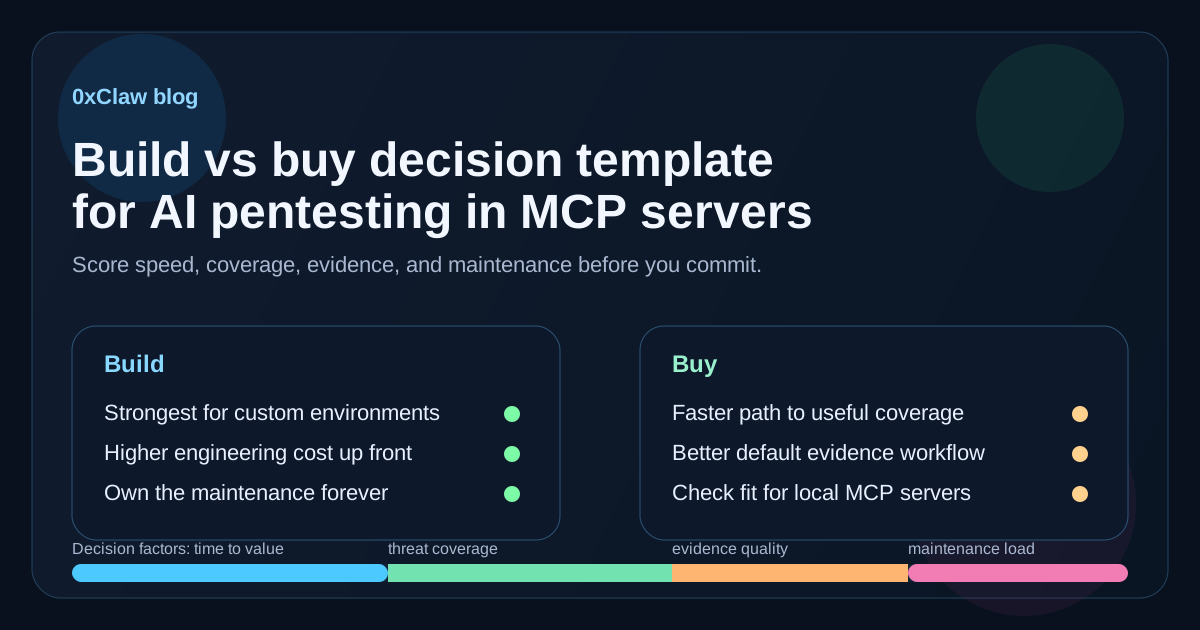
Use this build-vs-buy template for MCP pentesting to compare engineering cost, testing depth, evidence quality, and operational fit.
Use this build-vs-buy template for MCP pentesting to compare engineering cost, testing depth, evidence quality, and operational fit.
- Build vs Buy for MCP Security | 0xClaw should explain infrastructure choices in a way that is easy to quote, compare, and operationalize.
- Tie architecture explanations back to how local execution, governance, and evidence handling work in practice.
- Use official docs plus product pages so the page can rank for definitions and support AI citation.
Quick answer: should you build or buy AI pentesting for MCP servers?
Buy if you need credible coverage in the next quarter, do not already have a team that understands MCP-specific failure modes, and care more about getting repeatable evidence than owning every layer of the tooling. Build if you already run strong offensive-security engineering in-house, expect to test MCP systems continuously, and can justify the cost of maintaining protocol-aware test logic, local-runtime safeguards, and retest workflows over time.
That is the short answer. The longer answer is that AI pentesting for MCP servers is a bad place for lazy build-vs-buy thinking. Teams often say "we should just script this ourselves" after seeing a narrow demo. Then they discover that MCP security work is not one scanner plus a prompt list. It is authorization review, prompt injection through tools and resources, local server exposure, evidence capture, approval controls, and retesting after fixes. Anthropic's MCP introduction explains why the protocol is attractive. OpenAI's MCP guidance and the official MCP security best practices explain why it creates new trust boundaries.
If you are still mapping the category, start with the broader /blog and /compare pages. If you already know you want a productized path, review /pricing and /download beside this template.
Why MCP changes the usual build-vs-buy math
Most security teams already know how to reason about build vs buy for SAST, DAST, and routine web pentest automation. MCP shifts that math because the system under test is no longer just an API or a web app. It is a tool-execution layer sitting between a model and real actions.
That matters for three reasons.
First, the attack surface is mixed. The official authorization spec expects OAuth-style rigor around scopes, consent, and audience validation. The security best practices also warn about token passthrough, insecure local servers, and over-broad privileges. A normal appsec harness will catch some of this, but not the full trust-boundary problem.
Second, attacker input can arrive through more than one door. The OWASP MCP Top 10 does not read like a classic web checklist because it has to account for tool poisoning, rug pulls, privilege escalation, and cross-tenant tool abuse. If your team builds a homegrown harness, it has to understand those patterns or it will produce a very comforting but very incomplete report.
Third, the economics are different from a one-time penetration test. MCP systems evolve quickly. New tools get added. Tool descriptions change. Resource handlers change. Local server startup paths change. The thing you build has to stay current with both protocol guidance and your own product surface.
That is why the real question is not "Can we build something?" You can. The real question is whether you want to own the maintenance burden that comes after the first proof of concept.
What you are actually deciding
Build vs buy sounds binary, but in practice there are three choices:
| Option | What it really means | Best fit |
|---|---|---|
| Build in-house | Your team creates and maintains the test harness, attack library, evidence model, and retest workflow | Mature offensive-security engineering teams |
| Buy a productized workflow | You adopt a tool or platform built for AI pentesting and adapt it to your environment | Teams that need speed and repeatability |
| Blend both | Use a product for the base workflow, then add custom test logic for your own tools and risk areas | Teams with strong security engineers but limited time |
Most teams should start with the third option, even if they eventually move closer to build. The reason is simple: the expensive part is not the first run. It is the operational plumbing around approval boundaries, trace collection, regression testing, and proof that a fix actually closed the issue.
I have seen teams underestimate that part repeatedly. They budget for exploit logic and forget the rest. Six months later they have a pile of scripts, inconsistent evidence, and no clean retest path for engineering. That is not ownership. That is drift.
The decision template you can use in a real buying process
Use the template below as a weighted scorecard. Score each line from 1 to 5, where 1 means "weak fit" and 5 means "strong fit." Multiply by the weight. Do this once for "build" and once for "buy." If the totals are close, default to the option that gets you better evidence sooner.
| Criterion | Weight | Build questions | Buy questions |
|---|---|---|---|
| Time to first useful coverage | 20% | Can we produce meaningful findings in 30-60 days? | Can the vendor or product show value in the next sprint or quarter? |
| MCP-specific threat coverage | 20% | Do we already know how to test auth, prompt injection, local servers, and tool poisoning? | Does the product or vendor prove coverage across those same paths? |
| Evidence and replay quality | 15% | Will our output include traces, handlers, repro steps, and retest artifacts? | Does the bought workflow preserve the same evidence standard? |
| Engineering opportunity cost | 15% | What high-value work will our security engineers stop doing to build this? | What recurring vendor cost are we accepting instead? |
| Fit with local and remote deployments | 10% | Can our harness test both workstation-local and hosted MCP servers? | Can the bought workflow handle our actual deployment mix? |
| Approval and safety controls | 10% | Can we enforce human approval before risky actions? | Does the product already support bounded execution and approvals? |
| Long-term maintenance | 10% | Who updates the harness when the spec or product changes? | How much custom maintenance still lands on our team after purchase? |
Here is the practical interpretation:
- If build wins mainly because vendor cost looks high, your model is probably incomplete.
- If buy wins mainly because "the demo looked polished," your model is also incomplete.
- The decisive rows are usually threat coverage, evidence quality, and opportunity cost.
That is the part procurement often misses. Security engineering time is not free just because it is on payroll already. If your best operator spends three months building a rough MCP test harness, you did not avoid cost. You just paid it in a less visible way.
When building makes sense
There are real cases where building is the right call.
You already have offensive-security engineering depth
If your team can design attack harnesses, operate safe test boundaries, preserve raw evidence, and keep regression tests alive after product changes, then in-house development can make sense. This is especially true if your MCP estate is unusual enough that general-purpose tools will always need heavy customization.
Your environment is deeply custom
Some organizations have proprietary tools, internal resource types, and approval models that do not map neatly onto an off-the-shelf workflow. In those cases, a product may still help, but you will probably need custom testing modules anyway. If the customization is large enough, full internal ownership may be more coherent.
You need continuous validation as a core capability
If MCP security testing is going to become a durable internal program, not just an annual project, building may be worth it. The NIST adversarial ML taxonomy is useful here because it frames adversarial testing as an ongoing discipline with classes of attacks and mitigations, not a one-off exercise. That mindset fits build better than ad hoc procurement.
You can afford the hidden maintenance work
This is the make-or-break question. Can you afford:
- updating attack logic when tool schemas change,
- retesting across local and remote runtimes,
- keeping approval gates intact,
- maintaining a consistent evidence model,
- teaching new team members how the harness really works?
If the answer is no, you are not choosing build. You are choosing future churn.
When buying makes more sense
Buying is the better answer more often than technical teams like to admit.
You need useful coverage quickly
If leadership expects a decision or a risk reduction plan this quarter, buying usually wins. The bought path is rarely perfect, but it is much better at reducing the time between "we should test this" and "here is a replayable finding with remediation notes."
Your team knows AppSec, but not MCP-specific abuse paths
A strong web security team does not automatically know how to evaluate tool poisoning, malicious resource instructions, token passthrough misuse, or dangerous local server defaults. The official MCP security guidance is explicit enough that this gap should not be hand-waved away.
You care about retesting and evidence discipline
This is where productized workflows usually beat internal scripts early on. Good bought workflows tend to be opinionated about traces, operator review, saved artifacts, and retest loops. Those are not glamorous features, but they are what engineering teams need after the initial finding lands.
You do not want to rebuild table stakes
Some work is simply not worth rebuilding unless it is strategically central to your company. Approval workflows, evidence preservation, and repeatable report structure are good examples. If your differentiation is not "we are a security-testing tooling company," there is a strong argument for buying those layers and spending internal time on custom tests that reflect your unique stack.
A realistic cost model teams should use
The usual spreadsheet is too shallow. It compares license cost to engineer salary and calls it a day. That misses the operational drag.
Use this simpler model instead:
| Cost area | Build | Buy |
|---|---|---|
| Up-front time | High | Low to medium |
| Time to first finding | Slowest at the start | Faster |
| Spec tracking | Your responsibility | Mostly externalized |
| Evidence workflow | You design and maintain it | Usually included |
| Custom test logic | Strongest upside | May require extensions |
| Retest discipline | Easy to neglect | Easier to standardize |
| Procurement friction | Lower if internal-only | Higher if vendor review is heavy |
Then add one question that changes the whole equation: what happens if the first version is only 60 percent complete?
That is the uncomfortable middle state many teams land in. The harness works on one happy-path target, but not on local servers. It catches prompt injection in prompts, but not through resource content. It stores screenshots, but not enough detail to replay the issue. At that point you have already paid the build cost, but you still have not bought yourself reliable coverage.
The hybrid model is usually the best operating answer
A hybrid model is boring, which is one reason it is often right.
Use a productized workflow for:
- baseline MCP testing,
- operator-visible execution,
- evidence capture,
- approval controls,
- retesting after remediation.
Then add internal logic for:
- proprietary tools,
- unusual auth models,
- environment-specific abuse cases,
- product-specific scoring or reporting.
This approach lets you keep the hard-won parts that are actually unique to your business while avoiding a rebuild of generic workflow infrastructure. For many teams, that is the cleanest path from evaluation to practice.
It is also the easiest model to defend to both engineering and procurement. Engineering gets extensibility. Procurement gets a visible product boundary. Security gets evidence sooner.
If you want to compare that route against other categories, use /compare. If you want to evaluate whether a local workflow fits your team better than a vendor-managed model, /download and /pricing are the more relevant next steps than another abstract slide deck.
Questions to ask before you commit either way
Do not end the process with "build feels cheaper" or "buy feels safer." Ask sharper questions.
- Can we test both remote and local MCP servers, or only one of them?
- Can we prove token audience validation, scope boundaries, and approval controls, or are we mostly checking superficial prompts?
- Can another engineer replay the finding from our saved evidence without guessing?
- Who owns maintenance when the MCP spec or our tool surface changes?
- What is the cost of delaying coverage while we build?
- If we buy, what parts of the workflow still need custom internal logic?
- If we build, what parts are genuinely strategic rather than just rebuilds of table stakes?
If your answers are fuzzy, you are not ready to choose build.
FAQ
Is building always better for sensitive environments because it keeps everything in-house?
No. Keeping execution closer to your environment can help, but it does not automatically give you better testing. If the in-house workflow misses MCP-specific attack paths or produces weak evidence, the control benefit is smaller than it looks.
Is buying always better because vendors have more experience?
Also no. Buying can fail if the product only covers generic AI security language and not your actual runtime, auth model, or local-tool behavior. Ask for proof, not slogans.
What is the biggest hidden cost of building?
Maintenance. Most teams can assemble a first version. Far fewer teams keep the harness accurate after product changes, preserve evidence cleanly, and run disciplined retests.
What is the biggest hidden risk of buying?
Overestimating fit. A polished workflow can still be wrong for your deployment model, especially if your developers run local MCP servers or your tool surface is highly custom.
Should we start with a pilot before making a bigger decision?
Yes. A short pilot with one realistic target is usually enough to expose whether you need a product, a custom build, or a hybrid path.
Bottom line
The best build vs buy decision template for AI pentesting in MCP servers is the one that forces honesty about time, coverage, evidence, and maintenance. Build when security engineering depth is already in place and continuous custom validation is strategically worth owning. Buy when you need speed, repeatability, and a clean operational path from first finding to retest. For most teams, the durable answer is somewhere in the middle: buy the workflow foundation, then build the custom tests that only your environment needs.
Ready to run your first AI pentest?
Get 0xClaw up and running in under 3 minutes. No infrastructure setup. No cloud dependency.
More AI Pentest Guides
Continue through the local AI pentesting cluster with related guides on workflow, evidence, comparisons, and remediation.
Best AI penetration testing tools 2026
Compare 0xClaw, NodeZero, PentestGPT, Promptfoo, and garak by execution layer. Chat advice is not authorized target testing.
Read next ->AI Pentest CLI Explained | 0xClaw
Learn what an AI pentest CLI is, how local AI penetration testing works, and how to evaluate a safe, authorized workflow.
Read next ->Run a Local AI Pentest Workflow | 0xClaw
Learn how to run a local AI pentest workflow from scope to report across authorized web, API, host, and network testing.
Read next ->