
Best API Tool Abuse Tools | 0xClaw
Compare the best tools for testing tool abuse in APIs, including Promptfoo, PyRIT, RAMPART, Burp Suite, and garak.
Compare the best tools for testing tool abuse in APIs, including Promptfoo, PyRIT, RAMPART, Burp Suite, and garak.
- Best API Tool Abuse Tools | 0xClaw should explain infrastructure choices in a way that is easy to quote, compare, and operationalize.
- Tie architecture explanations back to how local execution, governance, and evidence handling work in practice.
- Use official docs plus product pages so the page can rank for definitions and support AI citation.
Quick answer: which tools are best for testing tool abuse in APIs?
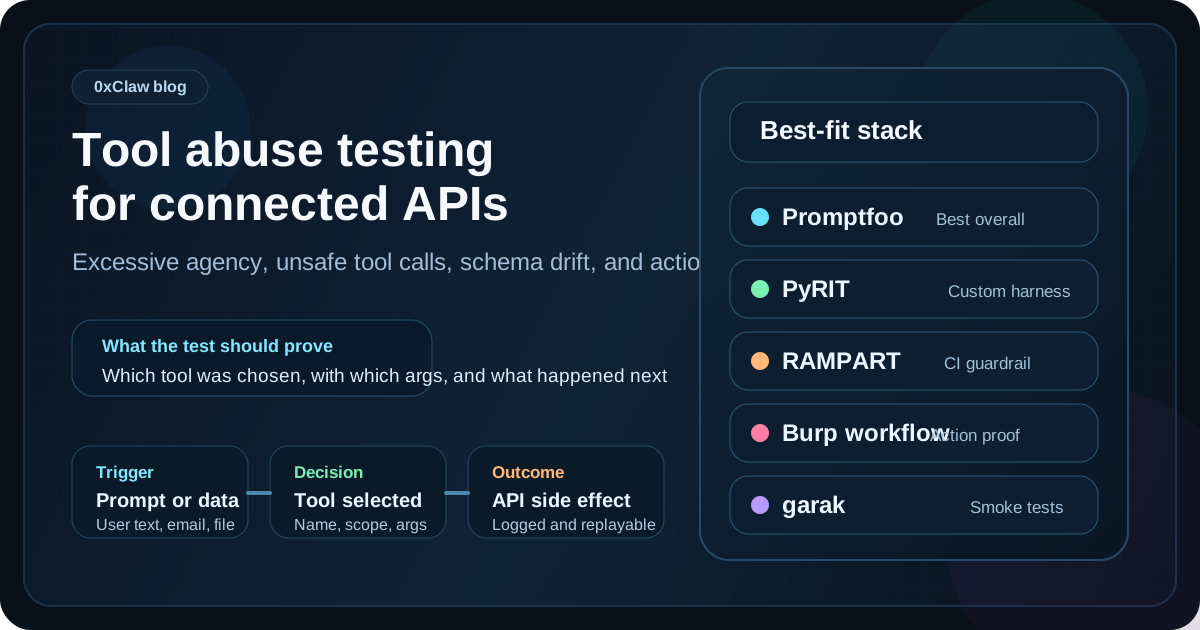
For most teams, Promptfoo is the best starting tool for testing tool abuse in APIs because it already has a practical way to probe excessive agency, insecure tool use, and model behavior that drifts beyond allowed actions. If the target system has messy state, custom headers, uploaded files, or a nonstandard request path, PyRIT is the stronger harness. If you already found a dangerous workflow and want to make sure it never ships again, RAMPART is the best regression layer. If the finding matters, Burp Suite or another proxy workflow is still the cleanest way to prove the actual API calls and side effects. garak is worth keeping around for fast baseline sweeps, but it is not enough by itself.
That split is less tidy than a one-winner list, but it matches the job. Tool abuse in APIs is not just "the model said something dumb." It is the point where an LLM or agent can choose a legitimate tool, pass the wrong arguments, exceed its intended scope, or forward unsafe output into an ordinary API action. OWASP's LLM06:2025 Excessive Agency frames the root causes as excessive functionality, excessive permissions, and excessive autonomy. The newer OWASP material for agentic systems goes one layer deeper and calls out tool misuse and exploitation as its own problem area. If you are comparing broader offensive-testing stacks around AI systems, start with /compare. If you want the wider platform view around agent testing workflows, browse /blog, /download, and /pricing.
Why tool abuse in APIs deserves its own category
I keep seeing teams lump this into prompt injection and move on. That is too shallow.
Prompt injection explains one common way the system gets manipulated. Tool abuse is what happens next. The agent has access to a search endpoint, a database wrapper, a ticketing action, a shell helper, a CRM connector, or an internal admin API. The attacker does not need the agent to "break out" in some dramatic movie sense. They only need the agent to use a valid tool in an unsafe way.
OWASP's agentic guidance is blunt about this. Tool misuse can lead to data exfiltration, workflow hijacking, runaway cost, and unintended destructive actions, even when the tool itself is legitimate. That is an important distinction. A lot of real incidents will not look like a compromised plugin or stolen credential. They will look like an overpowered tool, weak parameter validation, or an agent that was trusted to self-police.
PortSwigger's Web LLM attacks material lands in the same place from a different angle. Once an LLM can reach APIs, the attack surface is no longer just the prompt box. The model can discover tools, call them on the user's behalf, and sometimes chain into ordinary web vulnerabilities through those APIs. In practice, that means testing tool abuse in APIs is half AI security and half old-fashioned application security with a new control plane sitting in the middle.
What you are actually testing when you test tool abuse
The phrase "tool abuse" gets used loosely, so it helps to pin down the failure modes.
Over-scoped tool access
The agent can reach tools or endpoints it never needed. An email summarizer can send mail. A document reader can delete files. A CRM lookup tool can dump every record instead of the one object the workflow needs.
Unsafe tool selection
The agent picks the wrong tool because a prompt, retrieved document, or earlier tool output nudged it there. This often shows up as "that call was technically allowed, but it should never have been chosen in this context."
Parameter abuse
The model chooses the right tool but fills it with bad arguments. Sometimes that is straightforward data exfiltration. Sometimes it is indirect injection into a downstream API. Sometimes it is just a cost bomb, like an agent hammering a paid endpoint because nobody capped execution.
Unvalidated forwarding
OWASP's agentic Top 10 highlights untrusted model output being forwarded into tools and shells. This is where sloppy bridging code turns "model suggestion" into "real action." It is not glamorous, but it is one of the first things I would try to break.
Missing human approval
High-impact actions should not happen just because the model sounds confident. OWASP's excessive-agency guidance explicitly recommends human approval for sensitive actions. If your delete, send, transfer, or publish flow has no approval boundary, the problem is not subtle.
Tool schema drift
This is easy to miss. The MCP security cheat sheet treats the whole tool schema as an injection surface, not just the tool description. If a tool quietly gains extra parameters, looser validation, or broader permissions, the attack surface changes even when the UI looks identical.
Best tools for testing tool abuse in APIs compared
| Tool | Best for | What it proves well | Main limitation |
|---|---|---|---|
| Promptfoo | Most teams, first-pass coverage | Excessive agency, insecure tool use, repeatable red-team cases | Less flexible than a custom harness for odd API choreography |
| PyRIT | Custom API harnesses | Stateful workflows, uploaded files, raw HTTP or API-mode targets, custom scoring | More engineering work to wire up |
| RAMPART | Regression testing after a real finding | Pytest-native attack tests, evaluators for tool calls and side effects, CI reporting | Better at keeping coverage than doing first discovery |
| Burp Suite or similar proxy | Action proof and exploit validation | Exact request chains, parameter abuse, downstream impact | Manual effort and no built-in LLM attack library |
| garak | Baseline model-side sweeps | Quick adversarial probes and detailed hit logs | Weak for proving workflow-specific API abuse |
If you want the short version, Promptfoo wins on practicality, PyRIT wins on control, RAMPART wins on staying fixed, Burp wins on proof, and garak wins on cheap breadth.
Promptfoo is the best default for most teams
Promptfoo is the tool I would hand to most product security or AppSec teams first because it is opinionated in the right places. Its excessive-agency plugin is designed to check whether a model claims actions beyond its capabilities and whether it uses only the allowed tools. That sounds simple, but it maps well to the first layer of trouble in agent APIs.
The reason I put Promptfoo first is not just the plugin list. It is the handoff path. You can define a repeatable red-team case, point it at a real target, inspect the result, then keep that same test around after the fix. That matters more than people admit. Security findings die all the time because the discovery method was too bespoke to survive past the demo.
Promptfoo is a good fit when:
- the application exposes a stable HTTP API
- your team wants readable test definitions
- you need to probe unsafe tool selection or impossible-action claims quickly
- you want something engineers can keep in CI after the security review
I would not call Promptfoo the most flexible tool in the category. I would call it the least painful place to start that still gives you serious coverage.
PyRIT is the best choice when the workflow gets weird
PyRIT gets better as the target gets messier. Its prompt-target docs show two paths that matter here: a raw HTTPTarget that can work from a recorded HTTP request and a simpler HTTPXAPITarget for JSON bodies, form data, and file uploads. That sounds like an implementation detail until you hit a real system with session headers, uploads, or multi-step state. Then it matters a lot.
This is where I stop caring about clean product demos and start caring about control. If the workflow includes poisoned files, indirect context from an upstream service, or multi-turn agent state, I want a harness that lets me shape the exact path rather than forcing the system into a canned pattern.
Use PyRIT when:
- the target API needs custom auth or headers
- a file, PDF, email, or other artifact carries the malicious payload
- you need custom success criteria instead of a generic pass or fail
- you want to compare several models or guardrail layers against the same action path
The tradeoff is obvious. PyRIT asks for more engineering discipline. That is fine. Some targets deserve it.
RAMPART is the best way to keep a fixed bug fixed
RAMPART is newer, but the design choice is the interesting part. Microsoft positions it as a pytest-native safety testing framework for agentic systems, with execution strategies, evaluators, and structured reporting. In plain English, that means you can write an attack as a test, tell the framework what side effect or tool behavior counts as failure, and keep running it in CI.
That is exactly what you want after a tool-abuse finding. Discovery is exciting once. Regression is where the value lives.
RAMPART is especially useful when:
- you already know the abusive workflow
- the system is probabilistic enough that repeated trials matter
- you want to assert on tool calls, text patterns, or side effects
- the engineering team already lives in pytest and will actually maintain the tests
I would not use RAMPART as my only discovery tool. I would use it as the point where the exploit graduates from "clever security finding" to "part of the build gate."
Burp or another proxy is still the best proof tool
This part is not trendy, but it is where a lot of sloppy claims fall apart.
If a report says the agent "appears able" to misuse a tool, I want to see the request path. Which endpoint was called? Which parameters were copied from the model output? Did the downstream API reject the call, partially honor it, or execute it? Without that, you may have proved a model weakness without proving an application bug.
PortSwigger's guidance is useful because it keeps the methodology grounded: map the API attack surface, identify what the LLM can access, then probe those APIs like any other reachable target. That last step matters. Once you know the model can reach a tool, you should treat that tool like a publicly reachable API path and test it accordingly.
Burp earns its place when you need to:
- replay the exact call chain
- inspect hidden parameters or headers
- separate prompt-level weirdness from backend authorization failures
- prove impact to engineers who do not care about AI jargon
I would not ship a high-severity tool-abuse finding without a proxy-level proof step unless the target architecture makes that impossible.
garak is useful for cheap coverage, but it is not enough
garak still deserves a spot in the stack because it is good at being noisy in a useful way. Its prompt-injection docs show the built-in PromptInject probes and the hit-log style reporting that captures failing prompts and responses. For model-side coverage, that is handy.
Where garak helps:
- quick sweeps across models or wrapper changes
- regression smoke tests after prompt or policy changes
- collecting detailed failure logs without building a custom harness first
Where garak stops helping:
- it does not know your tool boundary by default
- it does not prove a downstream API side effect happened
- it cannot replace a workflow-aware harness for business-specific abuse cases
So yes, keep garak around. Just do not confuse broad model probing with finished API security testing.
How to build a practical stack for tool abuse testing
Most teams should not try to solve this with one product.
This is the stack I would actually run:
- Use Promptfoo to catch excessive agency and obvious unsafe tool behavior early.
- Add PyRIT for the awkward workflows that involve custom state, headers, or uploaded artifacts.
- Turn confirmed findings into RAMPART tests so the fix survives refactors and model changes.
- Validate serious bugs with Burp or another proxy, because impact lives in the request chain.
- Keep garak for cheap model-side sweeps between bigger test runs.
That stack also lines up with how tool abuse usually unfolds in production. First the model is steered. Then it selects a tool. Then the argument shape gets sloppy. Then the downstream API trusts the request too much. Somewhere in that chain, you either have a hard security boundary or you do not.
If you are working through the broader operational side of AI application testing, the rest of /blog covers adjacent workflows. If you are deciding whether you need a comparison view before choosing a stack, go to /compare. If you want to see the wider product and deployment surface around local offensive testing, look at /download and /pricing.
Where teams usually get this wrong
The common failure is not "we forgot to add a scanner." It is "we assumed the model would behave."
I see the same bad bets over and over:
- giving the agent one huge Swiss-army-knife tool instead of narrow tools
- trusting the model to decide whether a user is allowed to act
- passing model output straight into tool arguments without validation
- keeping old tools available because removing them is annoying
- treating schema changes as harmless metadata work
OWASP's guidance is pretty clear on the countermeasures: minimize the number of tools, minimize what each tool can do, minimize downstream permissions, require approval for high-impact actions, and enforce authorization in the downstream system instead of expecting the model to police itself. None of that is glamorous. All of it works better than writing a sterner system prompt.
FAQ
What is tool abuse in APIs?
Tool abuse in APIs happens when an LLM or agent uses a connected tool or function in an unsafe way. That can mean choosing the wrong tool, calling the right tool with bad parameters, exceeding its intended scope, or forwarding unsafe output into a downstream API action.
Which tool is best for testing excessive agency?
Promptfoo is the best default starting point for excessive-agency testing because it already includes a dedicated plugin and is easy to turn into repeatable tests.
Which tool is best for custom API workflows?
PyRIT is usually the strongest option when you need to test custom auth, headers, file uploads, or multi-step workflows that do not fit a simple red-team config.
What should I use after I find a real bug?
RAMPART is the best fit for turning a confirmed workflow into a durable regression test, especially if the engineering team already uses pytest.
Do I still need Burp if I use Promptfoo or PyRIT?
Yes. Those tools can surface risky behavior, but a proxy is still the fastest way to prove the exact downstream request, parameter abuse, and user-visible impact.
Is garak enough by itself?
Usually not. garak is useful for model-side sweeps and hit logging, but it does not replace testing against your actual tool boundary, approval flow, and downstream APIs.
Bottom line
If you want one recommendation, start with Promptfoo. If your workflow is more custom than a neat config file can express, move to PyRIT. If you already found a dangerous path, lock it down with RAMPART. If the finding is important, prove it with a proxy. Keep garak nearby for cheap coverage, not as your whole strategy.
That is the honest answer. Tool abuse in APIs is where AI security stops being abstract and starts touching the parts of the system that can really delete data, send messages, spend money, or cross trust boundaries.
Ready to run your first AI pentest?
Get 0xClaw up and running in under 3 minutes. No infrastructure setup. No cloud dependency.
More AI Pentest Guides
Continue through the local AI pentesting cluster with related guides on workflow, evidence, comparisons, and remediation.
Best AI penetration testing tools 2026
Compare 0xClaw, NodeZero, PentestGPT, Promptfoo, and garak by execution layer. Chat advice is not authorized target testing.
Read next ->AI Pentest CLI Explained | 0xClaw
Learn what an AI pentest CLI is, how local AI penetration testing works, and how to evaluate a safe, authorized workflow.
Read next ->Run a Local AI Pentest Workflow | 0xClaw
Learn how to run a local AI pentest workflow from scope to report across authorized web, API, host, and network testing.
Read next ->