
RAG App Vendor Guide | 0xClaw
Use this RAG app vendor guide to compare retrieval coverage, poisoning tests, evidence quality, containment checks, and retest discipline.
Use this RAG app vendor guide to compare retrieval coverage, poisoning tests, evidence quality, containment checks, and retest discipline.
- RAG App Vendor Guide | 0xClaw should explain infrastructure choices in a way that is easy to quote, compare, and operationalize.
- Tie architecture explanations back to how local execution, governance, and evidence handling work in practice.
- Use official docs plus product pages so the page can rank for definitions and support AI citation.
Quick answer
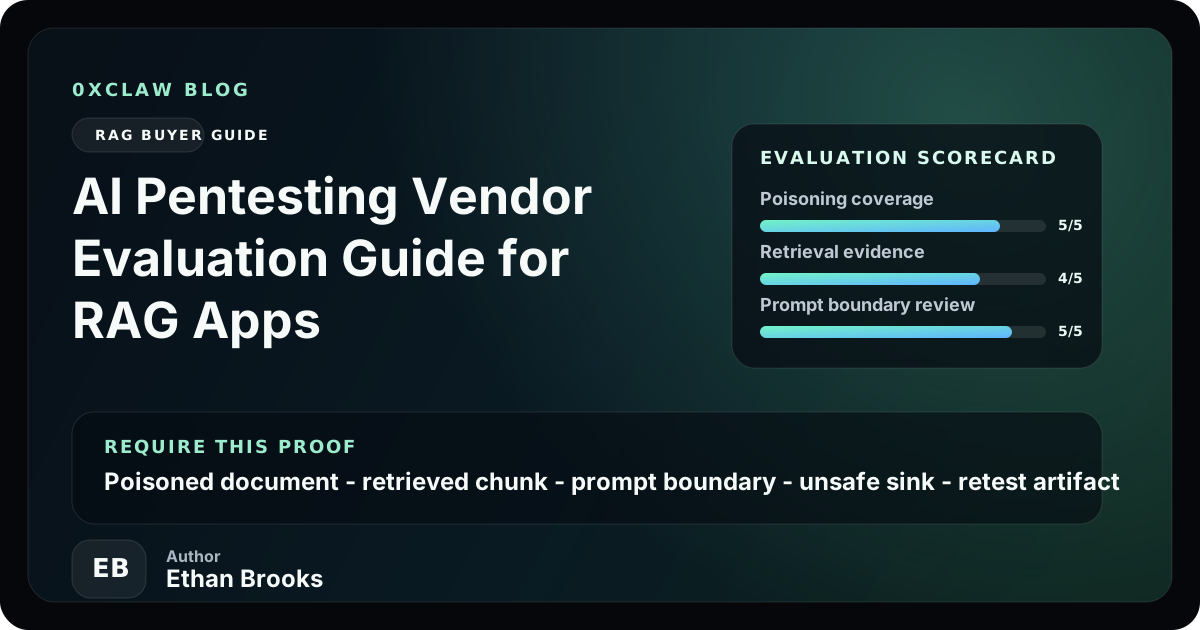
Choose the vendor that can show a retrieval attack end to end, not the vendor with the most polished LLM deck. For a RAG app, that means proving five things in one bounded exercise: how poisoned content enters the corpus, how the retriever or reranker surfaces it, how the final prompt treats that content, what unsafe output or action follows, and how the team can replay the exact case after a fix. If a vendor cannot produce that chain with concrete evidence, you are probably buying generic AppSec with "RAG" added to the proposal.
The shortest version of the buying rule is simple: require a live or recorded proof that names the untrusted source, the sink that became dangerous, the control that failed, and the retest artifact after remediation. The more a vendor stays in abstractions, the less likely it is to catch production-grade retrieval failures.
If you are still sorting out the category boundaries, skim the broader blog, compare product models at compare, and keep the commercial line honest with pricing and download. It is surprisingly easy to compare a services-heavy assessment against a self-serve testing workflow and call that a fair bake-off.
Why RAG apps need their own vendor evaluation lens
RAG systems fail differently from plain chatbots and differently from classic web apps. A normal application pentest still needs to check auth, data exposure, injection, and business logic. That part does not go away. What changes is the number of places where untrusted content can cross into privileged behavior.
In a typical RAG stack, the risk surface includes ingestion, chunking, metadata handling, embedding, retrieval, reranking, prompt assembly, model output, and any downstream tools or workflows triggered from the answer. The OWASP RAG Security Cheat Sheet treats the whole pipeline as part of the security problem, not just the last prompt. That is the right frame. A poisoned document does not need to "hack the model" in some dramatic way. It only needs to get retrieved at the wrong time, be trusted too much, and steer the system into leaking data or taking an action it should not take.
This is where vendor marketing gets slippery. Some firms mean "RAG testing" when they really mean a handful of prompt-injection strings against the chat interface. Some can assess the retrieval layer but have thin evidence once the system calls tools or writes data back out. Others understand the full path, but only in a hosted demo environment that looks nothing like your production connectors, document stores, or permission model.
The current public guidance points in the same direction. The NIST adversarial machine learning taxonomy published in 2025 separates attack classes instead of flattening them into one vague AI risk bucket. OpenAI's March 2026 piece on designing agents to resist prompt injection argues that the hard part is constraining impact when manipulation succeeds, not pretending perfect detection exists. That logic maps cleanly to RAG apps. A vendor that only talks about filtering bad prompts is ignoring the rest of the system.
What a credible RAG pentest vendor should actually test
I would expect a serious vendor to cover at least five layers, and I would expect the proposal to say so plainly.
1. ingestion and corpus poisoning
The vendor should test whether malicious or misleading content can enter the knowledge base through uploads, connectors, sync jobs, CMS entries, scraped pages, support tickets, or internal notes. That sounds basic, but it is where many real failures start. If the vendor has no plan for staged poisoning tests, the engagement will likely miss the bug that matters.
2. retrieval and reranking behavior
It is not enough to say a document was present in the corpus. The vendor should show when it gets retrieved, for which query, with what metadata, and whether reranking helps or hurts. This is where a lot of weak assessments fall apart. They can tell you the final answer looked wrong, but they cannot tell you whether the break happened in vector search, rank promotion, or prompt composition.
3. prompt-boundary integrity
Retrieved text is data, not policy. A good vendor tests whether the application keeps that distinction. The OWASP LLM01:2025 prompt injection page is useful here because it keeps pulling the discussion back to trust boundaries and downstream impact. If the vendor does not inspect how retrieved chunks are placed into the final prompt, it is leaving a huge blind spot.
4. sinks and side effects
This is where I start paying close attention. Does the RAG app only answer questions, or can it send data to another system, trigger a workflow, draft a message, update a record, or fetch external content? OpenAI's January 28, 2026 post on AI agent link safety is about URL-based exfiltration, but the bigger lesson is broader: once the system can act, the dangerous thing is not just the model response. It is the side effect.
5. replayable evidence and retesting
A pentest report that cannot be replayed is mostly a story. Engineering needs the original payload, the query, the retrieved chunk identifiers, any rerank evidence, the final assembled prompt or equivalent trace, the output, and the remediation retest. Without that chain, the vendor might still sound smart, but it is not giving your team a repeatable security loop.
A practical scorecard for vendor shortlisting
You do not need a sprawling procurement matrix. You need a short scorecard that forces specific answers and penalizes vagueness.
| Criterion | What strong looks like | What weak sounds like |
|---|---|---|
| Corpus poisoning coverage | Can inject or simulate poisoned documents through realistic ingestion paths | "We test prompt injection against the app" |
| Retrieval evidence | Shows retrieved chunks, metadata, and ranking context | "We observed an unsafe answer" |
| Prompt-boundary analysis | Explains how untrusted context is separated from system instructions | "We review the prompt design" |
| Sink awareness | Tests exfiltration, workflow triggers, or other downstream side effects | "We focus on model behavior first" |
| Environment realism | Can assess your real connectors, document stores, and permission boundaries | "Our standard sandbox should be representative" |
| Retest discipline | Replays the exact failure after remediation | "We can reassess later if needed" |
| Reporting quality | Produces engineering-grade traces, not just executive summaries | "We provide screenshots and recommendations" |
| Method freshness | Can explain what changed in its approach after recent RAG and agent guidance | "Our AI security framework is mature" |
The last row matters more than it looks. RAG security moved fast in 2025 and early 2026. If a vendor's method still sounds like a 2024 jailbreak workshop, it is probably behind. A decent litmus test is to ask how it distinguishes a prompt-layer nuisance from a retrieval-layer exploit with a real sink. Good teams answer quickly. Weak ones drift into governance language or generic "model red teaming."
Questions that force a real demo instead of a sales script
I would not ask "How do you test RAG security?" That invites a polished overview. Ask questions that make the vendor show work.
- Show one poisoned-content scenario from ingestion to final unsafe answer or blocked action.
- Show how you determine whether the failure happened in retrieval, reranking, or prompt assembly.
- Show the exact evidence engineering gets after the finding, including payload, chunk trace, and retest steps.
- Show one case where the model was influenced but the system still held because permissions, filtering, or approvals limited the damage.
- Show how you test URL-based or connector-based exfiltration risks when the app can fetch or send content externally.
- Show how your method changes when the RAG app sits behind enterprise auth, private docs, and access-controlled search.
- Show one retest after remediation, not just a reworded recommendation.
- Show what you refuse to do during a proof of concept because the scope is too broad or risky.
Those questions do something useful. They shift the conversation away from "Can you test LLMs?" and toward "Can you prove where this system breaks?" That is a better buying question.
How to structure a proof of concept for RAG vendor evaluation
The best proof of concept is narrow, realistic, and slightly inconvenient. It should be large enough to show whether the method works, but small enough that nobody can hide behind process theater.
Pick one workflow that matters. Good examples include:
- an internal knowledge assistant that answers from policies and can cite source documents
- a support copilot that reads tickets, KB articles, and customer history
- a deal desk or legal assistant that summarizes contracts or policy exceptions
- a browser-enabled research app that pulls external pages into the retrieval context
Then require four proof points.
- A controlled poisoning or indirect injection path
- A query path that retrieves the hostile content under realistic conditions
- A sink that would matter if the system trusted the hostile content too much
- A remediation retest after you change the relevant control
The control matters. You want the vendor to test real defenses, not imaginary ones. That could mean connector scoping, retrieval filtering, metadata-based allow rules, prompt-boundary hardening, URL restrictions, output gating, or user approval steps. OpenAI's recent source-sink framing is helpful here because it pushes people to name both halves of the failure. In practice, that makes RAG buying conversations more concrete.
One thing I would document up front is what counts as success. Some vendors sell an expert-led assessment. Some sell a product your team runs continuously. Some sell both, but only one side is mature. Run the same POC target and same pass criteria across all candidates or you will end up comparing a slick interface against a careful testing process.
Red flags that should slow the deal down
These show up quickly once you know what to listen for.
- The vendor keeps reducing RAG security to prompt injection strings in a chat box.
- The vendor cannot say how it inspects retrieved chunks or rank behavior.
- The vendor has no clear model for side effects, exfiltration, or downstream workflows.
- The vendor treats the final answer as the only evidence that matters.
- The vendor cannot explain how it handles enterprise document permissions or access-controlled search.
- The vendor wants broad production access before it can prove value on a bounded target.
- The vendor has no tight retest workflow.
- The vendor cannot point to a recent method update informed by public guidance from OWASP, NIST, or current agent-security research.
I would add one softer red flag. If a vendor uses "RAG" and "agent" interchangeably in every sentence, be careful. Plenty of modern systems blur the line, but the architecture still matters. A retrieval assistant that cites internal docs is not the same risk shape as an autonomous tool-calling agent. The OWASP Agentic Skills Top 10 is more relevant once reusable skills, plugins, or execution layers start entering the picture. A vendor should be able to say when that shift changes the assessment plan.
Where teams usually under-buy or buy the wrong thing
The most common mistake is under-buying on evidence. Teams accept a vendor report that says the model was manipulated, but not how the content entered the corpus, which chunk got retrieved, or which downstream control failed. That slows remediation and makes retesting messy.
The second mistake is under-buying on realism. The vendor tests a clean staging corpus with short synthetic files, then declares victory. Production RAG systems are messier. They contain duplicate docs, stale metadata, half-structured exports, access-controlled content, connectors that fail strangely, and retrieval behaviors nobody fully trusts. If the engagement never touches that reality, the result can look better than it should.
The third mistake is buying a one-time audit when the real need is a repeatable regression loop. RAG defenses drift. Retrieval settings change. Document connectors evolve. Prompt assembly gets refactored. Teams that only buy a snapshot assessment often discover six weeks later that the hardening no longer holds.
That is also where the product-versus-service question matters. If you need independent third-party evidence for leadership or procurement, a services-led engagement may be the right starting point. If you need engineers to replay tests every release, a tool-first workflow may fit better. The product boundary is easier to compare once you look across compare, pricing, download, and the surrounding category explainers in blog.
How I would make the final call
I would bias toward the vendor that makes failure evidence easiest to trust.
That usually means it can:
- demonstrate one realistic poisoning or indirect-injection path
- pinpoint the break across ingestion, retrieval, reranking, prompt assembly, or the sink
- explain what would have happened without containment
- produce a clean retest artifact after the fix
I would also give extra credit to vendors that are honest about limits. If the team tells you a particular connector is hard to test safely, or that a live proof needs stricter approvals because the sink can write to real systems, that is not weakness. That is operational maturity. In this market, fake certainty is still common.
When two vendors look close, I would choose the one that is stricter about scope, more concrete about evidence, and better at separating "interesting model behavior" from "security issue with impact." That distinction saves time later because it keeps engineering focused on the fixes that matter.
FAQ
What should a RAG pentest vendor be able to prove in one session?
At minimum, it should show how hostile content enters or is simulated in the corpus, how that content gets retrieved, how the application treats it in the final prompt, what unsafe answer or action follows, and how the same case is retested after remediation.
Is prompt injection testing enough for evaluating RAG vendors?
No. Prompt injection is one entry path, but RAG security also depends on ingestion controls, retrieval behavior, reranking, prompt-boundary design, access control metadata, output gating, and any downstream action or exfiltration sink.
What does good evidence look like in a RAG pentest report?
Good evidence includes the malicious payload or poisoned document, the triggering query, the retrieved chunks or citations, relevant ranking or metadata context, the final system trace or assembled prompt boundary, the output or side effect, and a replay plan for retesting.
Should I test a RAG assistant differently if it can call tools or browse the web?
Yes. Once the system can fetch content, send data, update records, or launch other workflows, the sinks get more dangerous. That means the evaluation should extend beyond retrieval correctness into action safety, approvals, and exfiltration controls.
How do I compare a consulting vendor against a product platform fairly?
Use the same proof-of-concept target, the same evidence requirements, and the same retest expectation. Otherwise you will reward presentation quality instead of testing depth.
Bottom line
The best AI pentesting vendor evaluation guide for RAG apps is blunt on purpose: do not buy a promise that the vendor "understands LLM risk." Buy proof that it can trace a real retrieval failure, explain the control that failed, and verify the fix afterward. If the vendor cannot make that chain visible, keep it out of the final round.
Ready to run your first AI pentest?
Get 0xClaw up and running in under 3 minutes. No infrastructure setup. No cloud dependency.
More AI Pentest Guides
Continue through the local AI pentesting cluster with related guides on workflow, evidence, comparisons, and remediation.
Best AI penetration testing tools 2026
Compare 0xClaw, NodeZero, PentestGPT, Promptfoo, and garak by execution layer. Chat advice is not authorized target testing.
Read next ->AI Pentest CLI Explained | 0xClaw
Learn what an AI pentest CLI is, how local AI penetration testing works, and how to evaluate a safe, authorized workflow.
Read next ->Run a Local AI Pentest Workflow | 0xClaw
Learn how to run a local AI pentest workflow from scope to report across authorized web, API, host, and network testing.
Read next ->