
API Pentest Vendor Guide | 0xClaw
Use this API pentesting vendor guide to compare API attack depth, agent abuse coverage, evidence quality, and retest discipline.
Use this API pentesting vendor guide to compare API attack depth, agent abuse coverage, evidence quality, and retest discipline.
- API Pentest Vendor Guide | 0xClaw should explain infrastructure choices in a way that is easy to quote, compare, and operationalize.
- Tie architecture explanations back to how local execution, governance, and evidence handling work in practice.
- Use official docs plus product pages so the page can rank for definitions and support AI citation.
Quick answer: how should you evaluate an AI pentesting vendor for APIs?
Use a scorecard, not a category label. A credible vendor should prove that it can test ordinary API failures like broken object authorization and broken function authorization, then keep going into AI-specific abuse paths such as prompt injection, unsafe tool calling, and overpowered agent workflows. If the team cannot show a replayable attack path, raw evidence, and a retest after the fix, you are probably looking at a polished demo rather than a useful security partner.
My short rule is blunt: buy the vendor that can explain exactly how an API action becomes unsafe once an LLM or agent can reach it. Skip the one that keeps saying "agent security" without naming the endpoint, the auth boundary, the tool call, and the evidence trail.
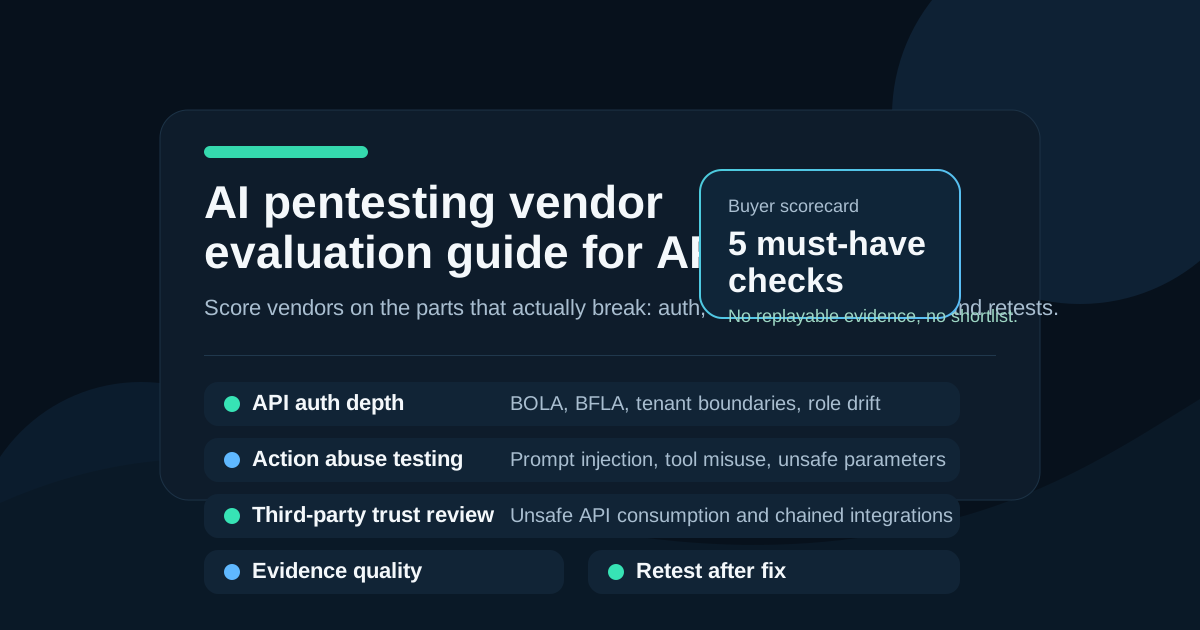
The visual below is the one-slide version of the buying rubric, and it matches the generated asset for this page:
If you are still sorting out the broader category, start with /compare. If you want to see how these buying questions connect to an actual workflow, keep /pricing, /download, and the rest of /blog open in parallel.
Why API vendor evaluation changed once AI agents got involved
API security used to be easier to explain in procurement. You asked whether the vendor could find auth failures, data exposure, input validation bugs, and business logic abuse. That baseline still matters. OWASP's API Security Top 10 still puts broken object level authorization and broken function level authorization near the center of the problem because they keep showing up in real systems, and for good reason. APIs expose actions directly. If the access checks are weak, the blast radius is obvious.
What changed is the control layer sitting in front of those APIs. When a model or agent can choose tools, fill parameters, summarize retrieved data, or chain actions, the old question "Can an attacker hit this endpoint?" becomes "Can an attacker steer the system into using a legitimate endpoint in an illegitimate way?"
That sounds subtle until you see it happen. A support bot gets access to order lookup and refund actions. A code assistant can call an internal deployment API. A research agent can read documents and then trigger downstream updates. None of those flows require a movie-style compromise. They only require a system that trusts the model too much or gives it tools that were never scoped tightly enough.
OpenAI's prompt-injection guidance makes the practical point: once AI systems can pull in third-party content and take actions, prompt injection becomes a real security problem rather than a quirky model behavior. OWASP's LLM06:2025 excessive agency category lands on the same issue from the buyer side. If a system has too much functionality, too much permission, or too much autonomy, the model does not need to be malicious. It only needs to be steerable.
That is why vendor evaluation for APIs needs a different bar now. You are not only buying someone to test endpoints. You are buying someone to test whether model behavior, API design, and operator assumptions fail together.
What a credible API pentest vendor should actually test
This is where a lot of buyers get misled. Plenty of firms can talk fluently about "LLM risk." Fewer can show a structured methodology that starts with API fundamentals and then moves into AI-assisted abuse.
At minimum, the vendor should cover four layers.
1. Core API authorization and object access
OWASP's API1:2023 entry is still the right anchor because broken object level authorization remains one of the easiest ways to turn a normal API into an exposure event. If the vendor cannot explain how it tests user-to-object checks on every endpoint that accepts an identifier, that is a serious gap. I would expect to hear about direct object references, hidden identifiers in bodies and headers, and negative tests that prove one principal cannot touch another principal's records.
The same goes for API5:2023 broken function level authorization. An AI layer does not make those bugs disappear. It often makes them easier to reach because the model can discover or invoke actions a human user would never navigate to manually.
2. AI-specific action abuse
This is the difference between a normal API assessment and an AI pentest. The vendor should try to push the system into unsafe action selection, overbroad tool use, and parameter abuse. OWASP's LLM06:2025 language around excessive agency is useful because it forces the conversation away from vague "AI hallucinations" and back toward concrete permissions and actions.
In practice, I would expect the vendor to test questions like these:
- Can untrusted content steer the model into choosing the wrong API action?
- Can the model fill a valid tool with unsafe arguments?
- Can a low-risk workflow escalate into a high-impact action because approvals are missing or weak?
- Can model output be forwarded into downstream API calls without validation?
If the answer is "we mostly test prompts," keep pushing. Tool selection and action execution are the real procurement issue.
3. Third-party API trust and unsafe consumption
OWASP's API10:2023 unsafe consumption of APIs matters more than people admit in AI systems. Many agent workflows call external services, internal wrappers, and vendor-managed APIs in a chain. The weak point is often the trust assumption between them. A buyer should want a vendor that checks whether the system validates upstream responses, enforces auth and transport expectations, and treats external data as hostile until proven otherwise.
This is one place where AI products fail in a very ordinary way. The model seems novel. The backend mistake is not. Teams trust a third-party response, pass it downstream, and skip the validation they would never skip in a human-facing flow.
4. Evidence, replay, and retest
NIST's adversarial machine learning taxonomy is useful because it treats the work as a testing discipline rather than a branding exercise. That means attack classes, assumptions, mitigations, and evaluation matter. A good vendor report should feel the same way. You want raw requests, response traces, affected endpoints, abused parameters, preconditions, and a clear retest after the fix. You do not want twelve pages of narrative and three screenshots of a toast message.
When a vendor says "we found a prompt injection issue," the next question should be "What action did it unlock?" When they say "we found unsafe tool use," the next question should be "Show me the request chain."
A buyer scorecard for AI pentesting vendors focused on APIs
This is the scorecard I would actually use in a shortlist meeting. It keeps the team from over-weighting brand polish.
| Evaluation area | What good looks like | Why it matters |
|---|---|---|
| API auth depth | Can prove BOLA, BFLA, role drift, and tenant-boundary failures with replayable requests | Prevents teams from buying AI language wrapped around shallow API testing |
| Action abuse testing | Tests prompt injection, excessive agency, unsafe tool selection, and parameter abuse | Shows whether the vendor understands how models turn into unsafe API actions |
| Third-party trust review | Evaluates external API consumption, response validation, and chained trust assumptions | Many agent systems fail at integration boundaries |
| Evidence quality | Provides raw traces, reproduction steps, endpoint names, and retest artifacts | Lets engineers fix and verify the issue without guesswork |
| Approval discipline | Separates read-only discovery from write-capable actions and records approvals | Reduces operational risk during the engagement |
| Runtime realism | Tests the real auth model, not a downgraded lab setup with easier permissions | Good results in a toy environment do not predict production safety |
| Fix validation | Can rerun the exact exploit after remediation | Turns a report into a usable engineering workflow |
| Operator fit | Matches your model, whether local-first, self-hosted, or vendor-managed | The wrong operating model wastes the evaluation even if the findings are good |
I would score those columns before I cared about "AI platform maturity" slides, benchmark charts, or high-level research claims. Those things can matter later. They are weak buying signals at the start.
Questions to ask in the demo if you want signal instead of theater
Most demos are optimized to avoid embarrassment, not to answer buyer questions. Narrow questions fix that.
- Show one finding from the original prompt or input all the way to the backend API request and the final evidence artifact.
- Show how you test broken object access when the model can look up or transform identifiers before calling the API.
- Show one example where untrusted content nudges the agent into a wrong or over-scoped action.
- Show how you distinguish a prompt-only issue from a real authorization or business-logic failure.
- Show a case where the downstream API blocks the action correctly so we can see how you separate model weirdness from a true vulnerability.
- Show how approvals work before any write-capable or destructive operation.
- Show a retest after a fix, not just a screenshot that says the issue is resolved.
- Show what changes in your method when the target uses internal APIs, third-party SaaS APIs, or mixed agent workflows.
Those questions sound simple, but they force the vendor to reveal whether the work is rooted in real API abuse or in generalized AI red-team language.
I also want to hear uncomfortable details. Did they need a proxy? Did they instrument logs? Did they need a custom harness for a multi-step workflow? Those are good answers. "Our platform's proprietary AI catches it automatically" is not a good answer. It is a dodge.
How to structure the proof of concept
Do not run an open-ended bakeoff. Pick a bounded target that resembles production enough to be annoying.
For most teams, a useful proof of concept includes:
- One API path with tenant or object authorization risk.
- One workflow where an LLM or agent can choose or trigger an API action.
- One integration boundary where external content or an upstream service can influence the call.
- One remediation loop where engineering makes a fix and the vendor reruns the test.
That structure tells you far more than a giant scope statement. It also keeps procurement honest. Some vendors look good only when they can choose their own easiest path.
I would require each participant to deliver the same proof points:
- A short threat model for the chosen API flow.
- One auth or object-level abuse case.
- One AI-specific action abuse case.
- One retest after remediation.
- A list of assumptions and what was not tested.
There is also a practical reason to keep the POC small. AI-assisted API abuse is often messy. The exploit path may cross prompts, retrieval, tool schemas, approval logic, and backend auth. A good vendor can handle that mess, but you still need a test that finishes in a normal buying cycle.
If you are comparing operating models as well as vendors, use the same target for both. Otherwise you end up comparing a smooth user interface against deeper technical coverage, which is how weak products stay alive in enterprise software.
Red flags that should slow the deal down
Some red flags are loud.
- The vendor talks about "securing agents" but never names an endpoint, permission, or object boundary.
- They treat prompt injection as the whole story and do not connect it to tool use or downstream API actions.
- They do not mention broken object or function authorization at all.
- They cannot explain how they validate a real auth boundary in a production-like setup.
- They show conclusions without raw request or response evidence.
- They ask for broad production credentials before proving they can find value safely.
- They promise coverage of "all AI risks" in a way that sounds more like positioning than engineering.
One quieter red flag matters too: the team sounds bored by ordinary API security. That is usually a bad sign. The AI layer gets attention, but the severe findings often still come from old mistakes in auth, object access, and trust assumptions. The right vendor respects both layers.
Where 0xClaw fits in the buying process
0xClaw fits buyers who want a practical way to evaluate AI-assisted pentest workflows around real API targets, especially when the work needs to stay close to engineering. That is different from saying it replaces every outside vendor or every formal assessment. It does not. Independent review still matters, especially for regulated programs and high-stakes sign-off.
Where 0xClaw becomes useful is earlier and later in the cycle. Earlier, it helps teams pressure-test whether the workflow can capture real evidence, handle approvals, and stay grounded in actual API attack paths instead of buzzwords. Later, it helps with retests once engineering starts fixing the issues. That matters because many buying teams learn too late that a vendor can find a problem once but cannot verify the fix cleanly on the second pass.
If that operating-model question is what you are really solving, the best next stop is /compare. If you want to see the commercial boundary, go to /pricing. If you want to try the local workflow directly, use /download. If you still need more category context first, stay in /blog and read the adjacent API and AI pentest guides in sequence.
FAQ
Do I need a vendor that specializes in AI, or can a strong API pentest firm do this?
A strong API pentest firm can do it if it has already built a real method for model- and agent-mediated abuse. Ask them to prove that with a concrete action path. If the answer is just "we also test prompt injection," that is not enough.
What should I demand in a sample deliverable?
Ask for a sanitized report that includes reproduction steps, raw requests and responses, affected endpoints, auth context, impact notes, and a retest section. A summary page without the underlying trail is not very useful.
Why does broken object authorization still matter if the model is the new risk?
Because the model usually does not invent impact out of thin air. It reaches an API that already had a weak control. AI changes how the path is discovered or exercised. It does not erase the importance of the underlying API boundary.
How do I separate prompt injection from a real vulnerability?
Look for the action. If the injected content changes model behavior but the backend still blocks the unsafe request, that is not the same as a confirmed exploit. It may still be worth fixing, but the severity belongs to the whole chain, not to the prompt alone.
Should a proof of concept include a remediation retest?
Yes. Without the retest, you are evaluating discovery only. A lot of the real value shows up after the first finding, when engineers need to know whether the fix actually closed the path.
Bottom line
The best AI pentesting vendor evaluation guide for APIs is not complicated. Start with API reality, add AI-specific action abuse, demand evidence, and require a retest. Buyers get into trouble when they reward broad AI language instead of attack-path clarity.
If the vendor can show how a model, an API, and a permission boundary fail together, keep them in the process. If they cannot get past generalities, move on.
Ready to run your first AI pentest?
Get 0xClaw up and running in under 3 minutes. No infrastructure setup. No cloud dependency.
More AI Pentest Guides
Continue through the local AI pentesting cluster with related guides on workflow, evidence, comparisons, and remediation.
Best AI penetration testing tools 2026
Compare 0xClaw, NodeZero, PentestGPT, Promptfoo, and garak by execution layer. Chat advice is not authorized target testing.
Read next ->AI Pentest CLI Explained | 0xClaw
Learn what an AI pentest CLI is, how local AI penetration testing works, and how to evaluate a safe, authorized workflow.
Read next ->Run a Local AI Pentest Workflow | 0xClaw
Learn how to run a local AI pentest workflow from scope to report across authorized web, API, host, and network testing.
Read next ->